
In poignant meeting with university students, Pope encourages greater fraternity between Europe and Africa
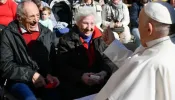
Vatican City, Mar 13, 2006 (CNA) - On Saturday evening, Pope Benedict XVI met with some 7,000 European and African University students, whom he urged toward greater fraternity, as well as the building of a “culture of love,” to counter what John Paul II had coined “the culture of death.”
The students had gathered in Rome for the forth European Day for Universities, during which, they explored the theme; "Christian humanism, the path of a new cooperation between Europe and Africa."
The Holy Father presided at an evening prayer vigil for the gathering where he was connected by satellite linkup to students in Bonn, Dublin, Freiburg, Madrid, Munich, Salamanca, St. Petersburg and Sofia, as well as the African cities of Abidjan, Antananarivo, Owerri and Nairobi.
The historic meeting was sponsored by the Council of European Bishops' Conferences (CCEE) and the vicariate of Rome's office for pastoral care in universities.
The Pope’s time with the students began when he arrived in the Pope Paul VI Hall at 6p.m. to lead the recitation of the rosary. He then addressed the young people who were present in the Hall as well as those following the event via the satellite linkups.
He began by saying that "This Marian vigil so dear to Pope John Paul II,creates bridges of fraternity between the young university students of Europe, and this evening it extends those bridges to within the great continent of Africa, so that communion may grow among the new generations and the civilization of love may spread.”
“For this reason,” he said, “to our friends following us from Africa I wish to send a particularly affectionate embrace, which I would like to extend to all the dear African people."
The Holy Father then greeted students in Spanish, English, German, French, Russian and Bulgarian, before referring to his recent Encyclical "Deus caritas est," which he distributed copies of to ten student representatives.
"In this way," he said, "I intend to give it symbolically to all university students of Europe and Africa, in the hope that the fundamental truth of Christian faith - God is love - may illuminate the journey of each of you and, through your witness, may come to irradiate the lives of those who study with you."
The Pope continued, saying that "This truth concerning the love of God -origin, meaning and goal of the universe and of history - was revealed by Jesus Christ with His Word and His Life, most of all in His Paschal death and resurrection.”
“It lies”, he stressed, “at the base of Christian knowledge which, like leavening, has the capacity to ferment all human cultures, bringing them to express the best of themselves and cooperate in developing a more just and peaceful world."
In preparation for the upcoming 21st World Youth Day, which will be celebrated on Palm Sunday of this year in various dioceses, the Pope encouraged the students to read his recently released Message for the occasion.
Likewise, he urged those who could, to participate in the traditional meeting in St.Peter's Square, due to take place on April 6th.
There, he said,"We will welcome the pilgrim Cross which has come from Cologne, Germany and, a year after his death, recall with grateful hearts my great predecessor John Paul II."
Following Pope Benedict’s address, the group concluded the Day with a pilgrimage of the university students' cross from the Paul VI Hall to the Church of St. Agnes in Rome's Piazza Navona.
U.S. Bishops respond to Catholic democrat statement: Human rights are an illusion if fundamental right to life is not protected
Washington D.C., Mar 13, 2006 (CNA) - On
Friday, the U.S Conference of Catholic Bishops responded to a
controversial statement recently released by 55 Catholic members of the
U.S. House of Representatives, saying that although their document
listed vital human rights concerns, they pale in comparison to the
fundamental right to life, which is violated in abortion.
Citing their
2004 statement on Catholics in Political Life, the Bishops said they
welcomed the statement as well as “other efforts that seek to examine
how Catholic legislators bring together their faith and their policy
choices.”
At the same time
however they said that “We need to do more to persuade all people that
human life is precious and human dignity must be defended.”
“This”, they
said, “requires more effective dialogue and engagement with all public
officials, especially Catholic public officials,” adding that they
“welcome conversation initiated by political leaders themselves.”
While
acknowledging the important points made in the Democratic statement
regarding important moral concerns like “priority for the poor, the
protection of family life, the pursuit of justice and the promotion of
peace”, which the USCCB called “fundamental priorities of the Catholic
moral tradition”, they also stressed the need to reaffirm the fact that
“abortion is a grave violation of the most fundamental human right—the
right to life…”
This right, which the bishops said “is inherent in all human beings,” is what “grounds every other right we possess.
Here, they cited
the late Pope John Paul II, who said, in his apostolic exhortation,
Christifideles Laici, that “The inviolability of the person which is a
reflection of the absolute inviolability of God fínds its primary and
fundamental expression in the inviolability of human life.”
“Above all,” the
Pope wrote, “the common outcry, which is justly made on behalf of human
rights -- for example, the right to health, to home, to work, to
family, to culture -- is false and illusory if the right to life, the
most basic and fundamental right and the condition for all other
personal rights, is not defended with maximum determination….”
Echoing one of
the statement’s concerns, the bishops said that “while it is always
necessary to work to reduce the number of abortions by providing
alternatives and help to vulnerable parents and children, Catholic
teaching calls all Catholics to work actively to restrain, restrict and
bring to an end the destruction of unborn human life.”
The bishop’s
statement, entitled, “A Statement on Responsibilities of Catholics in
Public Life,” was signed by Cardinal William H. Keeler, Chairman, USCCB
Committee on Pro Life Activities, Cardinal Theodore E. McCarrick,
Chairman, USCCB Task Force on Catholic Bishops and Catholic
Politicians, and Bishop Nicholas DiMarzio, Chairman, USCCB Committee on
Domestic Policy.
Prefect says Catholic agencies should not allow gay adoptions, San Francisco reconsiders policy
San Francisco, Calif., Mar 13, 2006 (CNA) - The
prefect of the Congregation for the Doctrine of the Faith has said
Catholic social service agencies should not place children with
same-sex couples.
In light of
this, the Archdiocese of San Francisco is currently reviewing its
practice of permitting homosexuals and lesbians to adopt children
through its local Catholic Charities.
Maurice Healy, a
spokesman for the archdiocese, said the decision to review the policy
came after Archbishop William Levada, prefect of the Congregation for
the Doctrine of the Faith said that bishops must not permit children to
be adopted by same-sex couples.
Healy contacted
Archbishop Levada at the Vatican after a Boston Globe journalist asked
him if the former archbishop of San Francisco had permitted gay
adoptions and if the archdiocese would continue to do so after the
bishops of Massachusetts decided to forbid them.
The bishops of
Massachusetts cited Church teaching in their recent decision to no
longer permit Catholic social service agencies to place children with
same-sex couples. They said they planned to seek an exemption from
state anti-discrimination policy.
In his e-mail
response to Healy, Archbishop Levada acknowledged that Catholic
Charities San Francisco had allowed three “difficult to place” children
to be placed with same-sex couples during his 10-year tenure there. He
explained these placements involved “prudential judgments” about the
children’s needs, Church teaching, and the agency’s mission.
He added,
however, that a 2003 Vatican document clearly indicates that “Catholic
agencies should not place children for adoption in homosexual
households.”
“The reasons
given in the document, as well as the potential scandal for the
faithful should an archdiocesan agency act contrary to the clear
teaching of the Church's Magisterium, require that a Catholic bishop
follow this clear guidance from the Holy See in his oversight of
Catholic diocesan agencies,” he wrote.
Prior to receiving the archbishop’s e-mail, Healy had defended the practice of allowing gay adoptions in a Globe interview.
Pope says commitment of Lent is listening to Christ as Mary did
Vatican City, Mar 13, 2006 (CNA) - During
his weekly Angelus prayer on Sunday, Pope Benedict XVI told a group of
thousands, gathered below his study window in St. Peter’s Square that
Christians are not called to always live in glorious, mystical
experiences, but rather, to humbly listen to the voice of Christ, just
as the Blessed Virgin Mary did.
The Pope, who
had just finished a week-long spiritual retreat, said that his recent
days were spent “completely dedicated to listening to the Lord, Who
always speaks to us, and who expects us to pay the greatest attention,
especially in this period of Lent."
He went on to
comment on Sunday’s Gospel reading, in which, the Transfiguration of
Christ on Mount Tabor, is recorded in Mark. He said that "when we have
the grace of undergoing a profound experience of God, it as if we
experienced something similar to what happened to the disciples during
the Transfiguration.”
“For a moment” he said, “we enjoy a foretaste of what will be the joy of heaven.”
He said that
"these are usually brief experiences that God sometimes grants,
especially prior to severe trials,” but also quickly pointed out that,
“it is given to no one to live 'upon Tabor' while they are on this
earth.”
“Human life is,
in fact,” he said, “a journey of faith and, as such, progresses more in
the shadows than in full light, and is not without moments of obscurity
or even of complete blackness.”
“As long as we
live in the world,” the Pope pointed out, “our relationship with God
consists more in listening than in seeing; and even contemplation comes
about, so to say, with eyes closed and thanks to the inner light lit
within us by the Word of God."
Calling to mind
the example of the Virgin Mary, Benedict recalled that, "advanced in
her own pilgrimage of faith day after day," she meditated on the Word
of God, both through the Scriptures and through events in the life of
her Son "in which she recognized and accepted the mysterious voice of
the Lord.”
He said that "This, then, is the commitment of each of us during Lent: to listen to Christ as Mary did.”
Specifically, he
encouraged the faithful to “listen to Him in His Word, conserved in
Holy Scripture…listen to it in the events of our own lives, seeking to
read therein the messages of Providence,” and finally, “to listen to it
in our brothers and sisters, especially in the smallest and the
poorest, towards whom Jesus Himself calls for a concrete display of our
love.”
The Holy Father
concluded by saying that “Listening to Christ and obeying His voice…is
the Way, the one Way that leads to the fullness of joy and of love."
Pope Benedict: Christians cannot bring world the joy of Christ if we are not profoundly united with Him
Vatican City, Mar 13, 2006 (CNA) - On
Saturday, just after Pope Benedict XVI and the Roman Curia had
completed their annual Lenten spiritual exercises, the Holy Father
recalled the past week’s profound experiences and called on Christians
to bring the “joyful news” of Christ to the world.
The Pope,
speaking off-the-cuff to fellow participants, praised Cardinal Marco
Ce, patriarch emeritus of Venice, Italy, who was this year’s preacher
of the spiritual exercises, saying that he had led the group on a
“Marian journey” to become part of the Word of God.
Pope Benedict
reminded the group that Cardinal Ce had begun by guiding them "in the
footsteps of St. Mark, walking the road with Jesus towards Jerusalem"
and by highlighting "the profoundly ecclesial nature" of the spiritual
exercises.
The Holy Father
continued by saying that "We cannot bring the world the joyful news
that is the person of Christ if we ourselves are not profoundly united
to Christ, if we do not know Him deeply and personally, if we do not
live from His Word."
Cardinal Ce, he
said, also dwelt upon "the Christological nature" of the exercises,
helping the Pope and Curia “to listen to the Master Who speaks with us
and within us; he helped us to respond, to speak with the Lord and
listen to His Word."
Pope concluded,
saying that ultimately, the cardinal guided the group "on a Marian
journey, a journey that calls us to become part of the Word of God, to
place our lives within the Word of God and so allow our being to be
permeated by this Word, that we may then become witnesses to the living
Word of Christ Himself in our time.”
Highlighting
what he called “renewed courage,” and “renewed joy,” he said that now,
“we move towards Easter, towards the celebration of the Mystery of
Christ, which is always more than a celebration or a rite, it is
Presence and Truth."
Not just distant lands, but hearts are main beneficiaries of Church’s missionary activity, says Pope
Vatican City, Mar 13, 2006 (CNA) - On
Saturday morning, Pope Benedict XVI met with delegates taking part in
an international congress marking the 40th anniversary of the Vatican
Council II Decree "Ad gentes. He told them that the Church “in our
time” is called to serve humanity, always trusting completely in the
person of Jesus Christ.
The congress,
being held in Rome, has been organized by the Vatican’s Congregation
for the Evangelization of Peoples and the Pontifical Urban University.
The Holy Father
recalled that the Church’s approval of this decree, on December 7, 1965
gave "renewed impulse" to the Church's mission, which was recognized as
being "a constituent element of her very nature."
He went on,
pointing out that the main service that Christians can render both to
individuals and the human race as a whole is "to announce and bear
witness to the Gospel."
The Pope then
quoted the words of his predecessor, John Paul II, who said that "the
'mission ad gentes' seems at times to slow down, because of
difficulties due to the changing anthropological, cultural, social and
religious environment of mankind," adding that, "The Church today is
called to face up to new challenges and is ready to enter into dialogue
with different cultures and religions seeking, together with all people
of good will, to construct peaceful coexistence among peoples.”
He added that
“indeed, not just distant lands and non-Christian peoples, but also
socio-cultural environments and, above all, hearts, are the true
beneficiaries of the missionary activity of the People of God."
The Holy Father
also stressed that "the Church is called to serve the humanity of our
time, trusting only in Jesus, allowing herself to be illuminated by His
Word and imitating Him in giving herself generously to our brothers and
sisters.”
“She is an
instrument in His hands,” he said, “and for this reason does what she
can, aware that it is always the Lord Who achieves everything."
He added that
"With the contribution of all Christians, the announcement of the
Gospel will surely become more widely-understood and effective,” and
asked that “Mary, the Star of evangelization,” might “give help and
support to those who, in so many regions of the world, work on the
outlying frontiers of the mission."
The Pope concluded his address by calling to mind those who "even in recent times, have given their lives for the Gospel.”
“May their sacrifice”, he said, “bring a renewed springtime, one rich in apostolic fruits for evangelization."
USCCB Web site proves Da Vinci Code is ‘museum of errors’
Washington D.C., Mar 13, 2006 (CNA) - The
Da Vinci Code is “a museum of errors,” says Elizabeth Lev. The art
history professor at Duquesne University’s Italian campus is only one
of several experts who have contributed to the U.S. Conference of
Catholic Bishops’ new Web site, Jesus Decoded.
The Web site is
an attempt to provide a solid Catholic response to the false statements
made about the Church in Dan Brown’s The Da Vinci Code, soon to be
released in theatres as a feature-length film.
The Web site
includes contributions from historians, an Opus Dei priest, Bishop
Gerald Kicanas, the U.S. bishops’ communications office and other
experts. Its purpose is to communicate the truth about the Church and
the Catholic faith in light of the film’s upcoming May 19 release.
“Along with
trashing Christianity, Dan Brown’s The Da Vinci Code is a veritable
museum of errors where Renaissance art is concerned,” writes Lev.
Lev’s
informative essay focuses on the artist at the centre of Brown’s story,
Leonardo Da Vinci, and his renowned work, The Last Supper. She
methodically debunks each claim Brown makes about the Renaissance
artist’s work and life with historical evidence.
“Art historians
have been slow in responding [to The Da Vinci Code], mostly because it
is difficult to know where to start,” she says. “The novelist’s
imaginative notions of iconography may make for best-selling fiction,
but they are wildly at variance with what is known about the life and
work of Leonardo.”
She demonstrates
Brown’s ignorance through his mistaken interpretation of Da Vinci’s
Mona Lisa, Virgin on the Rocks, and The Last Supper.
“Brown’s
appetite for desecration reaches its pinnacle when he comes to
Leonardo’s finest masterpiece, The Last Supper,” she writes.
She calls
Brown’s theory that the figure of the Apostle John is really Mary
Magdalene “preposterous” and explains how Da Vinci’s soft-featured,
long-haired and beardless depiction of John was a typical artistic
style used in Renaissance art to depict young men.
Lev also points
out that “Brown’s throwaway assertion that Leonardo was ‘a flamboyant
homosexual’ remains unsubstantiated…. The simple fact is that Leonardo
lived a Christian life.”
Church historian
Alan Schreck takes readers through the first four Church councils —
Nicaea, Constantinople, Ephesus and Chalcedon — and the conclusions
they reached, namely that Jesus was both human and divine, born of
Mary, the Mother of God. Schreck is a professor of theology at
Franciscan University in Steubenville.
Amy Welborn,
author of De-coding Da Vinci, also contributes to the Web site. She
points out the historical fallacies that Brown puts forth and questions
his historical sources. She observes that Brown did not refer to any of
the scores of texts, from the mid-1st century to the 4th century, which
have survived and which indicate very clearly what early Christians
believed. Instead, he refers to Holy Blood, Holy Grail and The Templar
Revelation, which do not reflect serious historical scholarship, she
says.
Welborn also
traces the origin of the Priory of Sion and shows that Brown’s
depiction of this and his claim that Leonardo Da Vinci belonged to it
are false.
“The Priory of
Sion was a small group of disaffected right-wing anti-Semitic
monarchists founded in 1956 in France. They forged the documents Brown
describes in this book, and snuck them into French libraries. The fraud
was widely exposed in the early 1970’s in France,” she states. In other
words, the Priory of Sion did not exist in Da Vinci’s era.
The Web site
addresses other issues, which are misrepresented in Brown’s book, with
great clarity, such as the Gnostic writings, the celibacy of Jesus,
Mary Magdalene and her role in Jesus’ life, Opus Dei and women in the
Church.
The Web site has
a page that addresses readers’ questions and promotes a television
documentary, titled Jesus Decoded, which also seeks to debunk the myths
about the Church put forth by The Da Vinci Code.
The documentary
was produced by the USCCB and has been made available to all NBC
affiliates. The Web site has a finder that lists when and on what
channel the documentary will be shown in each state.
For more, go to: www.jesusdecoded.com
Quebec bishops respond to dissenting priests
Quebec City, Canada, Mar 13, 2006 (CNA) - In
response to 19 dissenting priests, the Quebec bishops have issued a
press release calling for mutual understanding and unity in the Church.
The 19 priests
published a letter of dissent regarding Church teaching on same-sex
marriage and the ordination of homosexuals. The bishops’ call also
responded to a document by the Canadian Religious Conference that is
critical of Church teaching as well.
The priests’
open letter appeared in La Presse, the largest Montreal newspaper, in
late February. The priests are from five dioceses; five of them
minister in the Archdiocese of Montreal.
In their
communiqué, dated March 9, the bishops expressed openness and a need
for dialogue in the Church. However, they said, they regretted that
they were dragged into “a confrontational dynamic” with the clergy and
religious by the way in which these issues emerged in the press.
The priests’
letter “raises a complex question in our society” about sexuality, said
the communiqué. “Faithfulness to the Gospel also invites all Christians
to critically look at certain currents of thought that run through our
culture,” it continued.
The province’s
two cardinals, Jean-Claude Turcotte and Marc Ouellet, and the president
of the Quebec bishops’ conference, Bishop Gilles Cazabon, held a press
conference in Trois-Rivieres that same day.
Cardinal
Turcotte, archbishop of Montreal, told journalists that such dissent
within the Church is not unprecedented. He said each local bishop would
meet and speak with the priests who signed the letter.
Cardinal
Turcotte said the Church welcomes and ministers to homosexuals but it
cannot condone or bless behaviors that run counter to the Gospel. The
same rule applies to heterosexuals, he said.
Cardinal Ouellet
of the Archdiocese of Quebec agreed. He defended the Church’s teaching
on same-sex marriage. He affirmed that the Church must remain faithful
to the message of the Gospel and could not bless same-sex unions or
same-sex marriages.
The document of
the Canadian Religious Conference (CRC), which was to remain private,
was leaked to La Presse at the beginning of March. Among the CRC’s
concerns, which include the need for faith education and outreach to
the poor, it asked the Canadian bishops to review the Church’s position
on women’s ordinations and abortion.
The document was
the result of a survey of religious congregations in Canada; not all
congregations responded. It was submitted to the bishops in view of
their upcoming Ad Limina visit.
In their
communiqué, the Quebec bishops said they intend to discuss “the
questions and concerns of the Church in Quebec”—including the priests’
letter and the CRC document—during their visit to Rome in May, “with
the conviction that this will contribute to strengthening the links of
communion with the universal Church.”
Civil rights, family leaders call for Spain’s Secretary for Education to resign
Madrid, Spain, Mar 13, 2006 (CNA) - Eduardo Hertfelder, president of Spain’s Institute for Family Policy, has called for the resignation of Spain’s Secretary for Education, Alejandro Tiana, for defending unconstitutional positions.
Tiana recently said that parents are not the prime educators of their children because “in a modern educational system” the State cannot be given a subsidiary role with respect to families.” Hertfelder called thestatements an attack on the rights of parents, who are defended in Spain’s constitution.
Ignacio Arsuaga, president of the civil rights watch-dog website, www.hazteoir.org, also joined in the call for Tiana’s resignation saying he has “placed himself above the Spanish Constitution, the Universal Declaration of Human Rights and other pacts and international statements ratified by Spain.” He said the website would post a report on the efforts by the government to remove religious education from Spain and impose “citizen education.”
Alejandro Tiana is currently traveling the country explaining the new law on education that is being debated in the Spanish Senate. He called the debate “polished” and “enriching.” Nevertheless, government officials have not yet accepted to meet with those opposed to the new law.
Ecclesial movements hold “precious evangelizing potential” says Vatican official
Bogotá, Colombia, Mar 13, 2006 (CNA) - As the first ‘Encounter of Ecclesial Movements and New Communities’ continues in Bogota, Colombia, the president of the Pontifical Council for the Laity, Archbishop Stanislaw Rylko, told delegates that, “The ecclesial movements and new communities are bearers of a precious evangelization potential which the Church urgently needs today. They represent a richness still unknown and underappreciated.”
During his remarks at the conference, Archbishop Rylko recalled the memory of JohnPaul II in noting “the great need that exists today for mature Christian personalities, conscious of their baptismal identity,of their vocation and mission in the Church and in the world. The great need for vibrant Christian communities. And here is where the ecclesial movements and new communities enter. They are the response stirred up by the Holy Spirit to this dramatic challenge of the end of the millennium.”
In referring to formation in the faith and the strong proclamation of the gospel, the archbishop noted that in both of these areas, “the ecclesial movements and new communities bear great fruit for the life of the Church and for thousands of Christians from all corners of the world, they have become true laboratories of the faith, authentic schools of Christian life, of holiness and of mission.”
“We are witnessing today a troubling lack of educational establishments not only outside the Church but also within her. Quite often today the Christian family by itself is incapable of transmitting the faith the new generations and the parish is likewise insufficient, although it continues to be the indispensable structure for the Church’s ministry. Parishes, especially in large cities, encompass are as so extensive that it is difficult to establish personal relationships and make them places of true Christian initiation,” the archbishop said.
In the face of this situation, he continued, “ecclesial movements have become places of profound and solid Christian formation. The ecclesial movements and new communities are in fact characterized by a rich variety of educational methods and itineraries that are extraordinarily effective.”
This success, Archbishop Rylko noted, is due to the charisms that have given birth to the movements and because of them, “the fascinating original experience of the Christian event of which each founder is a particular witness can be reproduced in the lives of many people and in many generations without losing its novelty and freshness.”
“Charisms are the source of the extraordinary strength of the movements and the new communities,” said Archbishop Rylko. “This formation has as its starting point a profound conversion of heart. It is not by accident that these new ecclesial realities include among their members many converts. At the beginning of this process there is always a personal encounter with Christ, in which one’s life is radically changed.”
Lastly, the president of the Pontifical Council for the Laity spoke of the process of conversion for the members of the ecclesial movements, saying it is “sometimes a gradual process that requires time, and sometimes it is like an expected and overwhelming light, but it is always lived out as a free gift from God who makes the heart overflow with happiness and it is transformed into spiritual richness for one’s entire life.”
Massive pro-life march set to take place in Colombia
Bogotá, Colombia, Mar 13, 2006 (CNA) - The community of Salesians in Bogotá, Colombia, have chosen the theme “Defend the life of the unborn with me,” in organizing a massive Pilgrimage for Life, due to take place on April 2nd.
The event, thegroup announced, will begin with a Mass at the Parish of the Divine Child and will be followed a procession with the famous statue of the Divine Child— which will be carried through the streets of Bogota for the first time since 1937—to the Plaza de Bolivar, where Cardinal Pedro Rubiano Saenz will celebrate another Mass.
The Divine Child devotion is the most popular among Colombians. Each week more than 40,000 pilgrims visit the shrine. During a visit to the shrine in 1997, Mother Angelica, the foundress of the Eternal World Television Network (EWTN), said the statue of the Child Jesus spoke to her and gave her the inspiration to build a church dedicated to Him in central Alabama.
The Salesian Work of the Child Jesus, which cares for the statue, “hopes this historic procession will become an opportunity for the people of Bogota to make a public expression of their faith in Jesus Christ and show their Catholic commitment to the defense of human life in Colombia.”
The event comes as the Bishops’ Conference of Colombia is calling for the defense of all human life and for an untiring effort to guarantee a dignified life for each person.
Relics of Spanish civil war martyrs sent to over thirty countries, including US
Valencia, Fla., Mar 13, 2006 (CNA) - As it celebrates the fifth anniversary of the beatification of 233 martyrs from 1936’s Spanish civil war, the Archdiocese of Valencia has distributed more than 2,000 relics for veneration in parishes and religious communities in more than 30 countries.
The archdiocesan delegation for the Causes of Saints noted that March 11 was the fifth anniversary of the largest collective beatification in history, which celebrated 233 martyrs of Valencia who gave their lives for the faith in 1936.
Requests for the relics came mostly from parishes but also from seminaries, colleges, and Christian communities, as well as from individuals and families “who desire to venerate our martyrs in their homes,” said archdiocesan officials.
Parishes in the Philippines, China, Venezuela, Mexico, Tanzania, Japan, Brazil, Australia and the United States were among those requesting the relics.
The relic of Blessed Pascual Torres Lloret will be sent to a seminary in Hong Kong. Relics of Blessed Pascual have also been sent to parishes in Venezuela, Mexico, Tanzania, Japan and Brazil.
Most of the relics consist of “small bone fragments” of the martyrs. “Of the 233 beatified, we lack relics for more than 30 of them as the irremains have not yet been located or identified by the tribunals that have been in charge of the causes, even though their martyrdom has been completely confirmed,” officials said.