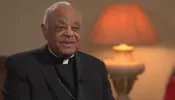

Soon-to-be Cardinal O’Malley looks toward future for strained Archdiocese of Boston
Boston, Mass., Mar 21, 2006 (CNA) -
On
Friday, Boston’s Archbishop Sean O’Malley will travel to Rome where
Pope Benedict XVI will officially be made a Cardinal. In an interview
with the Boston Globe, the Cardinal-designate looked back on his time
as Archbishop, and forward, as the Church faces new challenges and
tries to make itself understood in what he called “a highly secularized
culture.”
During the
exhaustive interview, the Cardinal-designate discussed what he sees as
profound strides in reconciling the archdiocese’s tumultuous sexual
abuse crisis, the recent Catholic Charities controversy over adoption
by same-sex couples, and even his thoughts on the volatile national
immigration debate.
Early on, the
Globe asked O’Malley what he thought of the symbolic red of the
cardinal’s hat representing the wearer’s willingness to suffer for the
Church.
He said he likes
to think that he is prepared for any suffering that might come for his
vocation and his Church and added that “the dominant culture, the
secular culture, does trivialize our beliefs, and at times ridicules
them.”
“It's not the
same as the kind of persecution that people experience in Cuba or,
before the fall of the Iron Curtain…But, I think that there are many
forms of persecution, and certainly one of them is to be ridiculed.”
He went on to
cite the many strides made in the Archdiocese to rectify the sexual
abuse crisis--which has colored much of the Archbishop’s
tenure--starting with the sale of the Archbishop’s own home. O’Malley
pointed out that there is likely no “other institution in
[Massachusetts] that has done as much to re-guarantee the safety of
children as the Catholic Church has done.”
He admitted however, that “we still have a long way to go.”
The
Cardinal-designate also defended the Holy See’s recent directive that
Catholic Charities not place adoptive children with same-sex couples—a
particularly heated controversy in Boston. He said that that “in our
works of mercy, in our social programs…we must be consistent in
teaching the Catholic faith in one voice.”
He pointed out
that “the Church's teaching on marriage is very central to our beliefs
and…we see that the institution of marriage in today's world is very
much threatened on many fronts, and yet it is the very cornerstone of
society.”
“The best way
for a child to be raised”, he explained, “is to be conceived and
nurtured and raised by committed, loving parents in a marriage. And so,
for the church, in our social service activities and other works of
mercy, we need to be consistent.”
He quickly added
however that “it's always difficult when people look at Catholic
teaching on the periphery, and don't see that the core of our teaching
is the love of God above all else, and the love of our neighbor as
ourselves.” He said he “was very pleased that the Holy Father's first
encyclical is 'Deus caritas est,' that God is love.”
“I know,” he
said, “that many people would cast our actions as mean-spirited or to
denigrate people. But it is our desire to be faithful to that love that
is the very core and reason for our church and our religion, that we
must love God, obey his commandments, and try and create a civilization
of love…in our highly secularized, individualistic world, I know that
that message doesn't come across too clearly.”
Archbishop
O’Malley also alluded to numerous transitions taking place in the
chancery itself, referring to the selection of a new chancellor, new
auxiliary bishops and a new director of development.
He also lamented
the archdiocese’s numerous parish closings--acts which were greeted
with much consternation by parishioners--but said that the Church
didn’t have much choice.
He said that the
“closing of parishes has allowed us to regroup, to strengthen some of
our communities, and it's going to allow us to be able to staff all of
our parishes with clergy for a much longer time. It's also allowed us
to strengthen our retirement funds that were weak.”
He added however, that “It certainly has been a very painful process,” both for parishioners and for himself.
Prince of simplicity
Cardinal-designate
O’Malley, a Franciscan Capuchin, is known for his simplicity and love
of poverty. Asked how he would handle the prestige of becoming a
cardinal, he responded, “We have the vow of obedience, and I took as my
motto 'Do Whatever He Tells You -- Quodcumque Dixerit Facite,' which
are the last words of the blessed mother in the Bible.”
He admitted
however, that he didn't “like the hoopla and will try to avoid as much
of it as I can without --I don't want to not recognize the dignity of
this honor and the office and what it means for Catholics, and so, when
in proper times I have to wear certain liturgical vestments, I will
certainly do that.”
“I've always
tried to observe what the church expects of us,” he said, “but my
preference is to try and maintain a simple lifestyle.”
Looking to the
future, O’Malley said that “passing on the faith is the biggest
challenge,” he faces, coupled with “inspiring people to have a sense of
personal vocation as individuals.”
At the same
time, he said, people must “feel that they are part of a communal
mission that Christ has entrusted to us as his people. For some people,
in today's world, religion is kind of reduced to this new age,
individual spirituality. But this is not our ecclesiology. This is not
our Catholic faith.”
Rather, he said
“Our Catholic faith is very much that, although I have a personal
vocation, a call to holiness and a call to a way of life, I'm also
called to be a disciple with, and to share a mission, with my brothers
and sisters in the household of the faith. And so, to communicate that
vision in today's world, which is so highly privatized and
individualistic.”
Church’s new doctrinal watchdog says Catholic politicians need to take Church teachings seriously
Vatican City, Mar 21, 2006 (CNA) - On
Friday, Archbishop William Joseph Levada will be the first of 15 men
from around the globe to be made Cardinal by Pope Benedict XVI.
Levada’s role is unique however. Earlier this year, he took over the
Holy Father’s former job as Prefect for the Congregation of the
Doctrine of the Faith--a job charged with upholding the teachings of
the Church.
Recently, the
Cardinal-designate granted an interview to Time Magazine, in which he
talked about the responsibilities of Catholic politicians and the
ramifications of the Church’s recent document on homosexuals in
seminaries.
During the 2004
U.S. presidential election, the issue of Catholic politicians promoting
and publicly holding views contrary to the Catholic Church became a
volatile one.
Asked whether
“politicians should be granted communion if they support policies
counter to Church teachings,” Archbishop Levada said that “There are
certain teachings that as Catholics we have to accept as part of Jesus'
Gospel. When you see Catholic politicians who favor abortion rights ...
you have to ask yourself how this person squares this with his personal
faith.”
“Catholic
politicians”, he stressed, “need to take this seriously. Maybe they
need to say I'm not able to practice my faith and be a public
representative.”
Likewise, the
Cardinal-designate hit on the Church’s recent document on homosexuals
in seminaries calling the controversial teaching tool “very clear.”
“It says a
person with deep-seated homosexual tendencies is not suited for the
priesthood,” he pointed out. “Somebody who comes to the seminary from a
gay lifestyle cannot be a priest.”
“But”, he also
offered, “if you can show us after five or 10 years that you have been
able to live a celibate life, it could be possible. But there would
need to be spiritual and psychological evaluations.”
Time’s Jeff
Israely closed his interview with the prelate by asking if the Pope had
“any advice on how to handle such a responsibility” when he “welcomed
you to the new job.”
With a laugh, Archbishop Levada said no. Benedict "just smiled, and said: ‘Go to it.’”
Cardinal George “deeply troubled” as Archdiocese of Chicago releases findings of massive abuse probe
Chicago, Ill., Mar 21, 2006 (CNA) - The
Archdiocese of Chicago released the disturbing findings of their
"Report on Clerical Sexual Abuse of Minors Findings and Solutions"
yesterday. In response to the wide-sweeping, independent probe,
Cardinal Francis George said that he was “deeply troubled.”
In a statement,
the Cardinal said that “This is a tragedy for the children, for their
families and all who are involved. But it also represents failures
within the Archdiocese to react promptly and appropriately to what
happened in these cases.”
He stressed that “Sexual abuse or molestation of a child by any adult is disordered. It is a sin and a crime.”
“When children
or young people”, he added, “are robbed of their innocence and suffer
the pain, anguish and anxiety caused by the illegal and immoral actions
of a priest, a person of trust, the tragedy of sexual abuse is
compounded.”
He quickly
pointed out however, that the archdiocese’s Father Daniel McCormack
“has been arrested and charged with sexually abusing three children”
and that the Church is continuing to look into additional accusations
by more families.
“It is up to the
legal process now to determine innocence or guilt on the part of Father
McCormack,” he said, “but we have tried to examine our own actions and
mistakes.”
“We are here
today”, he went on, “to report to the people of the community on how we
intend to move forward to further strengthen our commitment to the
protection and safety of children.”
Cardinal George
also said that he has asked Chancellor Jimmy Lago, “an expert in child
welfare, to take a hard look at what went wrong and to implement
changes.”
Personal responsibility
In is his statement, the Cardinal also wished to share some personal thoughts.
“For the many
missteps in responding to the accusations of sexual abuse of minors by
Father McCormack,” he said, “I accept responsibility.”
“For the tragedy
of allowing children to be in the presence of a priest against whom an
accusation of sexual abuse had been made,” he continued, “I am truly
sorry. I should have focused more clearly on the actions we needed to
take and I should have taken them more quickly.”
“For not
following the advice of our independent Professional Responsibility
Review Board to remove Father McCormack temporarily, even without a
judgment about his actions,” he added, “I am deeply sorry.”
The Cardinal
stressed his commitment “to a full disclosure of the facts and to the
implementation of deliberate, meaningful changes to do all in our power
to ensure that such events never happen again”.
The Monday
report showed a widespread breakdown in communications within the
Archdiocese. For example, a priest charged with molesting three boys
had been accused years before of having questionable conduct with a
minor while he was in the seminary and was still allowed to be
ordained.
The report was
based on investigations conducted by two outside consultants and an
internal review. It noted that the archdiocese's failure to follow its
own procedures put children in harm's way and may have violated
Illinois law.
It also
discovered that various archdiocese departments responsible for dealing
with abuse allegations failed to communicate. Likewise, the archdiocese
didn't seem to follow its own procedures and at one point, determined
that a policy of monitoring priests accused of sex crimes would be
adequate.
The
investigations were sparked by allegations against Fr. McCormack. He
pleaded not guilty earlier this month to aggravated criminal sexual
abuse charges and is accused of molesting three boys between September
2001 and January 2005.
According to the
Associated Press, officials at St. Mary of the Lake Seminary in
Mundelein were told that Fr. McCormack acted inappropriately with two
adult males and one adult minor in 1992, according to the report.
McCormack was ordained in 1994.
Jim Dwyer, a
spokesman for the Archdiocese said that all the information in the
report has now been turned over to prosecutors, who will decide if
penalties should be imposed on the church or its employees.
During an
interview with Jay Levine of Chicago’s CBS 2 news, Cardinal George
admitted his devastation at the consultant’s report.
"You read it, and you weep," he said.
Asked if the
review board was upset that he did not follow its recommendation, the
Cardinal said, "Of course. Sure, I would be too, and I understand that.
I wish I had taken their precautionary advice."
Appearing
clearly shaken, he told Levine, "When I pray, I think about the faces
of children abused by priests…And those are intense moments, and I ask
the Lord to protect them."
Regarding Fr.
McCormick, Cardinal George lamented, "Police let him go free, and I
misunderstood that to mean that they thought he wasn't a danger. I
think now as I've been told by lawyers and others, it doesn't mean
that, but it was certainly in my mind at the time. I didn't think he
was a danger."
The full report,
presented by Defenbaugh & Associates, Inc., is available at the
Archdiocese of Chicago's web site:
http://www.archdiocese-chgo.org/keeping_children_safe/report_032006/defenbaugh_report.pdf
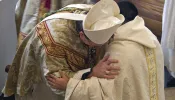
Pope Benedict to create 15 new Cardinals Friday
Vatican City, Mar 21, 2006 (CNA) - On
Friday, the Church’s College of Cardinals will grow to 193 members.
Among them, a 15 men will travel from various sees around the world to
be named the first cardinals of Pope Benedict XVI’s pontificate.
The Pope will
celebrate his first Ordinary Public Consistory at the end of this week,
bringing the total number of cardinals eligible to vote for a new pope
to 120,
According to Church law, only those under the age of 80, enjoy the right to participate in a papal conclave.
The Consistory
will bring the number of cardinals in Europe to 100, 60 of whom have
the right to vote. The Americas will now have 52 cardinals (20 from
North America and 32 from South America) with 36 electors. Africa will
have 17 African cardinals with 9 electors; Asian will have 20, with 13
electors, and Oceania will have four with 2 electors.
After Friday,
Italy will remains the home of the world’s largest number of cardinals,
40 in all including three new prelates who will be consecrated on March
24th.
Following Italy, the United States has the second largest number with 15 cardinals, and France and Spain each have nine.
Friday's consistory will follow new rites which were introduced at Pope John Paul II’s June 28th, 1991 ceremony.
Afghan man could face death for becoming Christian
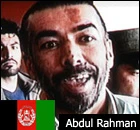
Kabul, Afghanistan, Mar 21, 2006 (CNA) - The
Associated Press is reporting that an Afghan man who reportedly
converted from Islam to Christianity is facing a potential death
sentence from a court in Kabul.
Abdul Rahman is
charged with violating his country’s Islamic laws by making the
conversion. Judge Ansarullah Mawlavezda told the AP that the man was
arrested last month after his family turned him into police for being a
Christian.
The judge said
that Rahman claims he converted 16 years ago—at age 25—while working as
a medical aid worker in neighboring Pakistan.
"We are not
against any particular religion in the world, Judge Mawlavezda said.”
But in Afghanistan, this sort of thing is against the law…It is an
attack on Islam. ... The prosecutor is asking for the death penalty."
The case is
thought to be the first of its kind in Afghanistan and reportedly, the
charges could be dropped if Rahman agrees to convert back to Islam.
That, he said however, is not an option.
Boston Archdiocese announces removal of 8 priests
Boston, Mass., Mar 21, 2006 (CNA) - The Archdiocese of Boston announced yesterday that 8 priests who were
charged with sexual abuse have now been removed from the clerical state.
A final decision
from the Holy See has determined that Anthony Buchette, Joseph Crowley,
Paul Finegan, Thomas Forry, Robert Morrisette, Frederick Ryan, Ernest
Tourigney and Patrick Tague will now cease to receive any financial
support from the Archdiocese and can no longer publicly exercise their
priestly authority in the Church.
In a statement,
Archbishop Sean O’Malley said that "During these days of Lent we are
called in a particular way to repentance and conversion…With this
Lenten call in mind, this moment provides an opportunity to express to
the survivors of clergy sexual abuse and to their families my deepest
sorrow for the grievous harm done to them.”
He said that
“The violations of childhood innocence, under the guise of priestly
care, are a source of profound shame,” adding his hope that “that the
emotional, physical, and spiritual wounds carried by survivors will be
healed and their trust renewed.”
The Archbishop,
who will become a cardinal on Friday, pledged the “on-going commitment
of the Archdiocese to accompany those who have been abused in their
healing work."
Although the 8
men have been removed from the clerical state, they are still permitted
to offer absolution to the dying in cases of extreme circumstance.
Redemption key idea in John Paul II’s thought, says Pope Benedict
Rome, Italy, Mar 21, 2006 (CNA) - In
the written introduction for the new edition of John Paul II’s, “Memory
and Identity,” Pope Benedict XVI notes that the key word of the entire
thinking of the late Pope is “redemption,” a concept that in
existential terms means “mercy.”
Last weekend the
Italian daily Corriere della Sera published the prologue written by
Pope Benedict XVI for the new edition of last book of his predecessor,
in which the late pontiff reflected on the history of the 20th century
and on good and evil.
For Benedict
XVI, John Paul II’s book, which will be re-published on March 22,
brings together “some of the fundamental experiences of his life” and
gives readers a “glimpse of his interior biography.” He also
points out that his recollections of the Nazi occupation and the
Communist dictatorship of Poland reveal that John Paul II experienced
“very personally” the oppression and enslavement of his homeland.
In recalling
some of Karol Wojtyla’s reflections on the concept of redemption,
Benedict XVI states that this is “the key word to all of John Paul II’s
thought,” and he recalled that “his first programmatic encyclical
begins with the significant words ‘Redemptor hominis,’ thus becoming
‘the summary of his theological and anthropological vision’.”
The Pope also
underscored the references in the book to the Blessed Mother, “who was
so central in the spiritual life of John Paul II,” and her role as “the
bearer of memory.” “The memory of the Church is the point where
the conscience of humanity widens and touches our origins, the
foundations of our being;” because “where the past is not known, the
future is also lost in favor of an empty present,” Benedict XVI added.
The Pontiff
insisted that all of the different memories have their roots in the
common memory of humanity, “conserved in an excellent way in the memory
of the Church,” in which lies “the strength of peace and reconciliation
of humanity.”
As anniversary of his death approaches, Canadian bishops offer resources for John Paul II memorials
Ottawa, Canada, Mar 21, 2006 (CNA) - Churches
across Canada have organized memorial services next month to
commemorate Pope John Paul II. With the approaching first anniversary
of his death, April 2, the Canadian Conference of Catholic Bishops
(CCCB) has made commemorative materials available for use in churches,
chapels and schools.
A portrait of
His Holiness Pope John Paul II, a reproduction of the original
black-and-white rendering, is available in a limited edition. Printed
on archival quality paper, each signed and numbered print comes with a
certificate of authenticity. Each portrait sells at $100.
Posters of the
late Pope are suitable to announce the place and times of memorial
services. They cost $2 each or $5 for packages of 5.
Finally, large-format banners on weather-resistant vinyl, with hanging grommets at each corner are available for $47 each.
To order or for more information, visit www.cccbpublications.ca.
Poor sales force laboratory to pull morning-after pill from Chilean market
Santiago, Chile, Mar 21, 2006 (CNA) - The
Grünenthal laboratory, which manufactures the morning-after pill in
Chile, has decided to pull the drug from the market because of poor
sales and the constant legal challenges being made by pro-life groups
who denounce the drug’s abortifacient nature.
Pro-life
leaders, represented by Fernanda Otero, applauded the decision, saying
it “proves that [the drug] induces an abortion.” “Life must
always be protected,” she said, adding she was sure the drug was going
to be pulled because nobody can guarantee that it “does not kill the
unborn.”
On the other
side, Veronica Schiappacasse, a researcher at the Chilean Institute of
Reproductive Medicine and a fervent supporter of the drug, said the
decision by Grünenthal was “troubling and understandable.” “I
suppose they had no intention of continuing to manufacture it as it was
not good business.”
Schiappacasse
said she would now look to the new government led by President Michelle
Bachelet “to create policies in favor of women’s rights and not be
pressured by minority groups that want to control the rights of
Chileans.”
New family and marriage think tank sets up shop
Ottawa, Canada, Mar 21, 2006 (CNA) - A
new Christian think tank on marriage and family has set up shop in
Canada’s capital with the hopes of impacting upcoming debates in the
House of Commons.
The Institute for Marriage and Family Canada (IMFC) is an outreach of Focus on the Family Canada, an Evangelical organization.
According to
IMFC executive director, the think tank is designed to provide
Parliamentarians, senators, political staff and other decision-makers
with the latest research on a number of issues, including marriage,
embryonic stem-cell research, euthanasia and other family-related
legislation.
Lobby groups and
educational institutions, based on Judeo-Christian principles, have
become more numerous and active in the nation’s capital recently,
reported the Ottawa Citizen.
Other
organizations include the National House of Prayer, which encourages
Christians from across the country to spend a week in the capital
praying for their political leaders, the Institute for Canadian Values
and Vote Marriage Canada.
Catholic dissident leader says Church in Cuba still being persecuted
Havana, Cuba, Mar 21, 2006 (CNA) - Three
years after the Castro government’s massive crackdown on opposition
groups, the leader of the Christian Liberation Movement, Oswaldo Paya,
said the persecution of the Church in Cuba continues.
In an interview
with the internet magazine Encuentro en la Red, Paya gave an extensive
analysis of the status of the opposition and the Church in Cuba.
“Its been three years since that day, which was an event that did not
end at that moment, but continues even to this day, since our friends
are still in prison. We can’t talk about this as if it were the
past, but rather as a continuing cruel present,” Paya explained.
“We are facing a
moment of regression and in recent months the so-called ‘acts of
repudiation,’ that is, those fascist, communist acts in which families
are terrorized and beaten, have gotten worse. In addition, state police
continue to go house to house, to all of the signers of the Varela
Project, in other to threaten them with unemployment, deny them leave
of the country, and threaten them with everything totalitarianism has
to pressure them to retract.”
Paya called for
a greater response from the international community, which, he said,
pays attention to other unjust situations in the world but is often
“silent or indifferent” in response to the injustice in Cuba.
Asked about
statements by Cardinal Renato Martino suggesting that the Church no
longer suffers repression in Cuba, Paya said, “I’m not going to comment
on messages or statements by the local Church or the Vatican. But
I can speak of my own experience and reality. This oppression not
only touches the churches and believers; it has a special component
dedicated just to us.”
While there is a
certain freedom of worship in Cuba, Paya noted the oppression in many
places is “palpable,” with government agents openly monitoring Masses
in an attempt to intimidate people. “Although this is not public,
I must speak about it, because I know firsthand how many religious
sisters and brothers are victims of threats, intimidating phone calls
and blackmail.”
Paya also called
for greater commitment from Church leaders to fulfill the Church’s role
as prophet and defender of human rights. At the same time, he
added, the laity is already in a position to “take on this
attitude.” “They only have to decide to do it. Because, I
have never been of the thinking that I have to act under the identity
of the Church—even though my inspiration comes from being a
Christian—or to see the Church as a political trench, or to identify
any one movement, program and personality, no matter how great they
are, with the Church.”
“I have always
defended that distinction,” Paya stated, “because everything in the
political and social sphere is debatable. And when a person or a
group wants a commitment from the Church, or acts in the name of the
Church, whether openly or not, then they are identifying the Church
with what could very well be a legitimate option, but it may be only
one option and not necessarily the option of the Church.”
Penitential walk brings together 200,000 in Brazil
, Mar 21, 2006 (CNA) - Last
weekend some 200,000 Brazilians joined together in a traditional
penitential walk celebrated each year during Lent in the city of São
Salvador da Bahía. The city’s archbishop, Cardinal Geraldo
Majella, led the walk.
After
celebrating an outdoor Mass, Cardinal Majella Agnelo was joined by
dozens of priests and deacons behind a processional cross which lead
the traditional Lenten walk.
Part of the
annual event includes dropping off non-perishable food at certain
hospitals and homes along the way, including the San Antonio Hospital,
founded by the late Sister Dulce, who died in 1992 and is revered by
Brazilians as “the angel of the poor of Bahia.”