
Catholics must be engaged in political debate, says Pope
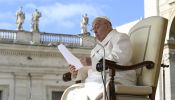
Vatican City, Mar 30, 2006 (CNA) - Speaking
earlier today to a group of parliamentarians from Europe’s Popular
Party, Pope Benedict affirmed the need for a Catholic voice in the
public square that informs consciences and helps citizens act “freely
and responsibly.”
The Church has
come under heavy fire in recent years--particularly in the U.S.--for
engaging in political debate where some say it has no place. Critics
charge that many politicians worldwide seek to relegate faith life
merely to the private sphere.
Benedict
reminded the parliamentarians however, "that when Churches or ecclesial
communities intervene in public debate, expressing reservations or
recalling various principles, this does not constitute a form of
intolerance or interference.”
He said that the
Church’s political interventions “are aimed solely at enlightening
consciences, enabling them to act freely and responsibly, according to
the true demands of justice, even when this should conflict with
situations of power and personal interest."
In this light,
the Pope said that the main area of the Church's intervention in the
public sphere "is the protection and promotion of the dignity of the
person.” “…She is thereby consciously drawing particular attention to
principles which are not negotiable."
Here, he listed
a number of principles for which Catholics must continue to fight.
Namely, these are: "Protection of life in all its stages, from the
first moment of conception until natural death; recognition and
promotion of the natural structure of the family, as a union between a
man and a woman based on marriage, and its defense from attempts to
make it juridically equivalent to radically different forms of union
which in reality harm it and contribute to its destabilization,
obscuring its particular character and its irreplaceable social role;
and the protection of the right of parents to educate their children.”
While he
admitted that "These principles are not truths of faith, even though
they receive further light and confirmation from faith,” he stressed
that “they are inscribed in human nature itself and therefore they are
common to all humanity.”
The Pope
explained that “The Church's action in promoting them is therefore not
confessional in character, but is addressed to all people, irrespective
of any religious affiliation they may have."
He closed by
calling on the politicians "to be credible and consistent witnesses of
these basic truths through your political activity, and more
fundamentally through your commitment to live authentic and consistent
lives."
Pope to European politicians: Ignoring Christian heritage is sign of historical immaturity
Vatican City, Mar 30, 2006 (CNA) - As
he met today with members of the European parliamentary group, the
Popular Party, Pope Benedict XVI encouraged Europe to recognize its
Christian roots and charged that ignoring them would be a sign of
immaturity and even weakness.
The group met with the Holy Father during the “Study Days on Europe,” an initiative organized by the party.
Speaking in
English, Benedict told the parliamentarians that "Roman Pontiffs have
always devoted particular attention to this continent; today's audience
is a case in point, and it takes its place in the long series of
meetings between my predecessors and political movements of Christian
inspiration."
He explained
that "At present, Europe has to address complex issues of great
importance, such as the growth and development of European integration,
the increasingly precise definition of neighborhood policy within the
Union and the debate over its social model.”
“In order to
attain these goals,” he continued, “it will be important to draw
inspiration, with creative fidelity, from the Christian heritage which
has made such a particular contribution to forging the identity of this
continent.”
The Holy Father
encouraged Europe to value its Christian roots, and in doing so, he
said they will “be able to give a secure direction to the choices of
its citizens and peoples.”
Likewise, he
said “It will strengthen [Europe’s] awareness of belonging to a common
civilization and it will nourish the commitment of all to address the
challenges of the present for the sake of a better future."
Benedict thanked
the Popular Party for their own "recognition of Europe's Christian
heritage" which, he said, "offers valuable ethical guidelines in the
search for a social model that responds adequately to the demands of an
already globalized economy.”
It will help
assure, he said, “growth and employment, protection of the family,
equal opportunities for education of the young and solicitude for the
poor.”
"Your support
for the Christian heritage,” he told the group, “can contribute
significantly to the defeat of a culture that is now fairly widespread
in Europe, which relegates to the private and subjective sphere the
manifestation of one's own religious convictions.”
“Policies built
on this foundation”, the Pope stressed, “not only entail the
repudiation of Christianity's public role; more generally, they exclude
engagement with Europe's religious tradition, which is so clear,
despite its denominational variations, thereby threatening democracy
itself, whose strength depends on the values that it promotes."
He also pointed
out that opposing or ignoring the European Christian tradition "would
be a sign of immaturity, if not indeed weakness. ... In this context
one has to recognize that a certain secular intransigence shows itself
to be the enemy of tolerance and of a sound secular vision of State and
society."
The Pontiff said
he was pleased however, "that the European Union's constitutional
treaty envisages a structured and ongoing relationship with religious
communities, recognizing their identity and their specific
contribution.”
He said that
above all, he trusts “that the effective and correct implementation of
this relationship will start now, with the cooperation of all political
movements irrespective of party alignments.”
Afghan Christian convert flees to Italy
Rome, Italy, Mar 30, 2006 (CNA) - Italy
has granted asylum to a Christian who faced the death penalty in his
native country of Afghanistan for having converted from Islam 16 years
ago. Conversion is a crime under Afghanistan's Islamic law. He was
arrested after police discovered him with a Bible.
Premier Silvio
Berlusconi said yesterday that Abdul Rahman, 41, whose case made
headlines worldwide, was in the care of the Interior Ministry after
arriving in Italy earlier in the day, reported the Associated Press.
Rahman’s case was dismissed on a technicality but many still feared for his life once released.
Pope Benedict
XVI had appealed on Rahman’s behalf to Afghanistan President Hamid
Karzai and the United Nations had made efforts to find a country to
take him.
Afghanistan's Parliament had demanded earlier Wednesday that the government prevent Rahman from fleeing the country.
Italy has close
ties with Afghanistan. Afghanistan’s former king, Mohammed Zaher Shah,
lived with his family in exile in Rome for 30 years. They returned to
Kabul after the fall of the Taliban regime. Italian troops were sent
into Afghanistan to help with reconstruction, after the U.S.-led
invasion of the country in 2001.
Muslim clerics
in Afghanistan condemned Rahman's release, saying it was a "betrayal of
Islam," and threatened to incite violent protests.
According to the
AP, Abdulrahman Jan, the top cleric in Zabul province, said the
government should either force Rahman to convert back to Islam or kill
him. "This is a terrible thing and a major shame for Afghanistan," he
reportedly said. The cleric had met with about 500 other people in a
mosque to criticize the government’s release of Rahman.
Despite vocation shortage, God continually calls men and women to serve his Church, says Pope
Vatican City, Mar 30, 2006 (CNA) - As
the Church prepares to celebrate the World Day of Prayer for Vacations,
due to be held in May, the Holy Father is stressing that although many
corners of the world currently face a priestly shortage, God continues
to call men to “take care of his people” through the priesthood.
Today the
Vatican made public Pope Benedict XVI’s Message for the 43rd annual
prayer day, which falls on May 7th. It’s theme this year is “Vocation
in the Mystery of the Church.”
In his message,
dated March 5th, the Pope writes that "The weight of two millennia of
history makes it difficult to perceive the novelty of the fascinating
mystery of divine adoption which lies at the center of St. Paul's
teaching."
He added that
"We are called to live as brothers and sisters of Christ, to consider
ourselves as sons and daughters of the same Father. This a gift that
overturns all exclusively human ideas and projects."
In this light,
the Pope asked "What, then, must we say of the temptation, so strongly
felt in our own time, to think ourselves so self-sufficient as to shut
ourselves off from the mysterious plan God has for us? The love of the
Father, revealed in the person of Christ, calls out to us."
Benedict pointed
out that through the centuries, men and women, "transformed by divine
love, have consecrated their lives to the cause of the Kingdom," and
"through Christ have known the mystery of the Father's love."
These people, he said, "represent the multiplicity of vocations that have always been present in the Church."
The Holy Father
went on to describe the Second Vatican Council's universal call to
sanctity. In each generation, he said, Christ "calls individuals to
take care of His people; in particular He calls men to the priestly
ministry to exercise a paternal function.“
He stressed that
“The priest's mission in the Church is irreplaceable. Therefore, even
though some areas suffer a shortage of clergy, we must not lose the
conviction that Christ continues to call men" to the priesthood.”
He added that "Another special vocation occupying a place of honor in the Church is the call to consecrated life.”
Although these
men and women “undertake various forms of service in the field of human
formation and care for the poor, in education and in assistance to the
sick, [consecrated people],” the Pope said, “do not consider these
activities as the principle aim of their lives because, as the Code of
Canon Law says: 'Contemplation of divine things and assiduous union
with God in prayer is to be the first and foremost duty of all
religious'."
As he concluded
his message, Pope Benedict issued a call to pray "for vocations to the
priesthood and the consecrated life,” saying that “The Church's
sanctity depends essentially on her union with Christ and her openness
to the mystery of grace at work in the hearts of believers.”
“For this
reason,” he said, “I would like to invite all the faithful to cultivate
an intimate relationship with Christ, Master and Pastor of His people,
imitating Mary who guarded the divine mysteries in her heart and
contemplated them assiduously."
Last days of John Paul II were serene, says former secretary
Krakow, Poland, Mar 30, 2006 (CNA) - The
archbishop of Krakow and former personal secretary of Pope John Paul
II, Cardinal Stanislaw Dziwisz, said Wednesday in Rome that the Polish
pope was serene and alert during his last days.
Cardinal
Dziwisz, who was at the Pope’s side during his final illness, said his
last days “were not as tragic as the media claims they were” because
the Pope “was aware that his time was drawing near and he was fully
prepared for death.”
According to the
cardinal, Pope John Paul II “was totally conscious, he heard the
prayers of the multitudes gathered under his window and with this
calmness and tranquility he helped those around him maintain or recover
their spiritual peace.”
In an interview
with the Italian radio network RAI, the cardinal also said that John
Paul II “said goodbye one by one to his closest associates, such as the
Secretary of State or Cardinal Ratzinger, who was dean of the College
of Cardinals, but also to the ordinary people who cared for his living
quarters…it was something very emotional and moving,” Cardinal Dziwisz
said in conclusion.
Today is the
anniversary of John Paul’s last public appearance. He greeted pilgrims
from his study window on March 30th of 2005.
Susan B. Anthony List Candidate Fund announces 2006 endorsements
Washington D.C., Mar 30, 2006 (CNA) - The
Susan B. Anthony List Candidate Fund announced its first round of
endorsed candidates for the 2006 election cycle at a campaign kick-off
event March 29 on Capitol Hill.
The SBA List
Candidate Fund is a connected political action committee of The Susan
B. Anthony List, a nationwide network of Americans dedicated to
mobilizing and advancing pro-life women in politics.
“We have every
intention of using the 2006 elections to increase the number of
pro-life seats in Congress and the number of pro-life women in
politics,” said SBA List Candidate Fund president Marjorie
Dannenfelser. “In addition to financially backing these candidates,
we’ll be running independent expenditure campaigns to mobilize pro-life
women voters in several states.”
The number of
winning candidates endorsed by the SBA List Candidate Fund has
increased in the past four election cycles. In 2004, SBA won 27 of 35
races.
The organization
has more than 140,000 members residing in all 50 states. For more
information on the SBA List Candidate Fund, go to: www.sba-list.org
Catholic population on the rise in Bible-belt entrenched Atlanta
Atlanta, Ga., Mar 30, 2006 (CNA) - Notre
Dame Academy in Duluth is a symbol of the growth of Catholicism in
metro Atlanta, Archbishop Wilton Gregory told the students and staff
during a recent visit.
The school,
which has Grades K-8, has more then 200 students and school officials
expect enrollment to double to about 400 for the next school year. The
growth of the Catholic community has meant that the demand for Catholic
schools has outstripped the supply.
After touring
the school, consecrating altars in a chapel and in the school
auditorium, and celebrating mass, Archbishop Gregory pointed to more
growth in the archdiocese. He said he has already participated in the
consecration of three new churches in his first year since being
appointed to Atlanta. The Catholic population is currently 5 percent.
Notre Dame
opened as an independent Catholic school in August. Its board purchased
a converted office park. Operational expenses are financed
independently by the fundraising efforts of laypeople who wanted to
make a Catholic school available to families in the northern part of
Gwinnett. The school is not supported financially by the archdiocese.
Expert: Alameda County, CA Facing More Than $30 Million in Damages against Christian school
Alameda County, Calif., Mar 30, 2006 (CNA) - The
Becket Fund for Religious Liberty filed an independent expert report,
detailing that damages against their client, Redwood Christian Schools,
will amount to at least $30 million.
Redwood
Christian brought suit against Alameda County in 2001 after county
officials denied Redwood Christian a permit to build a Christian school
on its property in Castro Valley. The school claims the officials’
decision is in violation of the First Amendment and the Religious Land
Use and Institutionalized Persons Act.
This figure,
says the expert report by Dr. Philip Allman, includes only damages from
loss of enrollment, construction delay, and increased financing costs.
The County could also face additional damages for deprivation of
constitutional rights such as free exercise of religion and freedom of
speech.
The case,
Redwood Christian Schools et al. v. County of Alameda, et al., is
scheduled to begin June 26 in the federal district court in San
Francisco.
Mexican bishops call on presidential candidates to offer solutions to immigration problem
Mexico City, Mexico, Mar 30, 2006 (CNA) - In
a statement released on Wednesday, the bishops of Mexico called on
presidential candidates to offer “concrete plans for the short, medium
and long term” for dealing with the problem of immigration, rather than
simply pointing out the problem.
In their statement the bishops argue that “to try to stop immigration
with different types of ‘barriers’ is impossible” and that “dialogue
and thorough solutions,” taking into account the “specific contribution
that immigration can offer for world peace,” are what is truly needed.
“The United States,” the bishops continued, “has recognized in practice
that it depends on the Mexican worker to keep the economy
healthy. Therefore, it should make a special efforts to establish
the legal means for Mexican workers there to find jobs that provide an
appropriate wage and just employment benefits and protections, in order
to live with dignity.”
“Regulating the flow of immigrants between countries is a process,” the
bishops added. “We cannot lose site of our responsibility to
carry out structural reforms so that Mexicans can experience in our
country the basic conditions necessary to live with dignity in whatever
profession they choose,” they said.
The statement, which was signed by the president of the Bishops’
Conference of Mexico, Bishop Jose Guadalupe Martin Rabago, and
Conference secretary, Bishop Carlos Aguiar Retes, calls for cooperation
by everyone to “seek out solutions together,” so that “the rights of
our brothers and sisters who are seeking a better life are recognized”
and “justice is served.”
30,000 children send letters calling on Colombian high court not to legalize abortion
Bogotá, Colombia, Mar 30, 2006 (CNA) - Pro-family
groups have collected more than 30,000 letters from children asking the
Constitutional Court of Colombia not to legalize abortion in the
country. Leaders said they planned to send the letters to high court
justices on March 30.
Members of
prominent family associations recalled that the Colombian constitution
“defends the life of every human being from the moment of
conception.” They said the project was an expression of the right
of parents to “educate, train and represent our children in the defense
of human life.”
“Children have
the right to express themselves and to be heard,” they said, and
“parents have the right and obligation” to support children in their
development by showing them love and understanding and imparting values
to them, “especially love for life.” “Nobody can deny us that
right,” they added.
Common themes in
the letters included, “I think that if more babies are not born, there
will be no more people,” and, “I think that if my mommy would have
aborted me, I would not be here and I would not be able to enjoy my
friends, nature, and so many beautiful things in life.”
Mexican bishop says he will not support “autonomous church”
Mexico City, Mexico, Mar 30, 2006 (CNA) - In
a statement sent to Catholic News Agency, Bishop Felipe Arizmendi
Esquivel of San Cristobal de las Casas and his Auxiliary Bishop Enrique
Diaz responded to the controversy surrounding a letter from the Holy
See which ordered a suspension of ordinations to the permanent
deaconate in the Mexican diocese.
“Although there
were some at the Vatican who supported our petition, the decision to
suspend these ordinations prevailed,” the statement said. “Let it
be clear, however, that this is not a definitive and permanent
suspension, but a temporary one, and those who are already permanent
deacons can continue exercising their ministry without any
restrictions.”
“First of all,”
the bishops continued, “we respect this decision with serene faith and
active hope, although with heartfelt sorrow. We will not ordain
any more permanent deacons until this door is opened again. We
could carry out new ordinations and they would be valid; but they would
be illicit and we would be breaking ecclesial communion, thus isolating
ourselves and making ourselves into an ‘autonomous Church,’ which no
one wants.”
They went on to
express their concern that “our efforts to become an ‘autoctonous
Church’ have been called ‘ideological.’ Although we acknowledge
the limitations and deficiencies, we believe that the efforts to
implement the idea of an autoctonous Church are being carried out in
conformity with the teachings of the Council.”
“We would be
falling into an ‘ideology’,” they argued, “into ‘ideological
isolation,’ if our project of an autoctonous Church were to be confused
with that of an autonomous Church. We are not, nor do we have the
intention of becoming, an autonomous Church.”
The bishops also
said the ordinations to the permanent deaconate in their diocese were
not meant to encourage hopes for a married priesthood, although they
said they have received “many requests” for the idea. The
reaffirmed their commitment to fostering vocations to the celibate
priesthood.
Regarding the
Vatican request to suspend the formation of more candidates to the
permanent deaconate, the bishops said, “We will continue the formation
of our catechists, not in view of a possible immediate ordination to
the deaconate, but rather in order to strengthen their service in the
communities, preparing them to be instituted as lectors and acolytes.”
“When the Holy
Spirit thus disposes and the doors are opened again, some of them will
already be ready for ordination,” they said.