
Catholic South Korean delegation visits communist north for first time
Seoul, South Korea, Apr 27, 2006 (CNA) - The
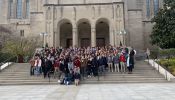
Archdiocese of Seoul sent its first-ever official Catholic delegation
to North Korea Wednesday; this is the first time its members have been
allowed to cross the border into the communist north. The group left
for its three-day trip on April 26.
The 61-member
delegation, made up of lay people and clergy, will inspect how the more
than $10 million it has sent to North Korea for humanitarian aid has
been used.
The delegation
is being led by Mgr. Thomas Aquinas Choi Chang-hwa, director of the
National Reconciliation Committee, established in 1995 to “deliver
God’s love to our North Korean brethren.”
Many sources
have said the visit has “raised hopes about an agreement allowing more
religious freedom in the country”, ruled by a Stalinist regime and held
by many to be an “an open air gulag.”
The delegation
is scheduled to inspect conditions in health facilities it funded and
to visit a food factory and a grain mill built with aid from Changchung
– the only Catholic church in Pyongyang.
The visit comes
after Pope Benedict recently installed a second cardinal for South
Korea earlier this year. Cardinal Nicholas Cheong Jin-suk is interested
in rebuilding the Church in the communist country and having a priest
installed there.
The cardinal
also heads the Roman Catholic diocese in the capital of North Korea,
although it is mostly a symbolic title since there are no practicing
Catholic priests allowed in the country.
The two Koreas
have been divided for more than 60 years. South Korea estimates there
are about 3,000 Catholics in North Korea and about 12,000 Protestants,
while in the South there are about 4.5 million Catholics.
Pope Benedict: Law of God does not eliminate human freedom, but perfects it
Vatican City, Apr 27, 2006 (CNA) -
Meeting
with members of the Pontifical Biblical Commission earlier today, Pope
Benedict XVI expounded on the nature of humanity which, he said, finds
its true freedom and happiness within the perfected humanity of Jesus
Christ.
The Pope’s
meeting with the Biblical scholars comes as the group completes their
annual plenary assembly, in which they explored the relationship
between the Bible and morality. Cardinal William Joseph Levada, head of
the Congregation for the Doctrine of the Faith and president of the
commission, presided over the assembly.
The Holy Father
began by greeting the participants--many of whom he knows personally,
having himself been president of the commission prior to being elected
Pope--stressing the importance of the plenary session’s theme.
''The primordial
impulse of human beings'', he said, ''is their desire for happiness and
a fulfilling life. Nevertheless, there are many today who think that
such fulfillment must be attained autonomously, with no reference to
God or to His law.”
“Some”, he
added, “have even suggested the absolute sovereignty of reason and
freedom in the field of moral norms. ... The proponents of this 'moral
laicism' affirm that human beings, as rational creatures, not only can
but must freely decide the value of their own behavior''.
Pope Benedict
firmly called this a ''false conviction'', which ''is rooted in a
supposed conflict between human freedom and any kind of law."
He pointed out
however, that "the law of God does not mitigate or eliminate human
freedom, on the contrary, it guarantees and promotes it. ... Moral law,
established by God at the creation and confirmed in the Revelation of
the Old Testament, finds its fullness and greatness in Christ.”
“Jesus Christ”,
the Pope stressed, “is the way of perfection, the living and personal
synthesis of perfect freedom in His total obedience to the will of
God''.
Expanding on
this thought, Benedict recalled that ''In revealing the Father and in
His own actions, Jesus also reveals the norms for just human behavior.
He explicitly underlines this connection when, at the conclusion of His
lessons regarding love for one's enemies, He says 'be perfect as your
heavenly Father is perfect'.''
He likewise
explained that ''The path indicated by Jesus through His teachings is
not a rule imposed from the outside. He Himself walks this path and
asks no more than that we follow Him. ... In the search for a
Christologically inspired ethic, it is always necessary to remember
that Christ is the Word Incarnate Who renders us participants in His
divine life, and with His grace He sustains us on the path towards true
fulfillment.''
Concluding his
address to the theologians, the Holy Father stressed that ''The essence
of human beings appears definitively in the Word made man," and "this
relationship with Christ defines the highest fulfillment of man's moral
actions. ... It is not an act dictated solely by external norms, it
proceeds from the vital relationship that unites believers to Christ
and to God.''
Pope clarifies Church’s traditions, norms for canonization; announces new instruction
Vatican City, Apr 27, 2006 (CNA) - As
the world watches the Catholic Church in its process for the
beatification of John Paul II, the Vatican has released a message from
Pope Benedict to the Congregation for the Causes of Saints, which just
finished its plenary assembly. In it, the Pope clarifies the Church’s
stance and means for assessing sainthood.
The message, released today, was addressed specifically to Cardinal Jose Saraiva Martins C.M.F., prefect of the Congregation.
The Holy Father
wrote that ''From her beginnings, the Church has dedicated great
attention to the procedures that elevate Servants of God to the glory
of the altars. The causes of saints are considered 'major causes'
because of their noble and material impact on the lives of the people
of God."
Benedict then
recalled many of his predecessors--including John Paul II--who sought
to improve the Church’s ways of studying and celebrating the lives of
saints, including the 1983 Apostolic Constitution ‘Divinus Perfectionis
Magister and the ‘Normae servandae in inquisitionibus ab Episcopis
faciendis in Causis Sanctorum.’
He wrote that
"The experience of more than 20 years since this text was published has
prompted this congregation to publish an 'Instruction for the procedure
of diocesan inquiries into the causes of saints,' which is chiefly
addressed to diocesan bishops and constitutes the first theme examined
by the plenary."
The new
instruction, he said, "attempts to facilitate the application of the
'Normae servandae' in order to safeguard the seriousness of
investigations", into virtues, causes of martyrdom or possible miracles.
The Pope went
on, saying that "It is clear that a cause of beatification or
canonization cannot be initiated in the absence of a proven reputation
for holiness, even when dealing with people who have been distinguished
for their evangelical coherence and for particular ecclesial or social
merits."
He then
addressed the second theme of the plenary session--"the miracle in the
causes of saints"--explaining that "miracles constitute divine
confirmation of a judgment expressed by the ecclesial authorities on [a
person's] virtuous life.”
“I hope”, he
added, “that the plenary will study this subject deeply in the light of
the tradition of the Church, of modern theology, and of the most
accredited discoveries of science.”
He likewise
cautioned that “in examining purportedly miraculous events, the
competency of scientists and theologians comes together, although the
decisive judgment falls to theology which alone is capable of
interpreting miracles in the light of the faith.”
“It should also
be clearly borne in mind”, he wrote, “that unbroken Church practice
establishes the need for a physical miracle, a moral miracle is not
enough."
Moving to the
subject of martyrdom, the Pope said that in its truest sense, the
source and motive of martyrdom must be modeled in Christ, not done for
what he called “fake different reasons” like “political or social ones.”
“It is of course
necessary”, he said, “to find incontrovertible proof of willingness to
suffer martyrdom, ... and of the victim's acceptance thereof. But it is
equally necessary that, directly or indirectly but always in a morally
certain fashion, the 'odium Fidei' of the persecutor should be
apparent.”
“If this element
is lacking,” Benedict explained, “there is no real martyrdom in
accordance with the perennial theological and juridical doctrine of the
Church."
The pontiff
concluded his message by again referring to the late John Paul II’s
Apostolic Constitution "Divinus Perfectionis Magister" which deals with
the need to associate bishops with the Holy See in dealing with the
causes of saints.
Based on that
document, the Pope said, "I have implemented the widespread desire that
the substantial difference between the celebration of beatification and
that of canonization should be more deeply underlined.”
Namely, he
stressed that “particular Churches should be more visibly involved in
the rite of beatification, it being understood that only the Roman
Pontiff may concede veneration to a Servant of God."
Holy See reaches working agreement with Bosnia-Herzegovina
Vatican City, Apr 27, 2006 (CNA) - Last
week, on the anniversary of Pope Benedict XVI election to the papacy, a
significant agreement was reached in the strained relationship between
the government of Bosnia-Herzegovina the Holy See.
The agreement,
which the Vatican announced, “confirms a number of principles and
defines issues regarding questions of common interest” was signed at
the presidential palace in Sarajevo on April 19th.
The Holy See was
represented by Archbishop Alessandro D'Errico, apostolic nuncio to
Bosnia-Herzegovina, and Bosnia-Herzegovina by Ivo Miro Jovic, Croatian
member of the country's collegial presidency.
A
statement--released today--said that the agreement, while "bearing in
mind the respective independence and autonomy of State and Church and
their willingness to collaborate with each other, establishes the
juridical framework for their reciprocal relations.”
“In particular,”
the communiqué went on, “it regulates the juridical position of the
Catholic Church in civil society; her freedom and independence in her
apostolic activities and in the regulation of her own affairs; and her
freedom of worship and of action in the fields of culture, education,
pastoral care, charity and the mass media.”
“The text also
makes provision for the running of Catholic schools of all levels;
spiritual assistance to the armed forces, and in prisons and hospitals;
and the organization of Catholic healthcare and charity structures''.
The statement
concluded by saying that the new agreement ''will come into force
following the exchange of the instruments of ratification."
Louisiana Senate passes pro-life bill
, Apr 27, 2006 (CNA) - The
Louisiana Senate passed a bill Wednesday that would prohibit abortion
except to save the life of the mother. The measure, which passed on a
30-7 vote, is similar to one enacted earlier this year in South Dakota.
The legislation now goes to the Louisiana House of Representatives for
consideration.
Fr. Frank
Pavone, national director of Priests for Life, applauded Louisiana for
taking a positive step toward “rebuilding the culture of life after
decades of Roe v. Wade’s devastation.”
“Everyone’s life
deserves the protection of law,” he added. “I pray that the Louisiana
House will continue the work to protect the most vulnerable in the
Bayou State, the unborn.”
Vatican analyst examines reactions to Cardinal Martini’s statements on condom use
Rome, Italy, Apr 27, 2006 (CNA) - In
an article entitled, the “Day After Carlo Maria Martini”, set for
publication in English on Friday, Italian journalist Sandro Magister of
“L’Espresso” analyzes the reactions to the controversial statements by
Cardinal Carlo Maria Martini regarding the morality of condom use.
Magister’s
article will include both public statements as well as reactions from
inside the Italian Bishops’ Conference to the proposals of the former
Archbishop of Milan who, among other things, told “L’Espresso” that
life does not begin at the moment of conception; an issue considered
“non-negotiable” by the Catholic Church in terms of its defense of
human life.
Magister will
also include reactions by sociologist and former member of the
Socialist Party, Paolo Sorbi, who is now head of the Pro-life movement
of the Archdiocese of Milan, and Bishop Dante Lafranconi, who heads up
the Italian bishops’ Committee on Family and Life.
The article will be available on Friday at: www.chiesa.espressonline.it/index.jsp?eng=y
University takes strong stand against unmarried staff cohabitating on student trips
St. Paul, Minn., Apr 27, 2006 (CNA) - Minnesota’s
University of St. Thomas has announced a controversial decision which
bars unmarried staff or faculty, who travel officially with students,
to share a room on those trips.
The new policy
states that St. Thomas will pay for rooms for faculty and staff
traveling with students, but only heterosexual spouses and children can
share those rooms. The policy does not apply to staff traveling to
professional conferences without students
That decision,
made by university president Fr. Dennis Dease, is unlikely to end the
controversy that's divided the St. Thomas campus for the past few
months and left some wondering “what’s next?” reported the St. Paul
Pioneer Press.
While the travel
policy affects only a few professors, it became a flashpoint on campus
after two unmarried, heterosexual professors were told in December they
could travel with students only if they stayed in separate rooms.
As a result, the
unmarried couple declined to lead a student trip to Australia in
January. They and others noted that before last year they had traveled
together, and gay faculty had traveled with their partners, on student
trips and it was not an issue.
Some faculty
fear the new policy will impact university culture and dissuade gifted
faculty and students from coming to the university.
Fr. Dease said
he hoped his track record of hiring and diversity would provide a
comfort level for St. Thomas employees. He said gay and lesbian people
on campus “enrich the community as much as anyone else.” But he added:
"I hope that people don't expect that in order to respect their values,
I have to sacrifice ours as an institution."
Vatican discussion to explore the ‘disappearance of youth’
Vatican City, Apr 27, 2006 (CNA) - The
Pontifical Academy for the Social Sciences has announced it will host a
gathering of experts April 28 to May 2 to discuss the theme: “The
disappearance of youth? Solidarity with children and young people in
turbulent times.”
The event, which
will take place at the central offices of the Academy, will feature
speeches by Professor Mary Ann Glendon, president of the Pontifical
Academy for Social Sciences and professor of law at the University of
Harvard; Msgr. Marcelo Sanchez Sorondo, chancellor of the Pontifical
Academy for Social Sciences and professor of philosophy the University
of Maria Asunta and Dr. Pierpaolo Donati, professor of sociology at the
University of Bologne.
In addition,
Professor Kenneth Arrow, recipient of the Nobel Prize for Economics and
professor emeritus of economics at the University of Stanford; Dr.
Ombretta Fumagalli Carulli, professor of law at the Sacred Heart
Catholic University of Milan; and Professor Rocco Buttiglione, Cultural
Minister of Italy, will all be on hand for the discussion.
Cuban government agents assault prominent dissident
Havana, Cuba, Apr 27, 2006 (CNA) - The
leader of the internationsl Christian Life Movement, Oswald Paya
Sardiñas, has issued a statement revealing that Cuban government agents
severely assaulted Martha Beatriz Roque Cabello, one of Cuba’s most
prominent dissident leaders.
In his
statement, Paya explains that similar acts “have been repeated against
defenseless women and families and are true operations of the State
Security in collaboration with other repressive groups and unscrupulous
persons.”
“The assault
against Martha Beatriz Roque was particularly savage and full of
cowardice,” Paya continued. “This is an assault against all of
the peaceful opposition in Cuba, but also against all citizens.
It’s a Fascist-Communist style assault that goes beyond all limits of
evil. Likewise, it reflects a sense of impunity, and also
indicates a serious danger for the Cuban society.”
Paya said that
assaults of this kind against those who peacefully oppose the Communist
regime would only lead to greater solidarity, “because we defend the
rights of all Cubans, and that is only reason why they are attacking
the peaceful opposition.”
The leader of
the Christian Life Movement called on the “international community, on
people of decency and of good will around the world” to “condemn this
abusive and cruel act against a woman.”
Roque Cabello
was one of dozens of dissidents arrested and imprisoned in 2003.
Despite her sentence of 20 years, she was released in July of 2004 for
health reasons.
Venezuelan bishops demand serious investigation into assassination of priest
Caracas, Venezuela, Apr 27, 2006 (CNA) - The
Bishops’ Conference of Venezuela has rejected statements by the
country’s Attorney General, Isaias Rodriguez, who said on Tuesday that
the murder of Father Jorge Pinango was a crime of passion and not a
result of the general lack of security which currently plagues the
country.
The president of
the Bishops’ Conference, Bishop Ubaldo Santana, read a statement
warning that Rodriguez was depriving the case of due process and that
his statements disparaged the slain priest, criminalized him and turned
him into “an accomplice in his own death.”
“The
investigations must respect the dignity of the person, be in keeping
with the law, and once those responsible have been identified, proceed
to the punishment of the guilty,” he said.
Bishop Santana
criticized the “inhumane and indecent” way in which the state media has
covered the story. He reiterated that investigations are just
beginning and that there should not be a rush to judgment. “This
monstrous crime has troubled the nation and highlights once again the
grave lack of security and the moral decay of the country.”
The Vice
President of the Bishops’ Conference, Archbishop Roberto Luckert,
criticized statements by Congressman Carlos Escarra, who said during a
television interview that Father Pinango’s murder had to do with his
private life. “There has been a murder and the crime must be
investigated. We don’t need to be disparaging the poor priest” in
front of his family, the archbishop said.
Vicente Alamo,
one of the investigators handling the case, announced this week that
one person who corresponds to descriptions of the attacker has been
detained. “At this time I have been informed that we are
detaining someone who corresponds to the characteristics and to other
information we have about the individual who we believe was responsible
for the killing of the Undersecretary of the Bishops’ Conference of
Venezuela,” he said.
Alamo also said
the van that was being used by Father Pinango was found in the parking
garage of an office building in Chacao. He said it was left in
the garage at 5:50am on Sunday and that witnesses said it was following
a Chevrolet Aveo. At 7:00am two individuals approached the
vehicle and attempted to remove it but were unsuccessful.
Lay group strives to bring lapsed Catholics back to faith
Manila, Philippines, Apr 27, 2006 (CNA) - A
new Catholic group in the Philippines is helping to bring erstwhile
Catholics back to their faith. Founder Henry Siy and his mostly lay
companions, known as Defensores Fides, (Defenders of the Faith) have
been working mostly on a one-on-one basis, to invite Catholics back.
Priests just can’t do the job by themselves, the group says.
"That's the
problem with many of us [Catholics]. We put everything on the shoulders
of priests," Siy, 52, told the Philippine Daily Inquirer. "Worse, we
rest our faith solely on priests and we focus on rituals. We are what
they call ‘sacramentalized but not evangelized,’” not knowing the true
meaning behind the rituals.
Since its founding in 2000, the group offers help in apologetics, which is the defense of the truth of Christian doctrines.
"Many of us have a deep faith but it stops there. We no longer know how to respond if we're asked to defend it," Siy said.
The group offers
nine to 12 courses covering the sacred Scripture, sacred and Church
tradition, salvation history, the Blessed Mother, the papacy and
Christology.
The group came
together because of their faith. Siy, a management consultant in the
chemical industry, had started a small Catholic bookstore, Totus, six
years ago. He invited a handful of regular customers to a meeting to
give him an idea of the books they liked, but they decided instead to
form a group of "defenders of the faith," reported the Inquirer.
The group, whose
members come from a variety of professions, focuses mainly on Catholics
who have joined evangelical denominations and the rapidly-growing
Mormon church.