
U.S. bishops urge for more action, commitment in Darfur crisis
Washington D.C., May 2, 2006 (CNA) - The
U.S. bishops have called on elected officials to strengthen their
efforts to bring an end to the ongoing moral and humanitarian crisis in
Darfur.
“Our nation
cannot remain silent in the face of killings, rape and destruction,”
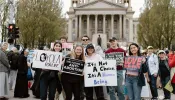
said Bishop Thomas Wenski in a statement prepared for last weekend’s
Save Darfur Rally.
The rally was
sponsored by the Save Darfur Coalition, an alliance of over 150
faith-based, humanitarian and human rights organizations on the
National Mall in Washington. Bishop Wenski is chairman of the bishops’
Committee on International Policy.
“Our country can
and must do more, much more, to defend and protect innocent civilians
in Darfur,” he said. “Anything else would be unworthy of us as a people
committed to human life and dignity.”
The U.S.
Catholic bishops welcome the Administration’s latest efforts to
strengthen the mission of the poorly funded, ill-equipped and
undermanned peacekeepers from the African Union who have sought to
bring some measure of protection to the helpless civilians of Darfur.
Since last year, the bishops have repeatedly urged passage of the
“Darfur Peace and Accountability Act.”
The U.S.
Conference of Catholic Bishops has advocated for several years on
behalf of the innocent victims of Darfur, who remain trapped in the
midst of violent clashes between the Sudanese army and rebel forces, as
well as subject to inhuman cruelty at the hands of the janjaweed
militia under the sponsorship of the government in Khartoum.
In addition to
the 400,000 people who have died since 2003, 2.5 million have been
driven from their homes and 3.5 million are at risk of starvation.
In early 2004,
Bishop John Ricard, then chairman of the Committee on International
Policy, warned that Darfur was “rapidly becoming the newest symbol of
human depravity and ethnic cleansing,” Bishop Wenski pointed out. Since
then, many well-intentioned attempts have been made to stop the
spiraling cycle of violence.
“As the security
situation deteriorates both in Darfur and across the border in
neighboring Chad, the delivery of humanitarian assistance to the 2.5
million who have fled their homes and the million more at risk of
starvation has become a daunting challenge to the international
community,” said the bishop.
Hong Kong’s Cardinal says Vatican should cut talks with China
, May 2, 2006 (CNA) - China’s
newly elevated Cardinal Joseph Zen has called for the Vatican to cut
talks with his country’s government in light of the state’s decision to
elevate Father Ma Yinglin to bishop on Sunday--something it did without
the Holy See’s approval.
According to the
Associated Press, Cardinal Zen said that the Chinese government also
plans to appoint Father Liu Xinhong to bishop of the eastern Anhui
province on Wednesday, despite the Vatican’s decision that Liu is not
qualified for the post.
In 1951, newly
communist China cut its ties with the Vatican, opting to form a
state-sanctioned Catholic church without the approval or oversight of
Rome. An underground Catholic Church--faithful to the Vatican--has also
formed since then which is now said to contain some 10 million members.
The two major
stumbling blocks to Holy See-China relations remain who has the
authority to appoint bishops--the state or the Vatican--as well as
China’s insistence that the Vatican halt its diplomatic relations with
Taiwan.
On Tuesday,
Cardinal Zen, who was appointed by the Vatican and an enthusiastic
supporter of renewed relations, told the South China Morning Post that
discussions "cannot continue because people will think [the Vatican is]
prepared to surrender. We cannot budge. When you brutally place such a
fait accompli, how can you call this dialogue?"
Leaders of the
state-sanctioned church and the government however, say they do not
believe that the Vatican will have an issue with the appointment of
Father Liu.
Church
vice-chairman Liu Bainian told Hong Kong broadcaster RTHK that "We
believe the pope will not disagree. We have not considered whether this
ordainment will bring negative consequences on Sino-Vatican relations."
The government likewise, defended their right to make appointments
without Holy See approval.
Cardinal Zen
however, has his doubts. He thinks that the government is less fully
behind the push to defy the Vatican than leaders of the state-run
church, who would lose their power if discussions were revived.
"I doubt that it comes from the top of the leadership," Zen said. "I don't think they would do such insensitive things."
Pope Benedict mourns death of influential Latin American Cardinal
Vatican City, May 2, 2006 (CNA) - Pope
Benedict XVI has expressed his personal condolences at the death of
Cardinal Raul Francisco Primatesta, Archbishop emeritus of Cordoba,
Argentina, a man who has been called a “living testimony to the social
doctrine of the Church.”
The Vatican
announced that the Holy Father has sent an official letter of
condolence to Archbishop Carlos Jose Nanez of Cordoba.
Upon learning of
the Cardinal’s death, the Pope wrote, “I offer my fervent prayers,
united to the faithful of that diocesan community and to those of San
Rafael, where Cardinal Primatesta previously exercised with
faithfulness his episcopal ministry, asking God to grant eternal rest
to he who, for so many years, was a diligent pastor.”
“Remembering his
selfless pastoral work that distinguished his episcopal service in that
nation,” the Holy Father continued, “working for the implication of the
doctrines of the Second Vatican Council and for the renewal of the
Church in faithfulness to Christ and toward the successor of Peter,” he
expressed his condolences and also extended his apostolic blessing to
participants in the funeral Mass “as a sign of Christian faith and hope
in the Risen Lord.”
Following his
retirement as Archbishop of Cordoba, Cardinal Primatesta became
President of the Commission for Social Concern of the Argentinean
Bishops' Conference.
As such, he was
a critical and highly respected social mediator, who prevented greater
conflict during the Argentinean Social crisis in the late 1990's.
Even in his
later years, he was frequently sought by political authorities and
social leaders for his advice in ways to avoid conflict. He was
regarded by Cardinal Jorge Bergoglio, Archbishop of Buenos Aires, as "a
living testimony of the Social Doctrine of the Church."
Vatican Social Scientists warn: no society can afford ‘vanishing youth’
Vatican City, May 2, 2006 (CNA) - Earlier
today, the Holy See’s Pontifical Academy of Social Sciences concluded
its 12th Plenary Session, discussing “Vanishing Youth? Solidarity with
Children and Young People in an age of Turbulence,” concluding that no
society can afford the loss of its young people, through neglect, abuse
or abortion.
During a press
conference this morning, the group said that the session included “over
30 presentations from scholars from every part of the world, meeting
for more than 30 hours over five days.”
Professor Mary
Ann Glendon, president of the Academy, said that the session’s “theme
is part of a multi-year project of the Academy which is examining the
broad implications of the demographic changes of the last few decades.
Two years ago, the Academy’s plenary session looked at the aging
population, with specific reference to social security and health
systems.”
Therefore, she
said “This year we looked at those same changes and their impact on
children and young people worldwide. This opens a new possibility for
Catholic social teaching, which to date has not focused as explicitly
on the situation of young people as it has, for example, on labor, or
women, or those living in poverty.”
The group, she
said discussed the dire situations many children of the world live in,
including those of neglect, abuse, oppression and sexual exploitation.
Among the
discussions, Professor Gérard-François Dumont, Rector of the University
of Paris-Sorbonne, recalled that while most of the world is familiar
with China’s one-child policy many of these one-child families are now
dominating Europe – “without government coercion.”
According to
Glendon, This, he said “involves a certain ‘refusal of the future’ that
will lead to a culture without brothers, sisters, aunts, uncles or
cousins.”
In his message
to the Academy, Pope Benedict wrote that "By nature, love looks to the
eternal…Perhaps the lack of such creative and forward-looking love is
the reason why many couples today choose not to marry, why so many
marriages fail, and why birth rates have significantly diminished."
Delegates also
discussed the discrepancies of children in some cultures who are forced
to grow up too quickly while others--mainly in the western
world--suffer from an “endless adolescence.”
The latter,
Glendon said, is “marked by an avoidance of responsibilities, a desire
to maintain all available options instead of permanent commitments, and
a refusal of moral limitations in the sphere of human sexuality, such a
syndrome makes it almost impossible for young people to assume the
enduring sacrifices on which stable marriages and families are built.”
"No society, no
culture", she concluded, "can afford to suffer a 'vanishing youth', for
with them would also vanish the real hope and noble ideals of every
nation".
Catholics respond to Da Vinci Code craze
Philadelphia, Pa., May 2, 2006 (CNA) - Several
books and resources have been developed by Catholics to set the record
straight about the false claims made about their faith in Dan Brown’s
bestselling fiction novel, The Da Vinci Code, the film version of which
will be released in theatres May 19.
The Catholic
Church has given its imprimatur to “The Da Vinci Deception: 100
Questions and Answers about the Facts and Fiction of The Da Vinci
Code,” published by Ascension Press.
The 144-page
book counters allegations made by The Da Vinci Code. An imprimatur is
an official declaration that a literary work is free from errors in
Catholic doctrine and morals. It was granted by Cardinal Justin Rigali,
archbishop of Philadelphia.
Carl Olson of
Eugene, Oregon has also written “The Da Vinci Hoax,” a 340-page,
heavily footnoted book that seeks to debunk many of Brown’s assertions
about Jesus, Mary Magdalene and the Catholic Church. Olson and his
co-author Sandra Miesel have been giving talks around the country to
mostly Catholic audiences.
In Malta, the
Catholic Church will issue a manual that responds to questions raised
by the novel in mid-May. The Institute of Pastoral Formation will
organize other events and initiatives on themes raised by the book.
Bishops of Bolivia criticize government for corruption, human rights abuses
La Paz, Bolivia, May 2, 2006 (CNA) - The
Bolivian bishops began their annual assembly last weekend with an
urgent call to the new government of Evo Morales to avoid reviving “the
same ways of acting that in the past produced death and suffering.”
In their
statement, which evaluates the annual state of the country, the bishops
criticized the government for using force and pressure to implement its
policies and for the lack of respect for human rights. They also
pointed out the contradictions between the statements and actions of
different government officials as reasons for “uncertainty and
confusion” in the country.
“It is dangerous
to think that the new Bolivia is going to be created by ignoring the
basic principles of respect for laws and agreements. Only through
interior change and renewal in each individual will we be able to
reverse this situation of inertia, desperation, slavery and death,” the
bishops stated, in response to the Bolivian government’s announcement
that it would review contracts with foreign businesses in the country
to give more power to the state.
Cardinal Julio
Terrazas, who read the statement, also mentioned the upcoming election
of a Constitutional Assembly, called for by President Morales, in order
to draft a new Bolivian constitution.
The cardinal
encouraged all Bolivians to participate in this initiative, but he
warned this would not be a magic solution to the problems facing the
country, such as poverty.
This was the
first time the bishops have publicly criticized the new government,
coming at a time when President Morales has been in Havana meeting with
Hugo Chavez of Venezuela and Fidel Castro.
Senator Byrd proposes constitutional prayer amendment
Washington D.C., May 2, 2006 (CNA) - For
the eighth time in 43 years, Sen. Robert Byrd (D—W.Va.) has proposed
that the U.S. Congress adopt a constitutional amendment allowing
voluntary prayer in public schools. Byrd introduced the amendment in
the U.S. Senate April 27.
"The importance
of prayer is recognized by people of faith in nearly all of the world's
religions," Byrd said, according to the Daily Mail newspaper. "Yet, in
America, prayer is increasingly barred from public life,” based on the
argument that it violates the First Amendment."
Byrd believes
the nation's courts pay too much attention to the clause in the First
Amendment that says, "Congress shall make no law respecting an
establishment of religion," and disregards the second part about
"prohibiting the free exercise thereof ..."
"I believe that,
in ruling after ruling, the U.S. courts have been moving perilously
close to prohibiting the free exercise of religion in America,” he
reportedly said.
Byrd said the
"ingrained predisposition" in the courts against religious or spiritual
expressions is contrary to the intent of the country's founding
fathers. Byrd discussed this point with Supreme Court Chief Justice
John Roberts.
"It seems to me
that any prohibition of voluntary prayer in school violates the right
of our school children to practice freely their religion," the senator
reportedly said. "Any child should be free to pray to God, of his or
her own volition, whether at home, in church or at school."
Byrd also said
that voluntary school prayer would help in "getting the country back on
the right track,” reported the Daily Mail.
The amendment
will go to the Senate Judiciary Committee for consideration. The
Supreme Court struck down prayer in schools in 1962.
Church leaders in U.K. call for 'living wage' reform
London, England, May 2, 2006 (CNA) - Cardinal
Cormac Murphy-O'Connor and other senior clerics joined trade union
leaders at a rally yesterday, on the fest of St. Joseph the Worker, in
calling for a living wage for workers in the United Kingdom, reported
24dash.com.
The rally, held
in the square of Westminster Cathedral, was preceded by a mass for
migrant workers in the cathedral church. It was attended by 2,000
people. The mass is the first of its kind and is organized with the
support of London Citizens, a community-based organization.
A “living wage”
is the minimum level necessary for a human standard of living. London
Mayor Ken Livingstone's Living Wage Unit has recommended a living wage
of £6.70 an hour in London compared with the current adult minimum wage
of £5.05 an hour, which will rise to £5.35 in October.
In recent years,
thousands of migrant workers from central and eastern European states
new to the European Union have come to London. These workers have been
credited with keeping inflation down, but they have suffered with low
pay and poor living standards.
The cardinal has
highlighted the plight of migrant workers and called on Catholic
parishes in the capital to welcome migrants whatever their legal status.
Catholic social
teaching states that as a matter of justice, human beings have a right
to work for a salary which will support them and their families.
Amid growing energy crisis, Guatemala cardinal says politicians should ride bus or walk to work
Guatemala City, Guatemala, May 2, 2006 (CNA) - In
response to the current energy crisis produced by climbing oil prices,
Cardinal Rodolfo Quezada Toruno of Guatemala said this week that
politicians should lead the way in living a simpler life.
The cardinal
said he supported President Oscar Berger’s announcement that the
country would change to daylight saving time and his call to conserve
energy by carpooling and walking more. “But politicians should
lead the way in living more austere,” he said, “by carpooling and
walking” to work. “If the president begins to walk as an example,
I’ll join him, because walking is also good for the heart,” the
cardinal joked.
He noted that
most Guatemalans use the public transportation system and consume
little energy due to poverty. “Our leaders are the ones who
should lead the way in living simply, in a visible way, so that
therefore our people are encouraged.”
‘Gospel of Judas’: an ideological attack against the Church, says Argentinean archbishop
Buenos Aires, Argentina, May 2, 2006 (CNA) - During
his television program, “Keys to a Better World,” Archbishop Hector
Aguer of La Plata, Argentina, said this week that the controversial
“gospel of Judas” is part of an “ideological attack” against the
Catholic faith and the Church.
“It seems
anti-Catholicism sells well, which shows there is also a commercial
venture at work” the archbishop said. “This is not because of the
dynamism of the market, nor is it by coincidence,” he warned. “It
is obvious that the commercial venture—the business—and the ideological
venture are very much connected, and we need to remember that and be
aware of all this.”
Archbishop Aguer
noted that the contents of the “gospel of Judas” “have been known for
at least 1800 years” and the text has always been considered part of
the apocryphal writings of “a Gnostic sect where Christian truths,
philosophical doctrines and, most especially, oriental mysteries were
all mixed together, and the Church condemned it rapidly.”
The Gnostic
ideology consisted of “an attack on the God of the Bible, with a strong
anti-Jewish tendency. Against all of this they exalted the supreme god
of the Gnostics and Judas was a key figure in the struggle against that
Biblical God who they considered a Semitic God,” the archbishop
explained.
“Now the ‘gospel
of Judas’ is presented as if it had just been discovered, when in
reality St. Iraneus of Lyon, in his work against the heresies in the
year 180, had already unmasked this false gospel,” he said in
conclusion.
Uruguayan bishops want country to avoid commercial conflict with Argentina
Montevideo, Uruguay, May 2, 2006 (CNA) - The
Bishops’ Conference of Uruguay has released a statement drafted at
their last general assembly in which they call for efforts to avoid a
commercial conflict with Argentina. The statement also announced a
meeting between a group of bishops from Uruguay, Paraguay, Argentina
and Brazil during the month of May.
The bishops
pointed out that “the conflict that today affects our country’s
relationship with Argentina caught the attention of the Assembly.
The bishops are very concerned about how this might immediately impact
the people, especially those who live on the coast, but also about the
future repercussions for relations between our two sister nations.”
Argentina and
Uruguay are currently in a dispute over the construction of two
cellulose plants which would bring in $1.8 billion in investments for
Uruguay. However, Argentina argues the plants would lead to an
ecological disaster in the Uruguay River, which runs between both
nations.
Both countries, together with Brazil and Paraguay, form a common market region known as the Mercosur, or southern market.
The bishops
announced that Church leaders from the four countries would meet in
Brazil at the end of May to discuss the issue.