Experts propose new study on Shroud of Turin
Madrid, Spain, May 5, 2006 (CNA) - During
the International Convention on the Holy Shroud of Turin, which took
place last Sunday at the Catholic University of Valencia in Spain, a
group of experts proposed a new scientific study be carried out on the
famous relic.
“We believe a
large amount of new data could be obtained,” said Bruno Barberis,
director of the International Shroud Center in Turin.
Barberis further suggested that an international team of experts could carry out the study.
The last
exhaustive study that was directly performed on the Shroud took place
in 1978. “We believe that with today’s technological advances we
could obtain important advances in the knowledge of how the image on
the cloth was formed, which continues to be a mystery for science,” he
added.
According to
Barberis, the proposal has already been presented to the Archbishop of
Turin, Cardinal Severino Poletto, “and now we are awaiting the decision
of the Holy See.”
The director of
the 1978 study, American doctor John Jackson, agrees with the idea and
said “it should take place through non-aggressive methods, which is
possible.”
More discoveries
During the
Convention, Jose Delfin Villalain, professor at the Catholic University
of Valencia, presented a study showing that the image of the man on the
Holy Shroud was produced between 4-6 hours after his death.
Speaking to the
Avan news agnency, Villalain said it was the most precise scientific
data that has been gathered to date about the moment in which the image
was produced on the cloth.
If it was, in
fact, the burial cloth of Christ, he said, “we could say that the image
of the Holy Shroud was formed between 7:30pm and 9:00pm, as the Gospel
text notes that the death of Jesus took place at 3:00pm.”
Likewise,
Villalain said during the Convention that “for the first time, what may
be images of internal organs” have been discovered on the Shroud.
The marks “correspond perfectly in their location and size” with the
heart, lungs, kidneys, liver and colon, he explained. The “quantity and
precision of the images is such that, although we cannot confirm it
with absolute certainty, we do believe they probably correspond to the
organs of the man of the Holy Shroud,” Villalain stated.
Humanitarian groups worried about Amnesty International’s wide-sweeping abortion initiative
Konigstein, Germany, May 5, 2006 (CNA) -
A
number of pro-life organizations, including the Catholic 'Aid to the
Church in Need' (ACN), have raised their voices against the
international human rights advocacy group, Amnesty International, and
its declared intention to spread abortion rights around the world.
On
Friday, Father Joaquin Alliende, ACN’s international ecclesiastical
assistant, said that it was “With great regret we have learned that
Amnesty International has proposed advancing abortion ‘rights’ around
the world as a new mission for their organization.”
The
main paper of AI's new Sexual & Reproductive Rights Consultation
Kit states that, "Governments have responsibilities to ensure that
everyone's sexual and reproductive rights are protected."
"No
one should be discriminated against”, it added, “when and if they
attempt to exercise their sexual and reproductive rights, or ask that
they be protected."
AI
is now calling for the global decriminalisation of abortion and say
that there should be widespread abortion on demand in cases involving
sexual assault or risk to a woman's life.
Fr.
Alliende, a Chilean priest, went on to explain: “AI has earned a high
reputation for its intensive efforts to gain the release of innocent
prisoners on conscience. ACN, a charity that is also often a ‘voice of
thevoiceless,’ highly appreciates this moral commitment of AI.”
However,
he said that “Now by proposing a pro-abortion initiative AI is
abandoning its own noble ethical principles, thereby shaking the very
foundations on which it is built; for the simple reason that unborn
life in a mother’swomb is the very weakest of all threatened and
persecuted human beings.”
“Thus”,
he said,“the day this initiative was launched will become a day of
mourning for all those who are unconditionally committed to true
humanism,” he concluded.
Amnesty
International’s current policy on abortion states that the group “takes
no position on whether or not women have a right to choose to terminate
unwanted pregnancies; there is no generally accepted right to abortion
in international human rights law.”
Catholic Church in Colorado scores victory as statutes of limitation bill crumbles
Denver, Colo., May 5, 2006 (CNA) -
The
Catholic Church in Colorado scored a hard-fought victory yesterday as
the state House of Representatives rejected a bill which many call
“blatantly anti-Catholic” in its effort to create an open season on
lawsuits against the Church over sexual abuse cases in which the
perpetrator may have died decades ago.
House
Bill 1090 has received a barrage of criticism, being called
anti-Catholic and being accused of placing unjust burdens on the Church
which do not exist on secular institutions like public schools.
The
bill, sponsored by senate president Joan Fitz-Gerald, passed the state
senate last week, but could not maintain its steam with sufficient
votes in the House.
The Church in
Colorado is maintaining its watchfulness however, as the Senate must
now give a response to the actions of the House.
Fitz-Gerald
had added a provision to temporarily lift the statutes of limitation,
allowing alleged victims to bring forth charges dating back to 1971.
A
major sticking point, say many Catholics, is that the bill is aimed
only at religious and private institutions--like the Church--while
leaving public entities all but immune.
At
one point, Fitz-Gerald went so far as to try to amend the bill to
include state institutions but ran into heavy opposition with insurance
companies saying they would not cover municipal governments for
lawsuits made on old claims.
In
his regular column this week, Denver’s Archbishop Charles Chaput wrote
that “The continuing effort of some lawmakers in the Colorado General
Assembly to burden the Catholic community with retroactive civil
liability for past sexual abuse cases is a textbook example of anger
posing as ‘justice.’”
HB
1090 was largely shaped using the template of a California law which
has financially crippled the Church there. Thursday’s move effectively
slows the tide of this model’s use against dioceses nationwide.
“The
people who pay for these damaging lawsuits”, Archbishop Chaput wrote,
“are …average, innocent Catholic families who had nothing to do with
the evil actions of some bad or mentally ill abusers 25, 35 or 45 years
ago.”
“No
one disputes the need for tough laws against the sexual abuse of
minors. And everyone — both inside and beyond the Church — agrees that
helping past victims of childhood sexual abuse to heal is a serious and
urgent need,” he said. “But suing the innocent today for sins and
crimes in the past is not justice.”
According
to the Denver Post, Timothy Dore, head of the Colorado Catholic
Conference called the defeat a clear “victory for our position.”
Pro-life groups question reliability of abortion report, point out contradictions
Washington D.C., May 5, 2006 (CNA) - The
U.S. bishops’ pro-life office and Concerned Women for America each
commented on the Guttmacher report issued yesterday, titled “Abortion
in Women’s Lives,” pointing out inherent contradictions and raising
questions about its reliability.
“The report
tries to maintain an impossible balancing act: claiming the goal of
reducing abortions, while at the same time calling for more aggressive
promotion of abortion services,” said Deirdre McQuade, director of
planning and information at the U.S. bishops’ Secretariat for Pro-Life
Activities.
And while the
report claims that widespread access to contraception leads to lower
abortion rates, the report’s own data show there is no correlation
between the two, McQuade said.
“States ranking
highest for access to contraceptive services, including California and
New York, also rank highest in abortion rates,” McQuade noted. “Others
that Guttmacher considers weak in contraceptive services, such as
Kansas and the Dakotas, have among the lowest abortion rates in the
country.”
“Those states
have reduced their abortion rates, in part, by choosing not to
subsidize abortion, and ensuring informed consent for women and
parental involvement for minors seeking abortions – policies which the
Guttmacher report demands be rescinded,” she explained.
According to
Concerned Women for America (CWA), the report also attempts to deny the
increasing evidence that abortion harms women physically and
psychologically.
“A study by
Guttmacher Institute on abortion should be taken with as much
seriousness as a tobacco industry study on nicotine,” said CWA
president Wendy Wright. “True to form, Guttmacher asserts that abortion
is safe, then claims abortion providers have the solution for reducing
what it says is harmless.”
According to
Wright, a New Zealand study of 500 girls from birth to age 25 found a
definitive link between abortion and depression.
“Clearly,
abortion carries numerous medical risks— even death, as we have seen
with the abortion pill RU-486,” she said, urging women and policymakers
to read the report and recognize the research that reveals abortion is
a dangerous medical risk.
The report also
asserts that a woman with an unintended pregnancy should have the right
to decide whether or not she is ‘ready’ to be a mother,” said Wright.
“The fact is she
already is a mother; the question is whether she will be the mother of
a living child or a dead child. It is absurd to suggest that a human
being’s life is not worthwhile or valuable because the woman did not
pre-plan her pregnancy,” she stated.
Pope Benedict thanks Swiss Guard for 500 years of ‘priceless’ service
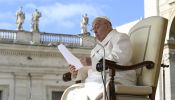
Vatican City, May 5, 2006 (CNA) - Following
a 720 kilometer trek from Switzerland to Rome, Pope Benedict XVI
thanked members of the Swiss Guard who had traced the historic route of
their predecessors 500 years ago to protect Pope Julius II and the
Catholic Church from its enemies.
The pilgrimage,
undertaken by past members of the Guard, is part of the Holy See’s
ceremonies celebrating fifth centenary of the group’s 1506 founding.
In his address
to former and current members of the Swiss Guard, Pope Benedict greeted
them in German, French and Italian, recalling the group’s ceremonial
entry into Rome.
"To greet you,"
said the Pope, "is the successor of Julius II, whose name is forever
linked to the Pontifical Swiss Guard. ... I congratulate you for this
wonderful initiative which reminds us of the valor of those 150 Swiss
citizens who, with great generosity, defended even unto death the
person of the reigning pontiff, writing with their sacrifice an
important page in the history of the Church."
He went on,
saying that "Considering these five centuries, we give thanks to God
for the good your predecessors have done, and for the priceless
contribution the Swiss Guard continues to make to the Holy See in our
own time."
Potential election of gay Episcopal bishop in California could have far-reaching consequences
San Francisco, Calif., May 5, 2006 (CNA) - Episcopalians
of the Diocese of California will vote for a new bishop this weekend,
but the results may create greater division among already-tense
churches in the worldwide Anglican Communion.
On Saturday,
about 700 priests and lay people will gather for a diocesan convention
at Grace Cathedral in San Francisco to elect a new bishop to replace
the retiring Rev. William Swing.
Three of the
seven candidates are openly gay, and choosing one of them to head the
diocese would further alienate some Episcopal members, reported the
Associated Press.
Among the
candidates they'll consider will be two gay men - the Rev. Canon
Michael Barlowe of San Francisco, and the Very Rev. Robert Taylor of
Seattle - and a lesbian, the Rev. Bonnie Perry of Chicago. All three
live openly with same-sex partners.
The four other
candidates are: the Rt. Rev. Mark Handley Andrus of Birmingham, Ala.;
the Rev. Jane Gould of Lynn, Mass.; the Rev. Donald Schell of San
Francisco; and Canon Eugene Taylor Sutton of Washington National
Cathedral.
The Anglican
Communion, with its 77 million followers in 164 countries, has been
torn over the issue of gay clergy for years. It became particularly
pronounced in 2003, when New Hampshire Episcopalians elected the Rev.
V. Gene Robinson, who has a longtime male partner, as their bishop.
Canon Bill
Atwood of the Ekklesia Society, an Episcopal aid network based in
Carrollton, Texas, told the AP that Californians will likely ignore the
consequences of their actions on the worldwide communion and vote
according to “a mistaken understanding of justice issues.”
Members will
vote until one of the candidates gets a simple majority. If there is no
winner, another voting exercise will be held May 13.
The winner
cannot be consecrated without approval from the Episcopal church's
legislative body, the General Convention, which meets in June.
Relics of six Mexican saints visit Denver
Denver, Colo., May 5, 2006 (CNA) - A
silver cross containing the relics of six Mexican priests martyred in
the 1920s will be on display at Denver’s Cathedral of the Immaculate
Conception for public veneration from May 5-7. Colorado is one of just
eight states to which the relics of these six Mexican priests are
traveling.
The reliquary will be exposed starting with 5:30 p.m. Mass on May 5 until Sunday.
All six of the
martyrs were declared saints by Pope John Paul II in 2000. In addition,
all of them were members of the Knights of Columbus.
The tour aims to
build awareness of all those who sacrificed their lives for the
Catholic faith during the Mexican persecution of the 1920s. During that
time of oppression, the Church was forbidden to own property, Catholic
seminaries and schools were closed, and priests and laity were told to
publicly denounce their faith or risk death.
Not coincidentally, the start of the visit coincides with the Mexican celebration of Cinco de Mayo.
The stories of these saints are available at www.kofc.org/relics.
Main aim of mission groups is to bend down, like good Samaritans, over our brothers’ needs, says Cardinal Sepe
Rome, Italy, May 5, 2006 (CNA) - Cardinal
Crescenzio Sepe, Prefect of the Vatican’s Congregation for the
Evangelization of Peoples yesterday addressed the national Directors of
the Pontifical Mission Societies (PMS) gathered in Rome for their
ordinary General Assembly. He stressed that “Our missionary activity is
the effort we put in our work to make people know that God is love.”
“It is our main
mission as National Directors of the Pontifical Mission Societies,” he
said, “to bend down, like good Samaritans, over our brothers’
necessities, especially over the poor and the needy.”
Referring to new
statutes passed by the PMS, he said that “Today we have a clear and
adequate text to face the many problems and challenges rising from the
present missionary situation in the world. The Pontifical nature of the
PMS is therefore “the expression of their specific ecclesial nature: as
soon as this aspect started to become clear in their path, the
Societies began to enrich their structure.”
Speaking on the
mutual exchange of gifts within churches, which characterizes the
Catholic communion, the prefect stressed that “we must make sure that
the gifts that the Churches share abolish the superiority of the ones
who give and the inferiority of the ones who receive. They must
consider account of the real needs of the Churches and their lives.”
“In this
spirit”, he continued, “all must embark upon a brotherly dialogue,
which needs to be seen as a high form of co-responsibility.”
“I invite you”,
Cardinal Sepe told the group, “to make a special effort to prepare
yourselves gradually for the next 80th World Day of Mission, which will
take place on October 22 and
I am happy
to inform you that the Holy Father has transmitted, a few days ago, his
message for this World Day of Missions, which theme will be “Charity,
the soul of mission.”
The cardinal
concluded his address quoting Pope Benedict XVI’s message:
“Mission, in deed, if not guided by charity, if it doesn’t arise as a
profound act of divine love, takes the risk of becoming a mere
philantropic or social activity. The love that God nurtures for each
person, is in fact the heart of the announcing the Gospel. “
“Our missionary
activity is the effort we put in our work to make known that God is
Love. To be a missionary”, wrote the Pope, “means to love God with ones
whole being, and to give ones life for Him, if necessary. How many
priests, religious and lay, have given, in our time as well, the
supreme testimony of Love as martyrs!”
European Union Bishops encourage politicians, citizens to create framework for just society in Europe
Brussels, Belgium, May 5, 2006 (CNA) - The
Conference of European Union Bishops (COMECE) Executive Committee has
issued a statement ahead of Europe Day (May 9, 2006) in which they
welcome reflection on the future of Europe as well as positive
initiatives of the European Commission but warm that debates must
continue in the determination of Europe’s identity.
The executive
committee of the COMECE includes President Bishop Adrianus van Luyn
SDB, Bishop of Rotterdam, Netherlands, Archbishop Diarmuid Martin,
Archbishop of Dublin, Ireland (Vice-President) and Auxiliary Bishop
Piotr Jarecki, Auxiliary Bishop of Wasaw (Vice-President).
In welcoming the
initiatives to reflect upon the future of the European Union, the
COMECE Executive Committee highlights that “at present the European
Commission’s proposals are not sufficient to actually revive the debate
on the future of Europe particularly in light of the indifference
demonstrated by many citizens and politicians towards the European
Union (EU).”
They call upon
those responsible for Member States and European institutions to turn
their attention to the problems of Europe with renewed energy and to
establish a workable framework for the European Union to facilitate the
building of a more just society.
In their
statement, released Friday, the bishops observe that the European Union
must place the human being and its inalienable dignity at the heart of
its efforts to build a just society. They also identify the need for
greater account to be taken of the Christian faith and the ethical
convictions of many people in Europe, while maintaining a corresponding
regard for other faiths and beliefs.
“It is vital”,
they wrote, “that our leaders concentrate on shaping better and more
democratic structures. Reform of the EU’s current treaties would play a
major role in resolving some of the major challenges confronting the EU
in particular in economic and foreign policy.”
The
Bishops are convinced that necessary reforms can be achieved through
the Treaty Establishing a Constitution for Europe. The debate on the
future of Europe should therefore concentrate on the Constitutional
Treaty so as to facilitate ratification of the treaty in all the Member
States and establish a uniform political and legal framework for the
European Union, they say.
The Bishops
likewise emphasized that the Church is prepared to make its own special
contribution to shaping a just society in Europe. It is, however, the
citizens and in particular, the politicians, who bear responsibility
for building such a society.
The Bishops
encouraged all citizens and politicians “to face up to this
responsibility with renewed energy and to advance the building of a
just society in Europe.”
COMECE is a
Commission of the Catholic Bishops’ Conferences of the member states of
the European Union. The Bishops’ Conferences of Bulgaria, Croatia and
Romania have observer status.
Mexican bishops call for efforts to reduce emigration
Mexico City, Mexico, May 5, 2006 (CNA) - In
a statement released at the conclusion of their recent 81st Plenary
Assembly, the Bishops’ Conference of Mexico has exhorted the country’s
presidential candidates to “strengthen our democratic life” and to
introduce “urgent social changes” that will reduce its own citizen’s
need to emigrate to other countries.
In an historic
first during the gathering, the bishops met with several government
officials and with presidential candidates Roberto Madrazo, Andres
Lopez Obrador and Felipe Calderon.
“This allowed us
to learn about their proposals and present them the concerns which we
as citizens and pastors have regarding the future of our country,” the
statement indicated. Among the concerns mentioned by the bishops
were “the defense of life and of human rights, the family, education,
religious freedom, increased employment, the fight against poverty and
corruption.”
Regarding
immigration laws that are currently being debated in the U.S. Congress,
the bishops said the measures have “awakened consciences” and led to
“solidarity” with immigrants. “We exhort all to join in this
spirit of solidarity and to come up with initiatives that appropriately
reconcile the sovereignty of states with the respect for the dignity of
the person,” the bishops stated.
Lastly, the
bishops pointed out that Mexico’s next president would have to meet the
challenge of “carrying out urgent social changes” so that “Mexicans do
not feel they have to abandon the country.”
Indian Bishops call for peace after Muslim shrine is razed
New Dehli, India, May 5, 2006 (CNA) - The
Catholic Bishops’ Conference of India on Wednesday condemned the
continuing violence in the city of Vadodara and said the outbreak of
riots is a setback to the healing process that had begun in India’s
western state of Gujarat.
In a press
statement, Archbishop Stanislaus Fernandes said the Catholic Church in
India is “saddened by the violence in Vadodara,” reported ICNS, the
Indian bishops’ news site.
Five people were
killed and dozens injured in clashes in the walled city over the
demolition of a dargah, a Muslim shrine built above the grave of a
well-respected religious person. On Wednesday morning, a 32-year-old
man was burnt alive by a crowd of 1,500 people.
The trouble
started when the Vadodara Municipal Corporation squad started
demolishing the 200-year-old dargah and locals of the area began
shouting slogans and later attacked officials involved in the
demolition.
Police said
people of the minority community had requested the authorities and city
mayor Sunil Solanki not to demolish the dargah, due to its historic and
sentimental value to citizens. They demanded that the dargah be
declared a heritage site.
However, the largely Hindu squad went ahead with its demolition as the structure was obstructing traffic, police said.
People from two
groups started pelting stones at each other and set on fire four shops,
officials said. Police fired at least 10 rounds and lobbed more than 30
tear gas shells to disperse the violent mob.
In their press
statement, the bishops also appealed to all groups to promote
reconciliation and peace processes and not to provoke harmful religious
sentiments.
“It is
unfortunate that the razing to the ground of a holy shrine, symbol of
peace and harmony, should also bring crumbling down the fragile edifice
of trust and harmony that was surfacing in this communally-sensitive
state,” Archbishop Fernandez said.
Traveling WYD Cross damaged in Senegal
Rome, Italy, May 5, 2006 (CNA) - The
official World Youth Day Cross, which is currently visiting countries
in Africa on its way to Sydney for next World Youth Day celebration to
be held in 2008, was damaged in Senegal when the vehicle that was
carrying it was involved in an accident.
According to the
Kath.net agency, the cross arrived in Dakar on Holy Tuesday. The
National Director of the Pontifical Missionary Works, Father Giuseppe
Giordano, said that the presence of the WYD pilgrim cross had
“strengthened the faith” of Catholics in the area, who are a minority
amidst a large Muslim population.
As the cross was
being transported to other cities, the small bus that was on was
involved in an accident. Some passengers in the bus also suffered
slight injuries but were immediately treated and released. Local
artisans quickly repaired the cross.
The cross was
then taken to the Catholic mission at Koumpountum, where according to
Father Giordano, “Catholics are a small minority. The arrival of
the cross was a wonderful opportunity to reinforce in us Catholics the
sense of belonging to the universal Church. Even some Muslims
wanted to come and see the WYD cross,” he said.
Afterwards the
cross leaves Senegal, it will visit numerous other countries in Africa
including Ghana, Nigeria, Burundi, Rwanda among others before arriving
in Australia.
Remains of priest kidnapped by revolutionaries found in Colombia
Bogotá, Colombia, May 5, 2006 (CNA) - Authorities
this week said DNA tests have revealed that human remains discovered
near the San Juan River in northwestern Colombia are those of Father
Javier Francisco Montoya, who was kidnapped on November 21, 2004 by the
Revolutionary Forces of Colombia (FARC).
Father Montoya, who was 45 at the time, was kidnapped by FARC in the town of Alto de Tamana in the northwest region of Choco.
At the time of
the kidnapping, Father Montoya was preparing to celebrate the feast of
the Immaculate Conception. FARC later announced that Father
Montoya had been shot and that his body would not be returned because
it had been buried.
Nevertheless,
Bishop Alonso Llano Ruiz of Istmina-Tado, said he received a phone call
on April 24 informing him that human remains, along with some clothes
and a crucifix, had been found near the San Juan River.
Another priest, Father Cesar Dario Peña, was also kidnapped by the FARC in 2004. His fate remains unknown.