

Loading
Archbishop Conti: Secularism threatens ‘fundamental rupture’ in Scottish society
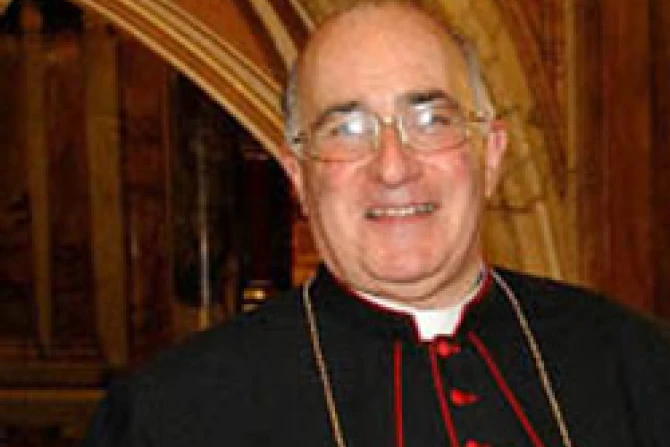
Archbishop Mario Conti.

.- Speaking in a recent homily, Archbishop of Glasgow Mario Conti discussed the anniversary of the Protestant Reformation in Scotland and the place of the Church in modern society. He warned against a looming “fundamental rupture” in efforts to eliminate faith from public discourse.

His remarks came in his homily at a Mass marking the anniversary of Pope Benedict XVI’s election to the papacy.

The Mass was celebrated in the presence of the Apostolic Nuncio to Scotland and the Scottish hierarchy at St Mary’s Church, the second oldest archdiocesan chruch, because the Cathedral of St. Andrew is under restoration efforts.

According to Archbishop Conti, the year 2010 marks the 450th anniversary of the Reformation Parliament, which in 1560 banned the Mass, prohibited recourse to Rome and published a new profession of faith based on the Protestant reformers.
Any hesitation about marking this anniversary, the archbishop said, is because of a “different” and “irenical” spirit in the ecumenical movement.

He cited Pope Benedict’s comments to the bishops of Scotland in their February meeting, where the Pope spoke of the “tragedy of division.”

“It is sobering to recall the great rupture with Scotland’s Catholic past that occurred four hundred and fifty years ago,” the pontiff continued. “I give thanks to God for the progress that has been made in healing the wounds that were the legacy of that period.”

Archbishop Conti said Christians may look forward to the healing of the Reformation’s “rupture,” but many fear a new rupture more fundamental “even than that of the Reformation.”

“I am referring to attempts to eliminate the voice of faith from public discourse, in other words a rupture between the Church, faith communities and the world of politics and public policy.”

He mentioned issues like breakdown in marriage and family life; increasing abortions; growing rates of teenage pregnancy and sexually transmitted diseases; drug addiction and alcoholism, especially among the young; a form of “social engineering” which “virtually equates civil partnerships with marriage;” assisted suicide; inhumane treatment of immigrants; and insufficiently restrained bio-technical research.

“All of these issues carry an ethical question,” the archbishop explained.

“We need to praise integrity where we see it, and also acknowledge the courage of politicians who do raise their voices in defense of the Church’s role and who promote publicly, despite secularist criticism, the fundamental place of marriage and the family and the general duty of citizens to care for one another, physically, socially and spiritually.

“The Church is the repository of the most fundamental values of our civilization and deserves recognition as an instrument of societal cohesion. Its voice is not that of a pressure group, one among many, but rather that of a teacher,” he continued.

He said Catholic doctrine should not be perceived as a series of prohibitions and “retrograde” positions, but rather as “creative and life-giving” and directed towards “the fullest possible realization of the great potential for good and happiness that God has implanted within every one of us.”

“It is that potential for good which our political leaders must identify and release,” Archbishop Conti advised.

The prelate cited Ezekiel 37’s story of the prophet Ezekiel and the valley full of bones. He also noted the Gospel story of the raising of Lazarus from the dead, in which Jesus tells people to unbind the risen Lazarus and “let him go free.”

Concluding his homily, the archbishop asked if these accounts are applicable to a Church “needing to be set free to live fully according to its principles, permitted to inspire the body politic.”

“Or is it the body-politic, bound with ‘bands of stuff’ and ‘a cloth around its face’ constrained by political dogma and unable ‘to see life whole’?

“Perhaps both ... Jesus says: ‘Unbind them. Let them go free!’”

* The number of messages that can be online is limited. CNA reserves the right to edit messages for content and tone. Comments and opinions expressed by users do not necessarily reflect the opinions or beliefs of CNA. CNA will not publish comments with abusive language, insults or links to other pages

RESOURCES »

Featured Videos

Actor admires Mexican martyr's strong defense of the faith
First video game about Jesus launches on Facebook
Vandals strike historic Santa Cruz church
EU accused of funding abortion with development money
Brent Dusing's advice to Internet Evangelists
Creator of Bible-based Facebook game lauds internet evangelism
Sacrifice of Titanic's Catholic priests recalled on 100th anniversary
Benedict XVI visits the Shrine of the Virgin of Cobre and meets President Raul Castro
Vestments for Pope's Mass in Cuba arrive with love from Peru
Pope Benedict XVI in Antonio Maceo Square in Santiago de Cuba
Benedict XVI meets with President Calderon and Mexican children
Americans speak up for religious freedom at nationwide rallies
Neighborhood rallies against plan to build strip club near convent
Pope's first Mexican address offers encouragement to faithful
Arrival of  Pope Benedict XVI  to Mexico
Pope offers his blessing to handicapped children in Mexico
Texas bishops hear call to unity at St. Peter's tomb
Interview with Br. Guy Consolmagno
Indiana Catholics respond to 'devastating' storm damage
Interview with Eric Scheidler, Executive Director of the Pro-life Action League
May
21

Liturgical Calendar

May 21, 2012

Monday of the Seventh Week of Easter

All readings:
Today »
This year »

Catholic Daily

Gospel of the Day

Jn 16,29-33

Gospel
Date
05/21/12
05/20/12
05/19/12

Daily Readings


First Reading:: Acts 19:1-8
Gospel:: Jn 16:29-33

Homily of the Day

Jn 16,29-33

Homily
Date
05/21/12
05/20/12
05/19/12
     HTML
Text only
Headlines
  

Follow us: