

Loading
Egyptian Christians worry about possible radical Islamic takeover
By Benjamin Mann
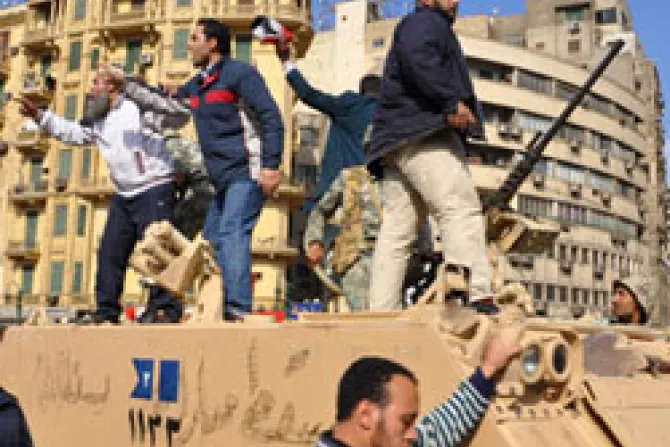
Protesters in Tahrir Square, Egypt. Photo Credit: Floris Van Cauwelaert

.- Protesters flooded the streets of Cairo on Feb. 4, aiming to make the tenth day of Egypt's popular uprising into the “day of departure” for President Hosni Mubarak. As the U.S. urges Mubarak to step down, Egyptian Christians worry that radical Islamic ideology may fill a void left by his absence.

Issam Bishara, Vice President for Pontifical Mission activities in Egypt, detailed the concerns of Coptic Orthodox and Catholic Christians in a Feb. 3 report provided to CNA by the Catholic Near East Welfare Association.

“Though some of the primary opposition leaders in this revolt appear to be modern secular reformers, church leaders believe the main engine fueling and organizing the demonstrators is the Muslim Brotherhood,” Bishara wrote. “They fear that the brotherhood intends to seize power through future elections, compromising all patriotic and ideological parties participating in the protests.”

The head of the Coptic Orthodox Church, Pope Shenouda III, has maintained his support for the Mubarak regime, and urged Coptic Orthodox Christians not to join the street protests. The Coptic Orthodox patriarch, whose church claims 95 percent of Egypt's Christians, has instead advocated a program of internal reforms.
So far, most of the demonstrators opposing President Mubarak have kept religion out of the picture. However, the prominent role of the Muslim Brotherhood – considered to be the best-organized opposition to Mubarak's National Democratic Party – is causing concern among Egyptian Christians.
The group's stated aim is to make Islam the “sole reference point” for Egypt's government and society.

“Coptic Christians — as well as Egypt’s Armenian, Greek Orthodox, Latin, Maronite and Melkite Greek Catholics — all fear a fate similar to that of Iraq’s Christians,” Bishara stated, recalling how a power vacuum in that country “left its minorities, especially the Christians, marginalized and exposed to the terror of Islamic extremists and criminals.”

Anxiety was already running high among Egyptian Christians, after a Jan. 1 church bombing that killed or injured more than a hundred worshipers. On Jan. 24 – one day before protests broke out against President Mubarak – a report by Human Rights Watch detailed “widespread discrimination” against Christians, who comprise about 10 percent of the 90-percent Muslim nation.

The Muslim Brotherhood officially describes itself as a non-violent movement, and has stated its commitment to democracy. But the brotherhood's connections within the Arab world have caused many to question its professions of peace. Its historical role as the source or inspiration for virtually every radical Islamic political movement now in existence is well-established.

Nina Shea, an international human rights lawyer who directs the Hudson Institute's Center for Religious Freedom in Washington, D.C., urged Westerners to regard the Muslim Brotherhood with extreme caution – both on account of the group's history, and because of the recent trend toward radicalization in Egyptian religious culture at large.

“The Muslim Brotherhood started off in Egypt, during the 1920s, with violent tendencies and violent tactics,” Shea recounted. “It shifted those tactics, as it was repressed, to moderate ones. In other places where it flourished – like in Gaza, or Sudan – it's been anything but moderate.”

“They're very tactically-minded,” she acknowledged. “In the short term, for tactical reasons, I would expect them to be moderate. But in the medium-term, they would revert to their roots” – including their core principle of imposing Islamic law throughout Egypt.

Westerners who choose to support the protesters unreservedly are playing “high-stakes poker,” Shea said – and should take into account that no popular uprising in the Middle East has ever resulted in a more democratic or pluralistic system of government.

“There are no precedents for it,” Shea said. “On the other hand, there is the precedent of Iran” – where the 1979 populist revolt, against a U.S.-backed authoritarian leader, ended with his replacement by the Ayatollah Khomeini and the nationwide institution of Islamic law.

In the event of a takeover by the Muslim Brotherhood, she said, Christians could expect to live as “dhimmis,” a traditional Islamic designation that strips non-Muslims of many legal protections.

In this arrangement, Shea explained, the government does not need to terrorize Christians at any official level. Rather, officials can simply ignore, or even tacitly permit, religiously-motivated violence and repression by other segments of society.

About two-thirds of Christians in the Middle East now live in Egypt. For this reason alone, Shea said, a takeover by the Muslim Brotherhood could have drastic consequences for Christians throughout the region.

“We could see the virtual end of Christianity's native presence in the Middle East, faster than anyone thought, if they come to power.”

* The number of messages that can be online is limited. CNA reserves the right to edit messages for content and tone. Comments and opinions expressed by users do not necessarily reflect the opinions or beliefs of CNA. CNA will not publish comments with abusive language, insults or links to other pages

RESOURCES »

Featured Videos

Group launches tour to end abortion in Canada
Actor admires Mexican martyr's strong defense of the faith
First video game about Jesus launches on Facebook
Vandals strike historic Santa Cruz church
EU accused of funding abortion with development money
Brent Dusing's advice to Internet Evangelists
Creator of Bible-based Facebook game lauds internet evangelism
Sacrifice of Titanic's Catholic priests recalled on 100th anniversary
Benedict XVI visits the Shrine of the Virgin of Cobre and meets President Raul Castro
Vestments for Pope's Mass in Cuba arrive with love from Peru
Pope Benedict XVI in Antonio Maceo Square in Santiago de Cuba
Benedict XVI meets with President Calderon and Mexican children
Americans speak up for religious freedom at nationwide rallies
Neighborhood rallies against plan to build strip club near convent
Pope's first Mexican address offers encouragement to faithful
Arrival of  Pope Benedict XVI  to Mexico
Pope offers his blessing to handicapped children in Mexico
Texas bishops hear call to unity at St. Peter's tomb
Interview with Br. Guy Consolmagno
Indiana Catholics respond to 'devastating' storm damage
May
24

Liturgical Calendar

May 24, 2012

Thursday of the Seventh Week of Easter

All readings:
Today »
This year »

Catholic Daily

Gospel of the Day

Jn 17,20-26

Gospel
Date
05/24/12
05/23/12
05/22/12

Daily Readings


First Reading:: Acts 22:30; 23:6-11
Gospel:: Jn 17:20-26

Homily of the Day

Jn 17,20-26

Homily
Date
05/24/12
05/23/12
05/22/12
     HTML
Text only
Headlines
  

Follow us: