

Loading
European court says crucifixes can remain in Italian schools (Updated)
By Benjamin Mann
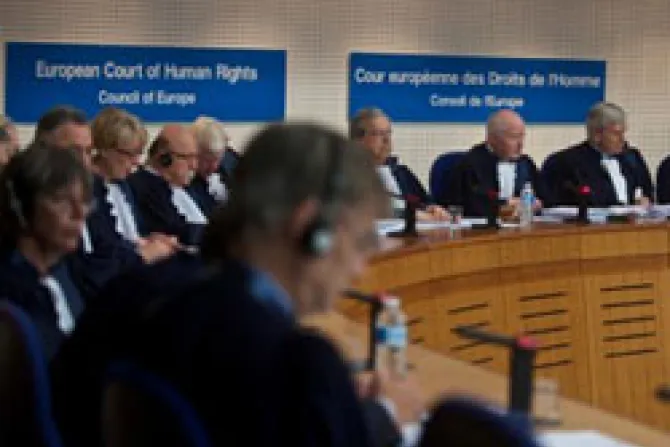
The Grand Chamber of the European Court of Human Rights issues its ruling. Credit: Council of Europe

.- Updated on March 18, 2011 at 4:26 p.m. MST.

The European Court of Human Rights has ruled that Italian public schools can continue to display crucifixes in classrooms, providing a final resolution to a case that had sparked concern about aggressive secularism on the continent.

The new ruling overturns an earlier judgment by a lower chamber of the same court, which declared in 2009 that the crosses violated students' human rights and represented a form of religious discrimination.

Seventeen judges of the Grand Chamber gave the 15-2 ruling on March 18, holding that there had been “no violation of Article 2 of Protocol No. 1 (right to education) to the European Convention on Human Rights.” The protocol requires that state schools “shall respect the right of parents to ensure … education and teaching in conformity with their own religions and philosophical convictions.”

In 2009, a lower chamber ruled that the crucifixes violated that protocol, as well as another provision guaranteeing “freedom of thought, conscience, and religion.” The court's new ruling also dismissed the challenge based on that statute.

The decision, which cannot be appealed within the European system, concludes a five-year legal battle that began in 2006. An Italian mother of two non-Catholic students had complained to the court that the crucifix displays were a form of involuntary religious indoctrination.

In a summary of the Grand Chamber's March 18 ruling, Court Registrar Erik Fribergh explained that the judges had found “nothing to suggest that the authorities were intolerant of pupils who believed in other religions, were non-believers or who held non-religious philosophical convictions.”

The registrar noted that the mother who brought the complaint on behalf of her children, had never cited any actual instances of religious indoctrination.

“The applicants had not asserted that the presence of the crucifix in classrooms had encouraged the development of teaching practices with a proselytising tendency,” Fribergh stated. Nor had she claimed that either of her children “had ever experienced a tendentious reference to the crucifix by a teacher.”

European Christians, however, may be surprised by at least one aspect of the judgment – in which the judges observed that the crucifixes may have little effect upon students.

“While the crucifix was above all a religious symbol,” wrote the registrar, “there was no evidence before the Court that the display of such a symbol on classroom walls might have an influence on pupils.”

But the Bishops' Conference of the European Community, in their joint response, stressed that the cross was not about to lose its significance for Europeans.

“The crucifix symbolizes the crucifixion and resurrection of Jesus Christ,” they wrote, giving their approval of the ruling. “Christians from all denominations therefore see in the cross the symbol of God’s comprehensive love for all mankind.”

“To believers from other religions and even to non-believers, the cross can be valued as a symbol for non-violence and resistance to retaliation,” the noted. “Its public display reminds all human beings of the respect for human dignity, a principle from which all fundamental rights are derived.”

The president of the European bishops' conference, Cardinal Peter Erdo, hailed the definitive ruling as “a sign of common sense, wisdom and freedom.”

“Today a page of history has been written,” he announced. “New hope has been given not just to Christians, but to all European citizens, believers and secularists, who were deeply offended by the ruling of November 3, 2009.”

“To consider the presence of the crucifix in a public space to be against human rights, would be to deny the very idea of Europe,” he observed.

“Without the crucifix, the Europe we know today would not exist.”

* The number of messages that can be online is limited. CNA reserves the right to edit messages for content and tone. Comments and opinions expressed by users do not necessarily reflect the opinions or beliefs of CNA. CNA will not publish comments with abusive language, insults or links to other pages

RESOURCES »

Featured Videos

Group launches tour to end abortion in Canada
Actor admires Mexican martyr's strong defense of the faith
First video game about Jesus launches on Facebook
Vandals strike historic Santa Cruz church
EU accused of funding abortion with development money
Brent Dusing's advice to Internet Evangelists
Creator of Bible-based Facebook game lauds internet evangelism
Sacrifice of Titanic's Catholic priests recalled on 100th anniversary
Benedict XVI visits the Shrine of the Virgin of Cobre and meets President Raul Castro
Vestments for Pope's Mass in Cuba arrive with love from Peru
Pope Benedict XVI in Antonio Maceo Square in Santiago de Cuba
Benedict XVI meets with President Calderon and Mexican children
Americans speak up for religious freedom at nationwide rallies
Neighborhood rallies against plan to build strip club near convent
Pope's first Mexican address offers encouragement to faithful
Arrival of  Pope Benedict XVI  to Mexico
Pope offers his blessing to handicapped children in Mexico
Texas bishops hear call to unity at St. Peter's tomb
Interview with Br. Guy Consolmagno
Indiana Catholics respond to 'devastating' storm damage
May
24

Liturgical Calendar

May 24, 2012

Thursday of the Seventh Week of Easter

All readings:
Today »
This year »

Catholic Daily

Gospel of the Day

Jn 17,20-26

Gospel
Date
05/24/12
05/23/12
05/22/12

Daily Readings


First Reading:: Acts 22:30; 23:6-11
Gospel:: Jn 17:20-26

Homily of the Day

Jn 17,20-26

Homily
Date
05/24/12
05/23/12
05/22/12
     HTML
Text only
Headlines
  

Follow us: