

Loading
Expert downplays Vatican council’s idea for financial body
By David Kerr
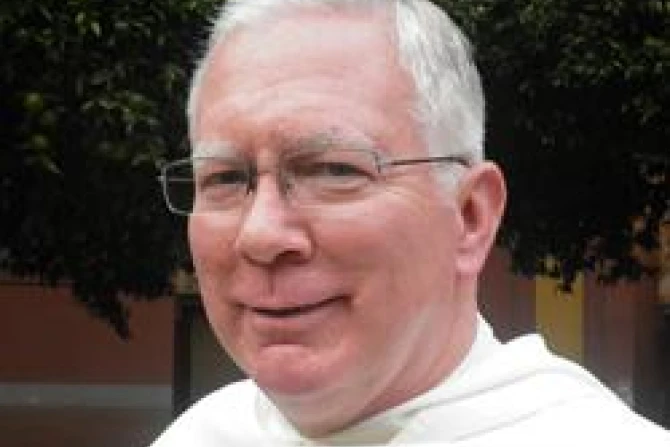
Fr. Robert Christian, OP.

.- After the Pontifical Council for Justice and Peace made headlines this week by issuing a document advocating the creation of a global financial body, one expert in Vatican documents downplayed its authority and said that it is only meant to spur reflection.
 
“I’d say if it calls itself ‘a note,’” Father Robert Christian, O.P., told CNA Oct. 26, “it is simply a meant to prompt the consciences of people as they ponder issues that seem to be of importance to the Universal Church.”

“So you’d say this is not something that is meant to bind consciences but is meant to stimulate consciences to reflection.”

Fr. Christian is Vice Dean of Theology at the Dominican Pontifical University of Saint Thomas Aquinas in Rome, also known as the Angelicum. He is a long-standing expert in interpreting “Vatican documents,” not all of which, he said, carry the same weight.

“There is a ranking of papal and Vatican documents that you can figure out if you look at the index of the ‘Acta Apostolicae Sedis,’ as it lists the documents in a rank from the most important to the least important.”
 
The “Acta Apostolicae Sedis” (Acts of the Apostolic See) is an annual publication dating back over 150 years. It contains the main public documents of the Pope and the Roman Curia. Fr. Christian describes it as “the Vatican’s own ranking of the relative solemnity of different teachings,” and he kindly took CNA down to the vast library vaults of the Angelicum University to explain his point.
“So we’re looking at the 1950 volume,” he said, opening the thick red volume and reading down the page. It “shows the dogmatic definition of the Assumption of Mary at the very top – that’s what’s known as a ‘Bulla Dogmatica’ – then the Encyclical ‘Humanae Generis’ and then onto lower level documents such as apostolic constitutions and so on.”

Fr. Christian explained that there is a “a hierarchy of documents,” and also a hierarchy of bodies within the Roman Curia. Inside of the Curia, “congregations” are more significant than “pontifical councils,” which means that “in terms of pastoral authority the Secretariat of State is top and in terms of doctrinal authority the Congregation for the Doctrine of the Faith is top.”

Another factor, he said, to take into consideration when assessing the significance of a “Vatican document” is whether it has been “reviewed by the Holy Father himself,” and also the number of Vatican departments involved in its creation.

He lamented that “unfortunately, the Church herself hasn’t actually explained that hierarchy very well.” Thus, he believes, it can be confusing for Catholics to understand what significance to give to different publications emanating from bodies within the Vatican.

As for this week’s document from the Pontifical Council for Justice and Peace, Fr. Christian has only read some of it but his initial analysis is that while it is appropriate for Vatican departments to speak out as part of the Church’s “social mission” they also have to be wary of straying beyond the limits of their competence.
 
“Is it the Church’s place to decry systems that seem to infringe on the dignity of peoples or to applaud those areas which seem to promote human dignity? Yes,” he said firmly.

“But is it the Church’s role to hypothesis concrete solutions to these things? Normally we would say ‘no.’ That’s what makes me a little nervous about a document which it seems may be promoting something rather more concrete than usual.”

He explained that such hands-on, practical decisions are termed “contingent realities” and held up Pope John Paul II’s social encyclical “Centesimus Annus” as a good example of how the Church usually approaches such matters.

In the 1991 document, he said, Pope John Paul “decried the excesses” of both state socialism and unbridled capitalism so that “we could see the correctness of the principle.”

But “the Pope didn’t hazard an idea of what concrete steps should be made because that’s really what politics is supposed to do. They are supposed to work on the basis of principles towards the concrete installation of structures and procedures that will help people.”

So while the Pontifical Council for Justice and Peace is trying to give “an expression of the application of real principles grounded in revelation to the world situation, such as the economic situation,” they are merely “asking for people to take this very seriously but there is no corresponding penalty for saying ‘no’.”
 
Certainly at the press conference to launch the document the Vatican spokesman, Fr. Federico Lombardi, S.J., stressed that the publication was “not an expression of papal magisterium,” and that it would be wrong to attach the words “Pope Benedict says,” to any subsequent reporting of it. However, he did add that the document was an “authoritative note of a Vatican agency.” 

Fr. Christian thinks that to avoid any confusion in the future it might be better not to publish such discussion papers through official Vatican channels.

One possibility he suggested would be for the Vatican to officially collaborate with the the social science faculties at places like the Angelicum or Gregorian Universities in Rome. Another, he said, would be to host officially sanctioned academic symposia in the presence of several cardinals.

In reality, he explained, the Vatican already uses a range of outside institutions and publications for the development of new ideas. The Jesuit journal “La Civilta Cattolica,” for example, is vetted by the Vatican Secretariat of State and so already has “a semi-official status,” he said.
 
Similarly, Fr. Christian’s own Angelicum University has been used in the past by the Vatican as an interlocutor with Muslim universities in the Arab world. This, he believes, actually gives the Vatican greater freedom than it would have if it used the Pontifical Council for Inter-religious Dialogue, which “can always carry all sorts of political overtones and misunderstanding.”

* The number of messages that can be online is limited. CNA reserves the right to edit messages for content and tone. Comments and opinions expressed by users do not necessarily reflect the opinions or beliefs of CNA. CNA will not publish comments with abusive language, insults or links to other pages

RESOURCES »

Featured Videos

Group launches tour to end abortion in Canada
Actor admires Mexican martyr's strong defense of the faith
First video game about Jesus launches on Facebook
Vandals strike historic Santa Cruz church
EU accused of funding abortion with development money
Brent Dusing's advice to Internet Evangelists
Creator of Bible-based Facebook game lauds internet evangelism
Sacrifice of Titanic's Catholic priests recalled on 100th anniversary
Benedict XVI visits the Shrine of the Virgin of Cobre and meets President Raul Castro
Vestments for Pope's Mass in Cuba arrive with love from Peru
Pope Benedict XVI in Antonio Maceo Square in Santiago de Cuba
Benedict XVI meets with President Calderon and Mexican children
Americans speak up for religious freedom at nationwide rallies
Neighborhood rallies against plan to build strip club near convent
Pope's first Mexican address offers encouragement to faithful
Arrival of  Pope Benedict XVI  to Mexico
Pope offers his blessing to handicapped children in Mexico
Texas bishops hear call to unity at St. Peter's tomb
Interview with Br. Guy Consolmagno
Indiana Catholics respond to 'devastating' storm damage
May
24

Liturgical Calendar

May 24, 2012

Thursday of the Seventh Week of Easter

All readings:
Today »
This year »

Catholic Daily

Gospel of the Day

Jn 17,20-26

Gospel
Date
05/24/12
05/23/12
05/22/12

Daily Readings


First Reading:: Acts 22:30; 23:6-11
Gospel:: Jn 17:20-26

Homily of the Day

Jn 17,20-26

Homily
Date
05/24/12
05/23/12
05/22/12
     HTML
Text only
Headlines
  

Follow us: