

Loading
Feast of St. Maximilian Kolbe, martyr of Auschwitz, to be celebrated August 14
Saint Maximilian Kolbe

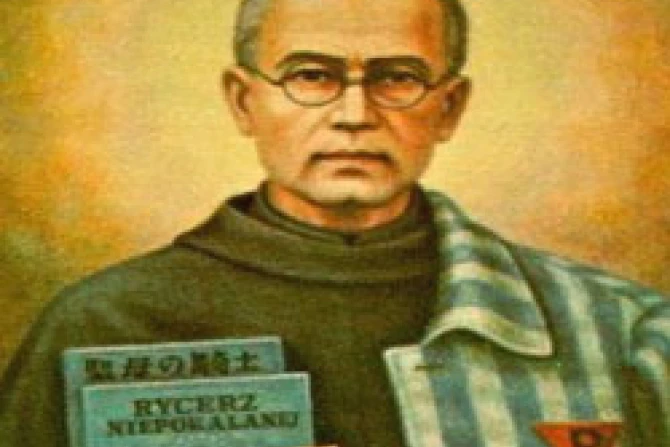
.- Saint Maximilian Kolbe, the Polish Franciscan priest, missionary and martyr, will soon be celebrated throughout the Church on his feast day, August 14.

The saint died in the concentration camp at Auschwitz, during World War II, and is remembered as a “martyr of charity” for dying in place of another prisoner who had a wife and children. He was canonized by Pope John Paul II on October 10, 1982.

St. Maximilian is also celebrated for his missionary work, his evangelistic use of modern means of communication, and for his lifelong devotion to the Virgin Mary under her title of the Immaculate Conception.

All these aspects of St. Maximilian's life converged in his founding of the Militia Immaculata. The worldwide organization continues St. Maximilian Kolbe's mission of bringing individuals and societies into the Catholic Church, through dedication to the Virgin Mary.

St. Maximilian, according to several biographies, was personally called by the Virgin Mary, both to his holy life and to his eventual martyrdom. As an impulsive and badly-behaved child, he prayed to her for guidance, and later described how she miraculously appeared to him holding two crowns: one was white, representing purity, the other red, for martyrdom.

When he was asked to choose between these two destinies, the troublesome child and future saint said he wanted both. Radically changed by the incident, he entered the minor seminary of the Conventual Franciscans at age 13, in 1907.

At age 20 he made his solemn vows as a Franciscan, earning a doctorate in philosophy the next year. Soon after, however, he developed chronic tuberculosis, which eventually destroyed one of his lungs and weakened the other.

On October 16, 1917, in response to anti-Catholic demonstrations by Italian Freemasons, Friar Maximilian led six other Franciscans in Rome to form the association they called the Militia Immaculata. The group's founding coincided almost exactly with the Bolshevik revolution in Russia, and the Marian apparitions at Fatima, Portugal.

As a Franciscan priest, Fr. Maximilian returned to work in Poland during the 1920s. There, he promoted the Catholic faith through newspapers and magazines which eventually reached an extraordinary circulation, published from a monastery so large it was called the “City of the Immaculata.”

In 1930 he moved to Japan, and had established a Japanese Catholic press by 1936, along with a similarly ambitious monastery.

That year, however, he returned to Poland for the last time. In 1939, Germany invaded Poland, and Fr. Kolbe was arrested. Briefly freed during 1940, he published one last issue of the Knight of the Immaculata before his final arrest and transportation to Auschwitz in 1941.

At the beginning of August that year, 10 prisoners were sentenced to death by starvation in punishment for another inmate's escape. Moved by one man's lamentation for his wife and children, Fr. Kolbe volunteered to die in his place.

Survivors of the camp testified that the starving prisoners could be heard praying and singing hymns, led by the priest who had volunteered for an agonizing death. After two weeks, on the night before the Church's feast of the Assumption of the Blessed Virgin Mary, the camp officials decided to hasten Fr. Kolbe's death, injecting him with carbolic acid.

St. Maximilian Kolbe's body was cremated by the camp officials on the feast of the Assumption. He had stated years earlier: “I would like to be reduced to ashes for the cause of the Immaculata, and may this dust be carried over the whole world, so that nothing would remain.”

* The number of messages that can be online is limited. CNA reserves the right to edit messages for content and tone. Comments and opinions expressed by users do not necessarily reflect the opinions or beliefs of CNA. CNA will not publish comments with abusive language, insults or links to other pages

RESOURCES »

Featured Videos

Group launches tour to end abortion in Canada
Actor admires Mexican martyr's strong defense of the faith
First video game about Jesus launches on Facebook
Vandals strike historic Santa Cruz church
EU accused of funding abortion with development money
Brent Dusing's advice to Internet Evangelists
Creator of Bible-based Facebook game lauds internet evangelism
Sacrifice of Titanic's Catholic priests recalled on 100th anniversary
Benedict XVI visits the Shrine of the Virgin of Cobre and meets President Raul Castro
Vestments for Pope's Mass in Cuba arrive with love from Peru
Pope Benedict XVI in Antonio Maceo Square in Santiago de Cuba
Benedict XVI meets with President Calderon and Mexican children
Americans speak up for religious freedom at nationwide rallies
Neighborhood rallies against plan to build strip club near convent
Pope's first Mexican address offers encouragement to faithful
Arrival of  Pope Benedict XVI  to Mexico
Pope offers his blessing to handicapped children in Mexico
Texas bishops hear call to unity at St. Peter's tomb
Interview with Br. Guy Consolmagno
Indiana Catholics respond to 'devastating' storm damage
May
24

Liturgical Calendar

May 24, 2012

Thursday of the Seventh Week of Easter

All readings:
Today »
This year »

Catholic Daily

Gospel of the Day

Jn 17,20-26

Gospel
Date
05/24/12
05/23/12
05/22/12

Daily Readings


First Reading:: Acts 22:30; 23:6-11
Gospel:: Jn 17:20-26

Homily of the Day

Jn 17,20-26

Homily
Date
05/24/12
05/23/12
05/22/12
     HTML
Text only
Headlines
  

Follow us: