

Loading
Halloween coincides with feast of missionary bishop St. Wolfgang
By Benjamin Mann
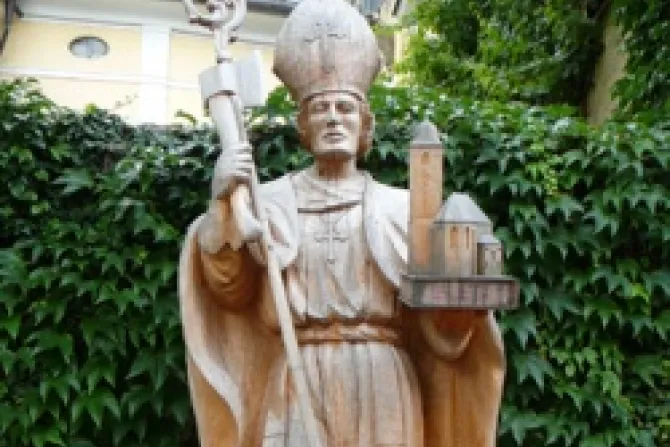
A statue of St. Wolfgang. Credit: Brian Sterling (CC BY-NC-SA 2.0).

.- Oct. 31, though best known as the Vigil of the Solemnity of All Saints (All Hallows’ Eve) in the Western church, is also the liturgical feast day of St. Wolfgang of Ratisbon, who was regarded as one of the greatest German saints of his time

The Benedictine monk and bishop, who served as a missionary to pagans and a reformer of the Church in southeastern Germany, was born around 934 in the historic southwestern German region of Swabia.

Wolfgang came from a family of nobility and was privately tutored as a child. Later on, the future monk was educated at the renowned Monastery of Reichenau, and at Wurtzburg. Wolfgang showed intellectual prowess and found companionship during his years of study, but was also dismayed by the petty jealousies and moral lapses he observed in Wurtzburg’s academic environment.

In 956, his school companion Henry was chosen to lead the Archdiocese of Trier. Though Wolfgang had become interested in monastic life, he chose to go with Henry to Trier, where his service to the Church included a teaching position in the cathedral school.

After Archbishop Henry’s death in 964, Wolfgang left Trier, became a monk of the Order of Saint Benedict, and settled at a monastery in the diocese of Augsburg. Its school prospered under his direction, and the local bishop – the future St. Ulrich – ordained him to the priesthood in 968. In his youth, Wolfgang had envisioned a secluded life of contemplation; but things turned out differently, as he was sent east to evangelize the Magyars in 972.

By Christmas of that year, Wolfgang had been chosen as the new Bishop of Ratisbon (present-day Regensburg in Bavaria). But he continued to live out his monastic vocation, retaining his distinctive Benedictine habit and dedicating himself to the same ascetic lifestyle. Amid the work of preaching and reform, Wolfgang remained a man of prayer, silence, and contemplative solitude.

Not surprisingly, the Bishop of Ratisbon made monasticism a focus of his church reforms, reviving religious life in places where it had fallen into disorder. Wolfgang also showed extraordinary care for the poor in his diocese, to such an extent that he was called “the Great Almoner.” On the other hand, he was also involved in affairs of state at a high level, and tutored the children of the Duke of Bavaria, including the future Holy Roman Emperor St. Henry II.

Wolfgang, despite being one of the great bishops and saints of his time, still encountered serious difficulties in his leadership of the Diocese of Ratisbon. On one occasion, a political conflict caused him to withdraw from his diocese to a hermitage for a period of time. Wolfgang is also said to have struggled with the great geographical extent of the diocese, parts of which were eventually entrusted to the Bishop of Prague.

In 994, while traveling in Austria, Wolfgang became sick and died in the village of Pupping. Miracles associated with his tomb, including many healings, led to his canonization of 1052. Several of St. Wolfgang’s devotees experienced relief from stomach ailments, and he remains a patron saint of such troubles today. His intercession is also sought by victims of strokes and paralysis, and by carpenters.

Tags: Saints


Ads by AdsLiveMedia.com

* The number of messages that can be online is limited. CNA reserves the right to edit messages for content and tone. Comments and opinions expressed by users do not necessarily reflect the opinions or beliefs of CNA. CNA will not publish comments with abusive language, insults or links to other pages

RESOURCES »

Featured Videos

Pope Francis prays over a sick boy in St Peter's Square
Denver women's clinic will offer natural, Catholic care
Interview Clips: Barbara Nicolosi speaks to CNA
US Cardinals press conference at North American College
Pope Benedict to retire to monastery inside Vatican City
Pope cites waning strength as reason for resignation
Hundreds convene in Denver to urge respect for life
New Orange bishop encourages Catholic unity in diversity
Chinese pro-life activist calls for reform, international attention
At Lincoln installation, Bishop Conley says holiness is success
Mother Cabrini shrine reopens in Chicago after a decade
Ordination of 33 deacons fills St. Peter's with joy
Cardinal says "Charity is the mother of all the virtues"
Augustine Institute expands evangelization effort with new campus
Bishops recall 'Way of St. James' as chance to trust in God
Los Angeles cathedral's newest chapel houses Guadalupe relic
Lay missionaries to the poor open new Denver headquarters
New Buffalo bishop stresses need for modern-day martyrs
Guadalupe message resounds at Los Angeles' massive Marian festival
Pastors of Aurora churches comfort, encourage parishioners
May
23

Liturgical Calendar

May 23, 2013

Thursday of the Seventh Week in Ordinary Time

All readings:
Today »
This year »

Catholic Daily

Gospel of the Day

Lc 22,14-20

Gospel
Date
05/23/13
05/22/13
05/21/13

Daily Readings


First Reading:: Sir 5:1-8
Gospel:: Mk 9:41-49

Homily of the Day

Lc 22,14-20

Homily
Date
05/23/13
05/22/13
05/21/13

Ads by AdsLiveMedia.com

Ads by AdsLiveMedia.com
     HTML
Text only
Headlines
  

Follow us: