

Loading
National Geographic documentary examines relics of third-century saints
By Kevin J. Jones
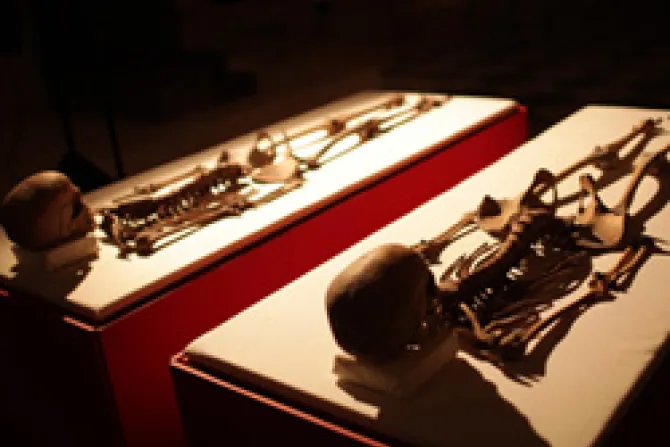
The remains thought to belong to the martyrs Chrysanthus and Daria. Courtesy of National Geographic

.- Two skeletons attributed to two married martyrs from the third century could be authentic, say researchers taking part in a new National Geographic Society documentary.

“All of the evidence we have gathered points toward the relics having belonged to Chrysanthus and Daria,” said investigation leader Ezio Fulcheri of the University of Genoa. “This has been a very rare opportunity to be able to study bones and other relics that relate directly back to a legend that has been passed on for almost 2,000 years. The completeness of the skeletons is also rare for martyrs of this era, implying that these relics were protected and venerated in their entirety at a very early point in history.”

The remains of the saints, martyred around 283 A.D. for spreading Christianity, are said to have been interred in the crypt of the cathedral in the northern Italian city of Reggio Emilia since the 10th century.

A 2008 renovation at the cathedral caused the dismantling of the altar which had been undisturbed since 1651. The remains, nearly 150 bones, underwent tests dating them to between 80 and 340 A.D.

Fulcheri led a team of scientists who considered the authenticity of the relics. Their investigations are the subject of the National Geographic Channel documentary “EXPLORER: Mystery of the Murdered Saints,” which airs on April 19 at 10 p.m. Eastern time.

Max Salomon, senior producer and series writer for EXPLORER, spoke about the documentary with CNA on April 18.

He thought the investigation was one of the first times that the Catholic Church has done a full investigation into a pair of saints dating from their period.

“This is the first time that we can really test the authenticity of what is believed to be the body of a saint. For us, it was really a privilege to have a seat at that table and see its risks,” he said.

Salomon noted that it’s risky for a Church to ask “hard scientific questions” about reputed relics that have been in its possession for perhaps 1,000 years.

“There’s a very good chance when you’re dealing with relics that the relics aren’t real,” he said, noting that the “huge” public interest in relics in the Middle Ages generated a black market for forgeries and false relics.

Auxiliary Bishop Lorenzo Ghizzoni of Reggio Emilia, Italy acknowledged this risk.

“We might discover that these relics are fake. That would be a huge problem for us,” the bishop said in the documentary. “If we find out we have bones like that, then we have to throw them out, destroy them. That would certainly be a scandal for the faithful.”

Salomon said he was impressed that Church leaders intended to remove the relics if the tests did not support their authenticity.

The intersection of faith and science is “always a complicated one,” he explained, because their answers haven’t always been in agreement. He thought the research on the saints’ remains was an opportunity for faith and science to intersect in a different way.

“In a sense, it’s a very modern thing for the Church to do, to embrace science and take on the risks of asking scientific questions,” he remarked.

The presence of two complete bodies presented “a huge opportunity for science” to determine the relics’ possible authenticity, Salomon explained. Often, relics leave “very little to work with” because there is too little material for a dating method like a Carbon 14 test.

The lives of Sts. Chrysanthus and Daria present an inspiring story.

Tradition holds that Chrysanthus was the only son of a Roman senator from Alexandria. He grew up in Rome and converted to Christianity. His father disapproved of his conversion and arranged a marriage between his son and a high priestess named Daria to try to bring him back to the Roman religion.

However, Daria embraced her husband’s religion and worked with him to convert thousands more to Christianity.

Roman authorities arrested the two for proselytizing and buried them alive in a sand mine in Rome around 283 A.D. While a wall was erected around the burial site to protect the grave, their remains were moved numerous times between 757 and 946, when the Diocese of Reggio Emilia entombed them beneath the cathedral altar.

* The number of messages that can be online is limited. CNA reserves the right to edit messages for content and tone. Comments and opinions expressed by users do not necessarily reflect the opinions or beliefs of CNA. CNA will not publish comments with abusive language, insults or links to other pages

RESOURCES »

Featured Videos

Group launches tour to end abortion in Canada
Actor admires Mexican martyr's strong defense of the faith
First video game about Jesus launches on Facebook
Vandals strike historic Santa Cruz church
EU accused of funding abortion with development money
Brent Dusing's advice to Internet Evangelists
Creator of Bible-based Facebook game lauds internet evangelism
Sacrifice of Titanic's Catholic priests recalled on 100th anniversary
Benedict XVI visits the Shrine of the Virgin of Cobre and meets President Raul Castro
Vestments for Pope's Mass in Cuba arrive with love from Peru
Pope Benedict XVI in Antonio Maceo Square in Santiago de Cuba
Benedict XVI meets with President Calderon and Mexican children
Americans speak up for religious freedom at nationwide rallies
Neighborhood rallies against plan to build strip club near convent
Pope's first Mexican address offers encouragement to faithful
Arrival of  Pope Benedict XVI  to Mexico
Pope offers his blessing to handicapped children in Mexico
Texas bishops hear call to unity at St. Peter's tomb
Interview with Br. Guy Consolmagno
Indiana Catholics respond to 'devastating' storm damage
May
25

Liturgical Calendar

May 25, 2012


All readings:
Today »
This year »

Catholic Daily

Gospel of the Day

Jn 21,15-19

Gospel
Date
05/25/12
05/24/12
05/23/12

Daily Readings


First Reading:: Acts 25:13b-21
Gospel:: Jn 21:15-19

Homily of the Day

Jn 21,15-19

Homily
Date
05/25/12
05/24/12
05/23/12
     HTML
Text only
Headlines
  

Follow us: