Loading
New documents reveal inner workings of papal birth control commission
By Benjamin Mann
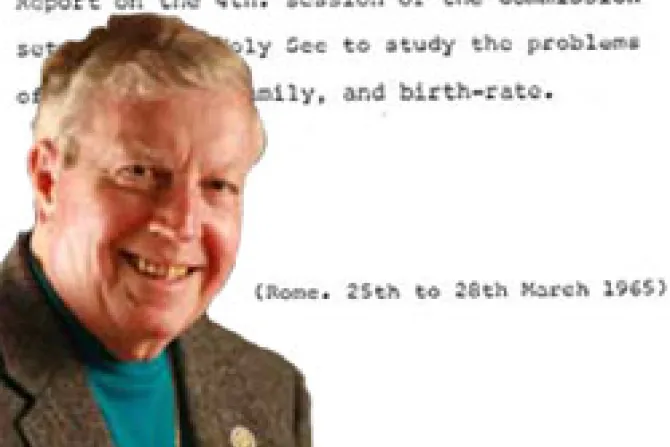
Moral theologian Germain Grisez

.- New documentation from a renowned moral theologian is shedding light on a controversial moment in Catholic history – the 1963-66 commission that considered the question of contraception prior to Paul VI's encyclical “Humanae Vitae.”

“The idea of what happened with the commission has been shaped by people who were pro-contraception.” said Germain Grisez, Professor Emeritus of philosophy and moral theology at Mount St. Mary's College in Maryland. “It's their account of what happened, that has been circulated over the years.”

Now, Grisez is seeking to set the record straight, by releasing documents that few in the Church have ever seen before. They can be viewed through his website, at http://twotlj.org/BCCommission.html.

According to Grisez, who assisted commission member Fr. John Ford in his work, several misunderstandings about the commission date back to 1967 – the year before Pope Paul VI condemned artificial contraceptive methods in his encyclical “Humanae Vitae.”

During that year, a number of commission documents containing pro-contraception arguments were leaked to the public and the press. The move led to the popular misconception of the Pope “overruling” a commission, although the commission had no authority to make decisions.

Those who supported the traditional teaching, like Fr. Ford, could have responded in kind with their own document leaks. But they chose not to do so at the time, considering themselves bound to keep the commission's work private and wait for the Pope to speak authoritatively.

“The people who weren't supportive of a change in Church teaching, believed that their knowledge of what the commission had done was confidential,” Grisez explained. “They didn't go around talking about it.”

According to Grisez, this one-sided perspective on the commission's work made it appear that Pope Paul had simply disregarded the majority report.

But the new documents shows that the Pope took both sides of the issue seriously, and gave advocates of artificial contraception every chance to make their case. It also shows how the commission's secretary general, Fr. Henri de Riedmatten, managed to exert a strong influence in favor of contraception, despite the opposing position of commission president Cardinal Alfredo Ottaviani.

Grisez noted that the Pope, rather than ignoring the pro-contraception arguments, was legitimately interested in considering the questions raised by new methods.

“He was perfectly happy to have a lot of people on the commission who thought that change was possible. He wanted to see what kind of case they could make for that view.”

But the Pope never intended to hand over his teaching authority to the commission. “He was not at all imagining that he could delegate to a committee, the power to decide what the Church's teaching is going to be,” Grisez said.

Some proponents of a change in teaching believed that Pope Pius XI's encyclical “Casti Connubii,” which condemned artificial birth control in 1930, had not conclusively settled the kinds of questions raised by new methods of hormonal contraception. They initially argued that the contraceptive pill was different from older methods, and could be accepted without contradicting prior teaching.

Pope Paul encouraged the commission to pursue this line of inquiry –  not expecting that the commission's work, after being leaked to the public, would be set on the same plane as his judgment.

“He never intended the commission to be a public body, or that its study should be publicized in print,” Grisez emphasized. “He thought they were going to study, and make their presentation to him, so he would understand it and think the matter through.”

This spirit of inquiry, however, had consequences he did not intend.

“When the documents were leaked in 1967, Paul VI was extremely upset about it. He sent a letter to all the bishops and cardinals who were on the commission, about the documents. It wasn't what he had in mind at all.”

In the end, the majority of commission members actually lost interest in attempting to argue that contraceptive pills could be squared with “Casti Connubii.” Instead, they simply advocated the acceptance of contraception, without attempting to reconcile this prospect with the previous teaching of the Church.

“Almost nobody, in the end, was arguing that the pill was anything different,” Grisez recalled. “In the commission documents, you wouldn't find much of a case anywhere for that – although that was the starting point for the whole thing.”

Pope Paul VI considered their work, but grew more convinced than ever that the majority position was not correct. “He became absolutely clear, in his own mind, that the pill was wrong. That led to the declaration in 'Humanae Vitae.'”

But in the public realm, the groundwork had already been laid for the disastrous reception of “Humanae Vitae” in 1968, through the leaking of the majority report that supported contraception.

Grisez hopes the new documentation he is providing might undo some of that damage, and help many people open their minds to the Church's teaching on sexuality.

“It would help the Church now, if people had a more sound notion of what did happen – an understanding of Paul VI's actual mentality, wanting to study the question without intending to hand over his authority.”

“If that were better understood,” he noted, “I think a lot of the resentment surrounding 'Humanae Vitae' could be dissolved.”

* The number of messages that can be online is limited. CNA reserves the right to edit messages for content and tone. Comments and opinions expressed by users do not necessarily reflect the opinions or beliefs of CNA. CNA will not publish comments with abusive language, insults or links to other pages

RESOURCES »

Featured Videos

Group launches tour to end abortion in Canada
Actor admires Mexican martyr's strong defense of the faith
First video game about Jesus launches on Facebook
Vandals strike historic Santa Cruz church
EU accused of funding abortion with development money
Brent Dusing's advice to Internet Evangelists
Creator of Bible-based Facebook game lauds internet evangelism
Sacrifice of Titanic's Catholic priests recalled on 100th anniversary
Benedict XVI visits the Shrine of the Virgin of Cobre and meets President Raul Castro
Vestments for Pope's Mass in Cuba arrive with love from Peru
Pope Benedict XVI in Antonio Maceo Square in Santiago de Cuba
Benedict XVI meets with President Calderon and Mexican children
Americans speak up for religious freedom at nationwide rallies
Neighborhood rallies against plan to build strip club near convent
Pope's first Mexican address offers encouragement to faithful
Arrival of  Pope Benedict XVI  to Mexico
Pope offers his blessing to handicapped children in Mexico
Texas bishops hear call to unity at St. Peter's tomb
Interview with Br. Guy Consolmagno
Indiana Catholics respond to 'devastating' storm damage
May
25

Liturgical Calendar

May 25, 2012


All readings:
Today »
This year »

Catholic Daily

Gospel of the Day

Jn 21,15-19

Gospel
Date
05/25/12
05/24/12
05/23/12

Daily Readings


First Reading:: Acts 25:13b-21
Gospel:: Jn 21:15-19

Homily of the Day

Jn 21,15-19

Homily
Date
05/25/12
05/24/12
05/23/12
     HTML
Text only
Headlines
  

Follow us: