

|
|
||||||||
|
New challenges require cooperation among nations, Pope explains
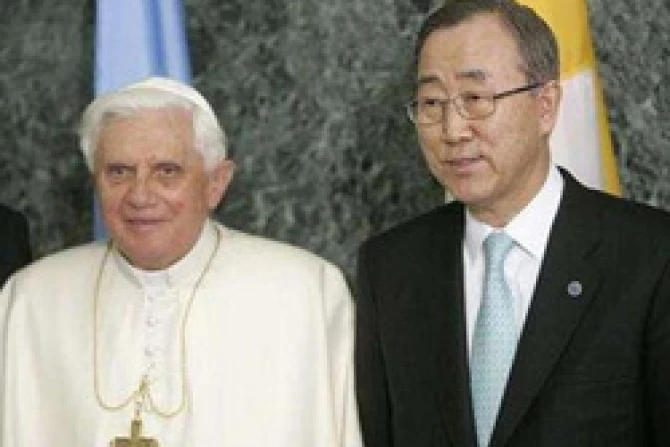
![]() Pope Benedict with the UN Secretary General, Ban Ki-moon
Related articles:
.- In his much anticipated address to the UN this morning, Pope Benedict XVI described how the current problems faced by the world require a collective response at the international level. Among the issues he cited were, development in Africa, scientific and medical advances and the defense of the family. “The United Nations embodies the aspiration for a ‘greater degree of international ordering,’” the Holy Father quoted from Pope John Paul II. And yet, he said that while the UN is supposed to act out of a “multilateral consensus”, it often does not because its decisions are “still subordinated to the decisions of a few”. What the world needs, said Benedict, are “interventions in the form of collective action by the international community.” “Indeed, questions of security, development goals, reduction of local and global inequalities, protection of the environment, of resources and of the climate, require all international leaders to act jointly and to show a readiness to work in good faith, respecting the law, and promoting solidarity with the weakest regions of the planet. I am thinking especially of those countries in Africa and other parts of the world which remain on the margins of authentic integral development, and are therefore at risk of experiencing only the negative effects of globalization,” the Holy Father said. “In the name of freedom,” Benedict XVI told the UN, “there has to be a correlation between rights and duties, by which every person is called to assume responsibility for his or her choices, made as a consequence of entering into relations with others.” Being responsible for choices led the Pontiff to reflect on the use of scientific and technological advances. “Notwithstanding the enormous benefits that humanity can gain, some instances of this represent a clear violation of the order of creation, to the point where not only is the sacred character of life contradicted, but the human person and the family are robbed of their natural identity," he said, pointing to attacks on life and the family. “Likewise,” he reflected, “international action to preserve the environment and to protect various forms of life on earth must not only guarantee a rational use of technology and science, but must also rediscover the authentic image of creation. This never requires a choice to be made between science and ethics: rather it is a question of adopting a scientific method that is truly respectful of ethical imperatives.” ADD A COMMENT (Your e-mail will NOT be published):
* Thanks for your comments. The number of messages that can be online is limited. Length should not exceed 1500 characters. CNA reserves the right to edit messages for content and tone. Comments and opinions expressed by users do not necessarily reflect the opinions or beliefs of CNA. CNA will not publish comments with abusive language, insults or links to other pages. ADVERTISING |
Latest news:
03:18 am | Facing massive deficit, NJ governor proposes cutting Planned Parenthood from budget 01:06 am | Chinese Catholics to have ‘great celebration’ for Feast of St. Joseph 11:34 pm | Confirmation of lesbian as Episcopal bishop causes regret in Canterbury 10:02 pm | Objectors to required Spanish course take case to EU Court 09:47 pm | Health care bill could force people to pay for abortion, bishops’ spokeswoman says Related news :
UN has duty to protect, but should not violate sovereignty, says Pope Holy Father describes UN as a 'family of nations' Support and promote religious rights, Benedict XVI tells UN Pope: True rights come from human nature, not special interest groups Get CNA News on your email:
Resources
|
ADVERTISING
Place your ad here |
||||||
|
||||||||

