|
|
||||||||
|
Protecting environment must involve morals, Archbishop Chaput insists
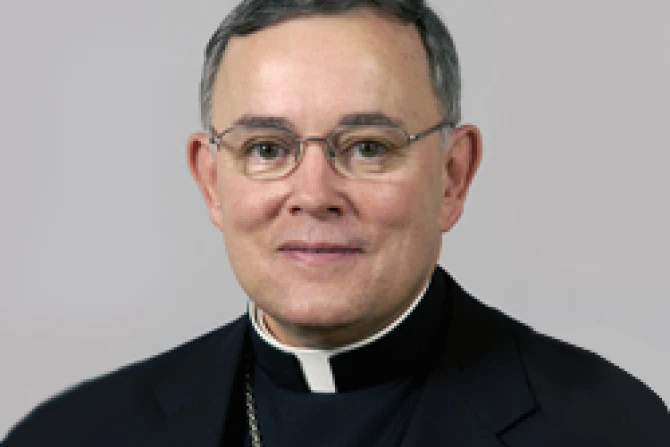
![]() Archbishop Charles Chaput
Related articles:
.- Aiming to promote a better understanding of the Church's teaching on the environment, the Catholic apostolate Creatio is hosting an international conference in Allenspark, Colo. The discussions began on Monday afternoon with a keynote speech by Archbishop Charles Chaput, who urged the participants to work towards a solution that ensures the protection of creation but also does not treat man as just another part of nature. The two-day conference is the first of its kind and brings together experts in the fields of outdoor recreation, philosophy and several disciplines under the umbrella of environmental studies. International conference participants hail from Italy, Peru and Spain. Archbishop Chaput began his opening remarks by highlighting the fact that Benedict XVI is developing "the most detailed corpus of official Catholic thought on the environment in Church history." This body of teaching will be further enhanced this coming January when the Pope delivers his World Day of Peace message on cultivating peace by protecting creation, Chaput said. "But a Catholic concern for the environment is not at all new," he noted, citing the ancient Christian belief that man's sin wounded creation and that he, along with creation, was redeemed by Jesus' sacrifice on the cross. "Human reverence for God’s creation is a natural consequence of Christ’s call to all human beings to be reconciled with God and with their fellow human beings," he explained, pointing to St. Francis of Assisi as one obvious example. "St. Francis, as I’m sure you know, is seen by some as 'the first environmentalist’," said Chaput explaining that the saint addresses two ideas that have given rise to "some of today’s bitter debates about the environment." These arguments find their root "in the philosophical tension between those who believe that human beings are separate from and opposed to nature, and those who say that humans are merely 'nature' and nothing more." Those who advocate for the position that man is separate from the rest of nature operate with the unconscious belief that "civilization is a 'cocoon' aimed at shielding humans from nature: We build cities, comfortable homes, cars, airplanes, computers and machines of all sorts to 'protect' us from nature, to defeat or conquer nature," Chaput summarized. While this world view correctly understands that "nature, including human nature, is somehow inadequate and needs to be fixed," it fails when it tries to fix man and creation with technology, he cautioned. On the other side of the debate, he explained, are those who see human beings as "simply another part of nature. We’re not finally unique in our dignity. In fact, we’re no more and sometimes even less important than other parts of nature." Moreover, Chaput noted, "this view argues that we humans have no right to use more than our fair share of nature’s resources. Nor do we have any right or entitlement to rule nature." "Ironically, this latter approach – which comes from a uniquely human thirst for justice -- is self-defeating. If we’re just another piece of the 'nature puzzle,' why should we be held more accountable than polar bears or whales or coyotes for what happens to the environment? And why should we care about creation at all, beyond our immediate, individual self-interest?" he asked. The Christian perspective on creation recognizes that "we have a responsibility toward the created world because we have a higher dignity given to us by the Creator Himself. Human beings bear the unique mark of being created in the image and likeness of God, and we are God’s cooperators in preserving his creation," the archbishop told the assembled experts. As many around the world ponder how to respond to the need to protect creation and mankind, Archbishop Chaput urged the conference participants to engage in a dialogue that includes faith and reason. "The suspicion of religious believers toward science in centuries past is well documented and unfortunate. It often had sad and damaging results. But what’s admitted less often is the disdain science can sometimes show toward religious faith. Science needs to regain a respect for the moral and religious dimension of the environmental debate." Noting that many in the scientific community seem to be afraid of anything that is associated with "morals," Chaput pointed out that morals are not necessarily the same as religious beliefs. A "moral duty," he explained, "is a different, universally shared thing. The word 'moral' comes from the Latin word mores, meaning common habits, customs or ways of doing things. It relates to principles of right and wrong behavior which are inherent in humans. These principles have been "imposed" by human nature and reality, not by religion. Morality is the wisdom of a society discovered through trial and error. "Human beings have a natural sense, reinforced by experience, that things like murder, cruelty, theft, adultery, lying, greed, pride and exploiting the weak are wrong. Faith and reason can walk that common moral ground of the human conscience and, if we’re serious about protecting the environment, they must walk that common ground." he stated. To illustrate his point, Archbishop Chaput related the story of what researchers found downstream of the University of Colorado in Boulder. "When scientists at the University of Colorado studied the trout in Boulder Creek downstream from that city’s sewer plant a few years ago, they found that, out of 123 fish, 101 were female, 12 were male, and 10 were a very strange mutation with male and female features," he recalled. Researchers were able to trace the cause back to "antibiotics, caffeine and especially the hormones from birth control pills can seriously contaminate a region’s drinking water," the prelate said, citing several local newspaper articles. One report quoted a biologist as saying that "the water effluent he found in Boulder Creek has unintended contraceptive effects in human beings." The scientists expected to hear an uproar from environmentalists when their findings became public but instead they heard silence. "Nobody is to blame for this, and I don’t have a solution," one well-known environmental activist said. In contrast, Archbishop Chaput lodged his disagreement with activists, insisting with the conference attendees, we "should have a solution. A moral solution." Any solution, he insisted, should take the form of "a response flowing from a respectful encounter of faith and reason; a response that will help us, collectively, to make the behavioral changes necessary to protect this beautiful world we share, ensuring not only its God-intended harmony, but our own well-being." To read more about Creatio, please visit: http://www.creatioweb.org/ Subscriber comments:

Published by: Matthew C. Masotti
West Windsor/NJ/USA 08/21/2009 03:06 PM EST
Unfortunately, not all environmentalists understand that a proper concern for the ecology of the human species is also important. Perhaps cases like the one involving the effects of human contraceptives on fish can provide witness that, by giving honor and proper respect to our own human biology, we can help to save and protect all species to which we have been given stewardship.
Published by: Rosi
Salem, Or. USA 08/19/2009 07:38 PM EST
If mankind would humble himself, placing God in the center of his life and sincerely try to live according to the Commandments....calling on God for direction and guidance....our world would not be in the mess that it is in. The solution is to live "God-centered" and not "man-centered" lives.
Then satan and sin would not have a chance!
Published by: dAVID LARSEN
scituate Mass 08/19/2009 06:08 PM EST
People by virtue of their design are morally capable of understanding how to protect all nature in context with their environment. They do this as a result of intelligence.
Plants and animals adapt or fail to adapt to environmental changes. Animals are design specific. They show us technique and an instinctive adapting to environment with some sense of an intelligence. A morally capable human being is the one creature by design,that demonstrates the highest of intelligence. One who has these attributes and acts by a strong faith in God as revealed truth,as lived in the life of Christ,is learning to understand the divine revelation of all that has ever been created,to be understood in time. Faith and morals are essential in the development of reason in a highly developed intelligence,for any human being. Without faith and morals,a human being is instinctive and demonstrates a high degree of error in their sense of judgement. Morality is no dirty word. Morality is ones sense of fairness in the judging of what is fair and reasonable in the relations that act to integrate the various environments of living things. Humankind is by design morally capable of saving our planet or immorally capable of destroying it.
Published by: Valerie
Florida 08/19/2009 12:56 PM EST
The only environmentalist I will ever trust is one who either practices or believes in NFP.
Published by: Ches
USA 08/19/2009 09:52 AM EST
Sin is the cause of all unhappiness and disorder in this world. Grace is the only solution. Holiness is what we all need to be striving to achieve. Consecration to Jesus thru Mary is the most efficient way to achieve holiness.
I have always thought it hypocritical of those who promote natural things for these people to not see the "unnatural" nature of birth control pills. They have their blinders on bigtime! ADD A COMMENT (Your e-mail will NOT be published):
* Thanks for your comments. The number of messages that can be online is limited. Length should not exceed 1500 characters. CNA reserves the right to edit messages for content and tone. Comments and opinions expressed by users do not necessarily reflect the opinions or beliefs of CNA. CNA will not publish comments with abusive language, insults or links to other pages. ADVERTISING |
Latest news:
03:07 pm | Spouse of Costa Rican presidential candidate 'pockets' Eucharist 02:15 pm | Vatican responds to widely divergent reports on Boffo resignation 12:56 pm | Venezuelan cardinal calls for new evangelization of country's capital 11:11 am | International congress to focus on priestly identity and celibacy 07:10 am | Former Saints star says Super Bowl victory revealed a ‘team with destiny’ Related news :
Catholic environmental group announces upcoming conference Vatican continues initiatives to go green Parishes get creative with efforts to go 'green' Retreat promotes encountering Christ while caring for environment Get CNA News on your email:
Resources
|
ADVERTISING
Place your ad here |
||||||
|
||||||||