Loading
Vatican official: Culture of silence is deadly for handling abuse claims
By David Kerr
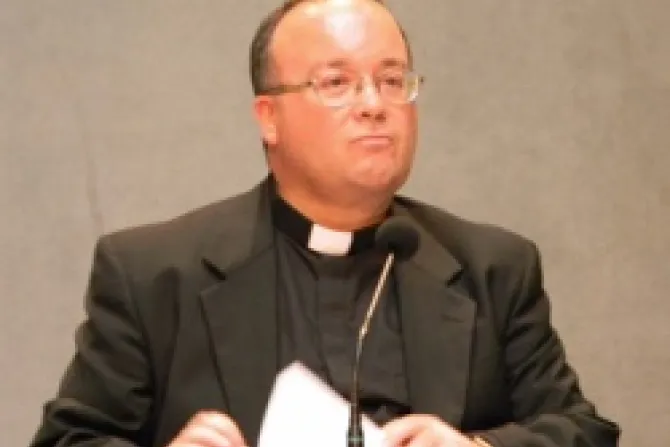
Monsignor Charles Scicluna

.- The Vatican’s sex crimes prosecutor says the Church should fight against a culture of silence as it combats the “sad phenomenon” of sexual abuse in society. 

“The teaching of Blessed John Paul II that truth is at the basis of justice explains why a deadly culture of silence or 'omertà' is in itself wrong and unjust,” said Monsignor Charles J. Scicluna, Promoter of Justice at the Congregation for the Doctrine of the Faith, on Feb 8.

“Omertà” is a term that describes the code of silence practiced by members of the Mafia.

The 52-year-old Maltese cleric was addressing the “Towards Healing and Renewal” symposium being hosted the Pontifical Gregorian University in Rome from Feb 6-9. The gathering has brought together over 140 representatives from bishops' conferences and 30 religious orders worldwide.

All such groups have until May 2012 to submit new guidelines for preventing abuse to the Vatican for approval although many already have such guidelines in place.

He explained to delegates how the best guide on the Church’s “moral and legal duty” to seek the truth when allegations are made can found in a 1994 address given by Blessed Pope John Paul II to the Vatican’s highest appeal court, the Roman Rota. On that occasion the late Pope outlined five principles that should inform the actions of those investigating allegations of abuse.

The first was that “justice is at times called truth,” which means that a culture of silence has to be rejected. Msgr. Scicluna said this principle requires the facts to be established “with a spirit of fairness” to both the alleged victim and the accused as guided by the Church’s canon law.

“Other enemies of the truth are the deliberate denial of known facts and the misplaced concern that the good name of the institution should somehow enjoy absolute priority to the detriment of legitimate disclosure of crime,” he explained.

Pope John Paul’s second principle was that justice based on truth “evokes a response from the individual’s conscience.”

“The acknowledgment and recognition of the full truth of the matter in all its sorrowful effects and consequences,” explained Mgsr. Scicluna, “is at the source of true healing for both victim and perpetrator.”

While experts in psychology could explain how and why perpetrators develop “coping mechanisms” such as denial, there is “no substitute” for “the liberating effect on a cleric’s conscience” which comes from the “full, humble, honest and contrite acknowledgment of his sin, his crime, his responsibility for the harm he has caused to the victims, to the Church, to society.”  

Similarly, there is a “radical need” for victims to be “heard attentively, to be understood and believed, to be treated with dignity as he or she plods on the tiresome journey of recovery and healing,” he said.

Pope John Paul II’s third maxim was that “truth generates confidence in the rule of law, whereas disrespect for the truth generates distrust and suspicion.”

He praised the late Pope for promulgating the 2001 Motu Proprio “Sacramentorum sanctitatis” which updated and strengthened the Church’s laws for dealing with allegations and incidents of abuse.

He explained how the document had raised clerical abuse to the level of a “delicta graviora” or “grave crime” in Church law and, in doing so, took the issue to the Congregation for the Doctrine of the Faith. These rules have since been revised and strengthened by Pope Benedict XVI, he said.

“The law is clear,” said Mgsr. Scicluna, but “the faithful need to be convinced that ecclesial society is living under the governance of law.” 

It is “not good enough,” he said, for the promotion of “peace and order in the community” that the law is simply clear but also that “people need to know that the law is being applied.”

The fourth principle proposed by Pope John Paul in his 1994 address was the duty of the Church “towards the common good.” In alleged cases of abuse, said Msgr. Scicluna, the Church would include the safety of children as a “paramount concern” which is essential to any understanding of “the common good.”

He told delegates that this included a “duty to cooperate with state authorities.”

“Sexual abuse of minors is not just a canonical delict or a breach of a Code of Conduct internal to an institution, whether it be religious or other. It is also a crime prosecuted by civil law,” he said.

The fifth and final principle of Pope John Paul II was that respect for the Church’s guidelines should not be distorted by “pastoral” concerns.

Mgsr. Scicluna recalled how in 1994 Pope John Paul had warned of “the temptation to lighten the heavy demands of observing the law in the name of a mistaken idea of compassion and mercy.”

The 2011 investigation into lapses of child safety in the Irish Diocese of Cloyne found that the former Vicar General of the diocese had not upheld the Irish Church’s 1996 guidelines on mandatory reporting as, he felt, they compromised his “Christian duty of pastoral care.”

Mgsr. Scicluna again quoted Pope John Paul’s advice from 1994 that “if the rights of others are at stake, mercy cannot be shown or received without addressing the obligations that correspond to these rights.”

He concluded his address to the symposium by stating his belief that “the honest quest for truth and justice is the best response we can provide for the sad phenomenon of the sexual abuse of minors by clerics.”


* The number of messages that can be online is limited. CNA reserves the right to edit messages for content and tone. Comments and opinions expressed by users do not necessarily reflect the opinions or beliefs of CNA. CNA will not publish comments with abusive language, insults or links to other pages

RESOURCES »

Featured Videos

Group launches tour to end abortion in Canada
Actor admires Mexican martyr's strong defense of the faith
First video game about Jesus launches on Facebook
Vandals strike historic Santa Cruz church
EU accused of funding abortion with development money
Brent Dusing's advice to Internet Evangelists
Creator of Bible-based Facebook game lauds internet evangelism
Sacrifice of Titanic's Catholic priests recalled on 100th anniversary
Benedict XVI visits the Shrine of the Virgin of Cobre and meets President Raul Castro
Vestments for Pope's Mass in Cuba arrive with love from Peru
Pope Benedict XVI in Antonio Maceo Square in Santiago de Cuba
Benedict XVI meets with President Calderon and Mexican children
Americans speak up for religious freedom at nationwide rallies
Neighborhood rallies against plan to build strip club near convent
Pope's first Mexican address offers encouragement to faithful
Arrival of  Pope Benedict XVI  to Mexico
Pope offers his blessing to handicapped children in Mexico
Texas bishops hear call to unity at St. Peter's tomb
Interview with Br. Guy Consolmagno
Indiana Catholics respond to 'devastating' storm damage
May
25

Liturgical Calendar

May 25, 2012


All readings:
Today »
This year »

Catholic Daily

Gospel of the Day

Jn 21,15-19

Gospel
Date
05/25/12
05/24/12
05/23/12

Daily Readings


First Reading:: Acts 25:13b-21
Gospel:: Jn 21:15-19

Homily of the Day

Jn 21,15-19

Homily
Date
05/25/12
05/24/12
05/23/12
     HTML
Text only
Headlines
  

Follow us: