

Loading
White House aligns with Supreme Court conservatives in religious schools case
By Benjamin Mann, Staff Writer
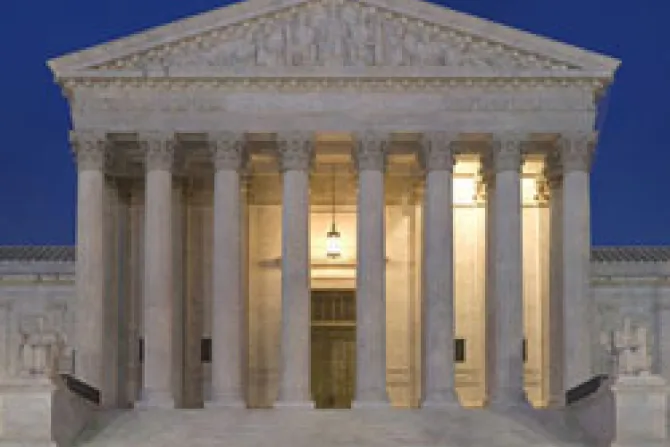
The U.S. Supreme Court

.- As the Supreme Court considered a case involving tax credits and religious education on November 3, indications of a surprising agreement emerged between some of the court's most conservative justices and the Obama administration.

The case pits the Arizona Christian School Tuition Organization against a group of citizens charging that a 1997 government tax credit program amounted to a state establishment of religion. The program allowed taxpayers to donate money toward a variety of private scholarship foundations, rather than paying the same amount to the government through taxes.

In 2002, the Supreme Court ruled that a school voucher program in Ohio which gives parents a tuition grant to be used toward a range of secular or religious schools did not violate the establishment clause. In April 2009, however, a panel of judges on the 9th  U.S. Circuit Court of Appeals ruled that the Arizona tax credit program might still amount to an establishment of religion.

The Obama administration disagreed—noting that the Arizona statute does not privilege religious education, and maintaining that it passes the constitutional test at least as easily as the Ohio vouchers. As the high court heard oral arguments in the case on November 3, Justices Antonin Scalia, Samuel Alito, and Chief Justice John Roberts seemed to agree with the White House's position.

In a strong gesture of support for the Christian tuition organization, acting U.S. Solicitor General Neal Kaytal said opponents of the tax credit had no case. “Not a cent” of taxpayers' money was even indirectly funding religious schools, the solicitor general observed. “Not a fraction of a cent … As you track the taxpayers' dollars, it doesn't actually fund any religious program.”

Thus, the Obama-appointed solicitor general said, challengers of the Arizona law could not bring a complaint as taxpayers, nor could they claim an establishment of religion.

Pursuing this line of reasoning, Chief Justice Roberts questioned Paul Bender, a Phoenix attorney representing those questioning the law. The Chief Justice asked Bender how the state could be “discriminating on the basis of religion” if it “doesn't care” whether individuals receive the tax credit for donating to religious or secular scholarship funds.

Justice Scalia went further, indicating that he saw no real difference between Arizona's tax credit system, and the widespread practice of tax deductions, which individuals can claim for their donations to religious charities.

Bender responded that although the statute as written was religiously neutral, the government was nevertheless allowing private money that it could legitimately claim, to be directed instead toward religious schools in a majority of cases.

The money, Bender asserted, was actually “not a contribution” to the tuition charities, since the government was forcing individuals to choose between paying it in taxes or directing it to the scholarship funds.

Justice Sonia Sotomayor articulated Bender's argument as an assertion that the scholarship money “does belong to the state,” even though it is never actually taxed. She said it could be considered “tax money … that private individuals are using.”

Justice Alito, however, objected to that response, saying it amounted to an assertion that “all (private) money belongs to the government” except the amount it “doesn't take” by taxation.

According to the Pew Forum on Religion and Public Life, the court's eventual ruling –expected before the summer—could affect a number of ongoing lower court cases that directly challenge religious groups' legal privileges.

* The number of messages that can be online is limited. CNA reserves the right to edit messages for content and tone. Comments and opinions expressed by users do not necessarily reflect the opinions or beliefs of CNA. CNA will not publish comments with abusive language, insults or links to other pages

RESOURCES »

Featured Videos

Group launches tour to end abortion in Canada
Actor admires Mexican martyr's strong defense of the faith
First video game about Jesus launches on Facebook
Vandals strike historic Santa Cruz church
EU accused of funding abortion with development money
Brent Dusing's advice to Internet Evangelists
Creator of Bible-based Facebook game lauds internet evangelism
Sacrifice of Titanic's Catholic priests recalled on 100th anniversary
Benedict XVI visits the Shrine of the Virgin of Cobre and meets President Raul Castro
Vestments for Pope's Mass in Cuba arrive with love from Peru
Pope Benedict XVI in Antonio Maceo Square in Santiago de Cuba
Benedict XVI meets with President Calderon and Mexican children
Americans speak up for religious freedom at nationwide rallies
Neighborhood rallies against plan to build strip club near convent
Pope's first Mexican address offers encouragement to faithful
Arrival of  Pope Benedict XVI  to Mexico
Pope offers his blessing to handicapped children in Mexico
Texas bishops hear call to unity at St. Peter's tomb
Interview with Br. Guy Consolmagno
Indiana Catholics respond to 'devastating' storm damage
May
25

Liturgical Calendar

May 25, 2012


All readings:
Today »
This year »

Catholic Daily

Gospel of the Day

Jn 21,15-19

Gospel
Date
05/25/12
05/24/12
05/23/12

Daily Readings


First Reading:: Acts 25:13b-21
Gospel:: Jn 21:15-19

Homily of the Day

Jn 21,15-19

Homily
Date
05/25/12
05/24/12
05/23/12
     HTML
Text only
Headlines
  

Follow us: