

Loading
Wednesday General Audience
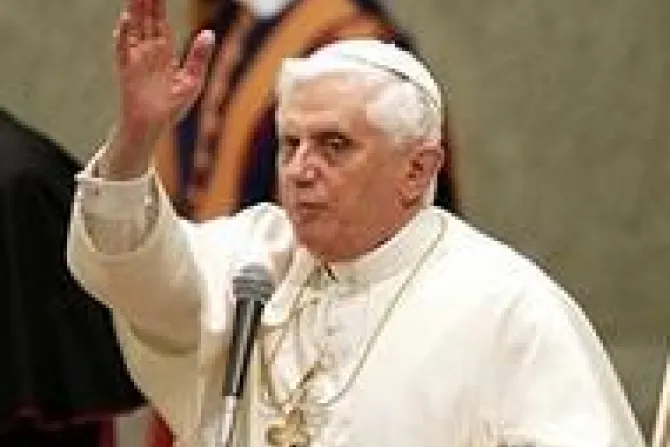
“Without God, man loses his greatness; without God, there is no true humanism,” says Pope Benedict

.- “Without God, man loses his greatness; without God, there is no true humanism”.

With these words, Pope Benedict XVI today recalled the great legacy of another early Church father, Saint Gregory of Nazianze, theologian, preacher and poet from fourth-century Cappadocia. 

A friend and admirer of St. Basil, whom the Holy Father remembered last week, St. Gregory was inspired to seek Baptism and to enter monastic life, devoting himself to prayer, solitude, and meditation. 

The Pope recalled how St. Gregory “loved to leave behind the things of this world and enter into intimate communion with God, so that the depths of his soul became like a mirror reflecting the divine light”. 

“Here was a man who sensed the primacy of God and so speaks to us today, to this world of ours”, the Pope said.  “Without God, man loses his greatness; without God, there is no true humanism.  That’s why we listen to this voice and also try to come to know the face of God”.

The Pope recalled how St. Gregory reluctantly, but in a spirit of obedience, accepted priestly ordination.  He was then sent to Constantinople, where he preached his five Orations: “beautifully reasoned presentations of the Church’s teaching”, the Pope said.

The Orations, known as "The Theologian", stressed that “theology is more than merely human reflection”, the Pope explained.  “It springs from a life of prayer and holiness, from wonder at the marvels of God’s revelation”.  

Gregory was elected Bishop of Constantinople and presided over the Council that took place there in the year 381.  But the Pope recalled how he encountered so much hostility that he withdrew once more to lead a life of solitude.

“His spiritual autobiography from this final period includes some of his most beautiful poetry”, the Pope said.  “As we admire the wisdom with which he defended the Church’s doctrine, let us be moved by the love that is conveyed in his poetry”.

At the end of the audience in the Paul VI auditorium, the Holy Father greeted the faithful present, and remembered the young, the sick and newlyweds. 

He also recalled St. Dominic of Guzman, tireless preacher of the Gospel, and pointed out that tomorrow is the Feast of St. Teresa Benedetta of the Cross, also known as Edith Stein, co-patron of Europe.  “These two saints help you, dear young people, to have simple faith in Christ,” the Pope said.  “Their example sustains you, dear sufferers of illness, to participate with faith in the salvific power of the Cross.  They encourage you, dear newlyweds, to be spread the light of God through your reciprocal faith”. 

RESOURCES »

Feb
12

Liturgical Calendar

February 12, 2012

Sixth Sunday in Ordinary Time

All readings:
Today »
This year »

Catholic Daily

Gospel of the Day

Mk 1,40-45

Gospel
Date
02/12/12
02/11/12
02/10/12

Daily Readings


First Reading:: Lev 13:1-2, 44-46
Second Reading:: 1 Cor 10:31-11:1
Gospel:: Mk 1:40-45

Saint of the Day

St. Julian the Hospitaller »

Saint
Date
02/10/12

Homily of the Day

Mk 1,40-45

Homily
Date
02/12/12
02/11/12
02/10/12

Most Popular

     HTML
Text only
Headlines
  

Follow us: