
Pope Benedict recalls 20th anniversary of Chernobyl nuclear disaster
Vatican City, Apr 26, 2006 (CNA) - Today,
Pope Benedict XVI recalled the 20th anniversary of the worst nuclear
disaster in human history, saying that the 1986 explosion at the
Chernobyl nuclear power station in Ukraine should prompt world leaders
to strive toward peace, while respecting the needs of both mankind and
nature.
The
Vatican pointed out that the Chernobyl explosion produced radioactive
rain detectable in the Soviet Union, Eastern Europe, Scandinavia, Great
Britain, and even the eastern United States.
Subsequently,
this radioactive fallout provoked irreparable damage to the
environment, cancers, mutations, genetic deformation and a large number
of deaths.
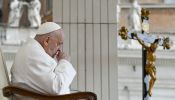
Following his
weekly general audience in St. Peter‘s Square today, the Pope said, "I
feel the need to express my great appreciation for the families,
associations, civil authorities and Christian communities who, over
these years, have striven to house and care for the people, especially
the children, struck by the consequences of that painful event.”
"As once again
we pray for the victims of so immense a tragedy and for those who carry
the signs on their bodies,” he continued, “we call on the Lord to
enlighten the people responsible for the fate of humanity that they,
through joint efforts, put all their energies at the service of peace,
while respecting the needs of mankind and of nature."
Pope Benedict: Church tradition is not just transmission of information, but the effective presence of Jesus
Vatican City, Apr 26, 2006 (CNA) - Speaking
to a crowd of over 50,000 gathered in St. Peter’s Square, Pope Benedict
XVI used the occasion of his regular Wednesday audience to expound on
the idea of apostolic tradition, saying that the Church relies not only
on material information passed down through the centuries, but on the
effective presence of Jesus himself.
The Pope based his audience on the subject of Ecclesial communion as well as the broader concept of tradition.
"Ecclesial
communion”, which is “aroused and sustained by the Holy Spirit, [and]
safeguarded and promoted by the apostolic ministry - does not only
extend to the believers of a particular historical period, but embraces
all times and generations," said the Pope.
He added that
"Thanks to the Paraclete, the early apostolic community was able to
experience the Risen Lord. Successive generations do the same, as the
faith is transmitted and lived through faith, worship and the communion
of the People of God.”
The Holy Father
likewise stressed that “This transmission of the 'things' of salvation
is what constitutes the apostolic tradition of the Church." The Holy
Spirit "actualizes the salvific presence of the Lord Jesus, through the
ministry of the apostles ... and through the entire life of the people
of the new covenant."
He then
explained that “This ongoing actuality of the active presence of the
Lord Jesus in His people - worked by the Holy Spirit and expressed in
the Church through the apostolic ministry and fraternal communion - is
the theological meaning of the term Tradition.”
This commonly
used term, he clarified, “is not just a material transmission of what
was originally given to the Apostles, but the effective presence of the
Lord Jesus ... Who, in the Spirit, accompanies and guides the community
He gathered."
"Tradition," the
Pope said, concluding his address, "is the communion of the faithful
around legitimate pastors over the course of history, a community
nourished by the Holy Spirit.”
“It is”, he
said, “the organic continuity of the Church, ... the permanent presence
of the Savior Who comes out to meet, redeem and sanctify us in the
Spirit."
Chinese underground bishop released
Beijing, China, Apr 26, 2006 (CNA) - A
Chinese bishop of the "underground" Catholic Church has been released
after five months in police custody, reports AsiaNews. He remains
however, under house arrest.
Bishop Giulio
Jia Zhiguo, 70, returned April 19 to his residence, where he is under
constant police surveillance. His release occurred while Chinese leader
Hu Jintao was visiting the United States, local sources pointed out.
The bishop had
been arrested Nov. 8, kept in isolation and subjected to heavy pressure
to join the government-sponsored Catholic Patriotic Association. This
was the eighth arrest for Bishop Jia since 2004; he has now spent 20
years in prison over his lifetime.
Bishop Jia is
among the most prominent leaders of the Catholic community in the Hebei
province, where government officials have undertaken a vigorous
campaign to suppress the underground Church.
Despite the
frequent arrest and interrogation of Catholic clerics, there are an
estimated 1 million people active in China’s underground Church.
Cardinal Lozano announces Vatican document on AIDS prevention
Vatican City, Apr 26, 2006 (CNA) - Speaking
on Vatican Radio, Cardinal Javier Lozano Barragan, president of the
Pontifical Council for Health Care, announced that his dicastery is
preparing a document on ministry to persons with AIDS.
While an
international conference on AIDS is currently taking place in Cabo
City, South Africa, with over a thousand experts meeting to discuss the
AIDS pandemic in Africa, the Mexican cardinal noted that
“unfortunately, the illness is spreading: we’re talking about now some
42 million people affected by AIDS.”
“And according
to doctors,” he said, “for every person who has AIDS another three are
infected with HIV, thus making it 169 million the number of persons
affected around the world by this terrible pandemic.”
The cardinal
said that while the task is difficult, the dicastery is preparing a
document on pastoral ministry for persons with AIDS. “It’s
possible it will be ready this year,” he stated.
Cardinal Lozano
said he was disappointed that most agencies involved in preventing the
spread of the disease understand prevention “as the condom…Certainly
the Catholic Church believes that the most important form of prevention
is abstinence and marital fidelity: in this way absolutely
nothing can happen.”
The cardinal said the question of the use of condoms in marriages in which one partner is HIV positive poses a “problem.”
“Precisely in
this sense we are preparing a profound study that will be both
scientific and moral. This study will certainly be presented to the
Holy Father through the necessary channels and the Holy Father,
according to his wisdom and with the assistance of the Holy Spirit,
will make the decision and will tell us which way to go. What he
says will be the position of the Church,” the cardinal said.
Bishop denounces Notre Dame decision to allow ‘Monologues’ on campus
South Bend, Ind., Apr 26, 2006 (CNA) - Bishop
John D'Arcy of the Fort Wayne-South Bend Diocese told students and
faculty at Notre Dame Law School Friday that he was "deeply saddened"
by university president Fr. John Jenkins' April 5 decision that “The
Vagina Monologues” would not be prohibited on campus.
"This is Notre
Dame," he said, according to the Observer newspaper. "We dare to say it
is the school of Our Lady. … This place has a special obligation."
The bishop gave
his address on the pastoral role of the bishop. He said the Second
Vatican Council had a strong impact on the role of the bishop, shifting
it from “CEO and administrator to a pastor and evangelist.”
When asked about
his relationship with university administration, Bishop D'Arcy
connected his pastoral role to the recent debates on academic freedom
raised by the “Monologues” incident.
"It is important
to recognize the independence of the university and its academic
freedom," he reportedly said. "But I have pastoral freedom. I cannot
refrain from preaching the Gospel."
He told audience
members Friday that the disagreement on this issue has placed his
relationship with the current administration “under stress.” However,
he retains his respect for the university.
Though he
denounced Fr. Jenkins' decision not to ban the "Monologues," the bishop
advised students to read the play and become informed about the
surrounding issues.
He said his
actions and decisions have been based on the late Pope John Paul II's
definition of academic freedom. The Catholic teaching states that
members of a university should be treated with academic freedom so long
as the rights of the individual members are maintained, the bishop said.
The bishop
rejected a student's suggestion that Notre Dame was no longer a
Catholic university. "I think among the major universities it is by far
the most Catholic," he said. "I have great affection for it, and so
does [Pope] Benedict [XVI]."
Church leaders concerned about Iran's Christians
Geneva, Ill., Apr 26, 2006 (CNA) - A
Swiss Catholic Church delegation who recently returned from a week-long
visit to Iran and says that Christians do not enjoy religious freedom
in the Islamic country.
The 10-member
delegation, led by Bishop Pierre Bürcher, auxiliary bishop of Lausanne,
Geneva, Fribourg and Neuchâtel, found that Christian minorities in Iran
were free to practice their religion but only within their own
communities. They cannot speak about their faith outside their
community.
As a result most Iranians knew little of Christianity and other religions, added Galgano.
The visit by
members of the Swiss Bishops Conference's Islam Committee followed an
invitation from Iran's Islamic Culture and Relations Organization,
which had visited Switzerland in September.
During this
current visit, the political crisis over Iran's nuclear aspirations,
the controversy over the Mohammed caricatures, and the West’s
perceptions of Iran were discussed. Iranians shared their desire for
peace. As well as meeting Christian minorities in Iran, the Swiss
delegation also visited Muslim holy sites.
There are
110,000 Christians among Iran’s 70 million people. A book containing
speeches from the visits is to be published in Farsi and English, and
distributed in Iran.
In another
effort to further dialogue, Bishop Bürcher is attending the "Doha
Trialogue" in Qatar this week between Middle Eastern Christians, Jews
and Muslims.
Freezing of embryos, an offense against the respect due to human beings, says Jesuit Priest
Paris, France, Apr 26, 2006 (CNA) - In reaction to recent remarks by Cardinal Carlo Maria Martini on thepossibility of adopting "left over" frozen embryos, Moral Theologian, Father Alain Mattheeuws S.J, offered an interview to the European Institute of Bioethics, stressing the responsibility of upholding the human dignity inherent to the embryos.
Father Alain Mattheeuws is a Jesuit with a doctorate in Moral and SacramentalTheology from the Institut Catholique de Toulouse. He is currently a professor at the Institut d’Etudes Théologiques in Brussels and wasinvited as an expert at recent Bishop’s Synod on the Eucharist in November of 2005.
In his interview, he takes on the delicate theme of bioethical research from the perspective of moral theology. Father Mattheeuws first gave moraldefinition to the act of freezing embryos: “It is morally illicit. Infact, we must ask ourselves what gives us the right to plunge an embryonic child into a ‘cold prison?’”
He then quoted the encyclical Donum vitae regarding this issue: “The freezing of embryos, even when carried out in order to preserve the life of an embryo—cryopreservation—constitutes an offence against the respect dueto human beings by exposing them to grave risks of death or harm to their physical integrity and depriving them, at least temporarily, of maternal shelter and gestation, thus placing them in a situation inwhich further offences and manipulation are possible” (I, 6),” he said.
The priest then tackled the difficult question of moral responsibility, warning that“We must keep from judging the people and at the same time recognize intruth the illicit nature of what they have done, at times in good faith. All of this is to say that in our efforts to inform theirconsciences, we must protect their dignity with love and respect.”
With respect to the parents of these frozen embryos, he remarked that “even as parents,they cannot morally sign ‘a complete release’ of the embryos issued from their bodies and from their personsThe parents have on the one hand a ‘first right,’ but not an absolute right over their children.”
“It is naturally and morally good”, he said, “that parents of these embryos take care of them.”
He added that "It is in their hands to avoid adding one evil on top of another: to create a surplus of embryos and freeze them is one evil, to keep themin this state is another. To decide to make them material forscience is also an evil. Parents must be vigilant in protecting thedignity of these frozen embryonic children. Their connection to their embryonic children cannot be dissolved.”
Father Mattheeuws also stressed the need for conjugal responsibility,underlining the “indissoluble link between the two significations ofthe conjugal act.” “This moral and spiritual exigency is notalways understood or lived in the receiving of a child,” he said.
The priest/professor said that he wished to set this issue in the global perspective of parenthood, stressing that “if we restrict fatherhood or motherhood to a purely punctual act, we do not give a full account ofthe whole of catholic tradition regarding the bonum prolis et educationis or the finis procreationis et educationis.”
“Motherhood”, he pointed out, “involves the body, not only in the moment of the conjugal act, but in pregnancy, giving birth, and education. Fatherhood is equally associated in this process by virtue of the conjugal act.”
Concluding, Fr.Mattheeuws said that “It remains for us to do the good possible, taking responsibility for the absurd condition in which these frozen embryos find themselves.”
Bishop defends right to refuse participation in national audit
Lincoln, Neb., Apr 26, 2006 (CNA) - Bishop
Fabian Bruskewitz of Lincoln is asserting his episcopal authority and
defending his prerogative to not participate in the U.S. bishops’
national audit of compliance with the Charter for the Protection of
Children and Young People, reported Lincoln Journal Star.
The Diocese of
Lincoln and the Melkite Eparchy of Newton, Mass., were the only
Catholic jurisdictions in the U.S. that did not participate in the
annual audit of compliance with guidelines on sex-abuse programs.
Lincoln participated in the first audit, in 2003, but has declined to
participate in subsequent audits.
In a March 30
statement, the bishop noted that the U.S. bishops’ charter on sex abuse
is “only an advisory document” and participation is optional.
“The Diocese of
Lincoln participated fully in the initial audit conducted by the USCCB
and has exercised its right to refrain from further participation in an
audit,” he said.
However, the
chairwoman of the National Review Board appointed by the bishops,
Patricia O’Donnell Ewers, called for “strong fraternal correction” of
the two bishops for their refusal to participate.
In his response,
Bishop Bruskewitz maintained that his diocese has always been in full
compliance with the law and pointed out that the review board has no
authority over bishops.
The Diocese of
Lincoln does not recognize Ewers and her board “as having any
significance,” said the bishop, citing the fact that some of the
members of Ewers’ board “are ardent advocates of partial birth
abortion, other abortions, human cloning and other moral errors.” The
bishop named current board member Dr. Paul McHugh and former board
member Leon Panetta.
The bishop’s
supporters have indicated the diocese’s clean record on child abuse
compared with other dioceses and praised the bishop for upholding
Church teachings.
The diocese has
a policy in place to protect children and to respond to any allegations
of abuse. Background checks are done for all people who are employed by
the diocese or by institutions, parishes or agencies which have any
connection with the diocese. All people, including children and youth,
are regularly instructed to report any incidents of abuse immediately.
Any credible allegations are presented to the diocese’s own lay review
board and then acted upon in accordance with canon law.
Bishop
Bruskewitz has also questioned the existence of the National Review
Board. “My personal experience with the Charter and the audit process
has led me to conclude that it is fundamentally a costly and expensive
undertaking that brings forward little result, at least as far as the
Diocese of Lincoln is concerned,” he reportedly said.
He reiterated
that the Lincoln diocese is in full compliance with all civil and
Church laws and has implemented all norms issued by the Vatican for
prevention of abuse.
“The Diocese of
Lincoln certainly is concerned with the protection of children and has
taken what it believes to be appropriate steps in this area,” the
bishop said.
Archdiocese of Dublin clarifies Church’s stance: Fr. Curran is not suitable professor of Catholic Theology
Dublin, Ireland, Apr 26, 2006 (CNA) - The
Archdiocese of Dublin has expressed the Church’s opposition to the
participation of Father Charles Curran in a controversial Theology
conference due to be held at St. Patrick’s College in Maynooth, Ireland
later this month.
The conference,
titled, “The Risks of Theology” is taking place within the jurisdiction
of the Archdiocese of Dublin although officials clarified that the
Church is in no way involved with its organization.
Archbishop
Diarmuid Martin said in a statement that “Rev. Charles Curran, while
being a Roman Catholic Priest in good standing, has been declared by
the Congregation for the Doctrine of the Faith as ‘not suitable and not
eligible to exercise the functions of professor of Catholic theology’.”
The statement, they said, was in response to queries regarding Fr. Curran’s invitation to the event.
Argentinean bishop: What the Nazis did in secret is today made legal
Buenos Aires, Argentina, Apr 26, 2006 (CNA) - During
a recent homily, Bishop Luis T. Stockler of Quilmes, Argentina,
lamented that “the experiments that were done secretly at the Nazi
concentration camps, in the name of the so-called Arian race, are today
done out in the open in the name of science and with the consent of
lawmakers.”
Referring to the
value of human life from the moment of conception, the bishop
underscored the heritage that the Judeo-Christian faith passed on to
humanity, because “there is no other religion that gives such value to
each person.”
During his
homily, Bishop Stockler emphasized the fact that humans are not “a mass
of organized molecules that disintegrate at death in order to be
absorbed into the universal energy to recycle nature’s
metabolism.”
Instead, he said
that “The dignity of the human person lies in that we were created in
the image and likeness of God and it is for this reason that human life
is inviolable.”
“That is the
reason why the Church is so inflexible when it comes to defending human
life. It’s not stubbornness, but rather the consequence of our
faith,” he added.
“The one who in
the name of Jesus Christ believes in the Father as Creator does not put
himself in His place in order to intervene in or fabricate human life
according to his own view. Today, genetic engineering dares to
manipulate human life and judge it in its prenatal state as undesirable
in order to eliminate it,” the bishop stated.
91st anniversary of Armenian Christian holocaust commemorated in Spain
Valencia, Fla., Apr 26, 2006 (CNA) - This
week, the Armenian community in Valencia, Spain, commemorated the 91st
anniversary of the deaths of 1.5 million Armenian Christians who were
killed by Muslim Turks in 1915 during a massive religious persecution.
The
commemorations took place April 24th at the Church of St. Monica in
Valencia and were organized by the Armenian Apostolic Church and
Pro-Commemoration Committee. Among those in attendance, was the
Armenian Republic’s Honorary Consul in Spain, Luis Barbera.
Beginning on
April 24, 1915, the Ottoman Empire ordered a crackdown on Armenian
Christians, which resulted in the deaths of 1.5 million people.
Although
modern-day Turkey has never acknowledged that it took place, the
persecution became the first case of genocide during the 20th century.
Nicaraguan congress to consider legalization of abortion during Penal Code reform
Managua, Nicaragua, Apr 26, 2006 (CNA) - The
National Assembly of Nicaragua is set to debate a proposal on Thursday
that would reform the country’s Penal Code and allow for therapeutic
abortion in that country.
The president of
the Bishops’ Committee on Family Ministry, Bishop Juan Abelardo, as
well as the president of the Nicaraguan Association for Life, Dr.
Rafael Jose Cabrera, published a letter to the country’s legislators on
March 25 urging that the statute be eliminated from the reform
proposals.
The letter also
denounced efforts by abortion clinics to secure approval of the new
Code, underscoring that the clinics are interested in providing
abortions “to any woman for any reason, with the only requirement being
a signature of approval from the woman, her spouse or a close relative,
and the signatures of three doctors.”
Similarly, the
letter called for the preservation of morality and family values in
Nicaragua, reminding lawmakers that the nobility of their words and
actions must correspond to the responsibility they have as leaders of
the country.