

Jul 14, 2008 / 18:31 pm
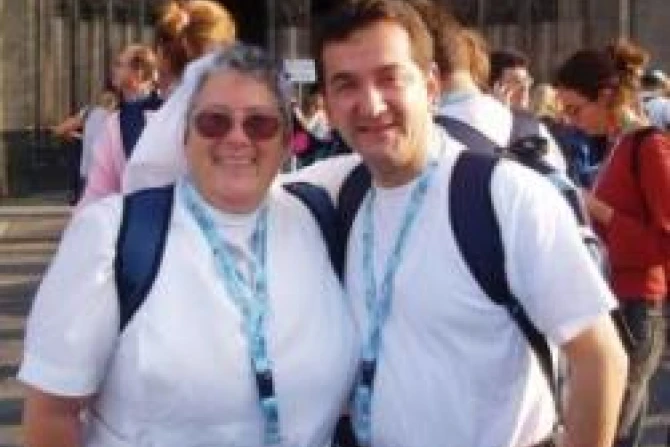
Salesian Sister MaryAnn Schaefer, admissions director at Mary Help of Christian Academy in North Haledon, NJ, couldn't dream of a better place to celebrate her 25th jubilee as a religious sister than at World Youth Day in Sydney, Australia.
WYD in Sydney will be an especially unique experience for Sister Schaefer. She will be cruising on Sydney Harbor in one of the 13 boats escorting Pope Benedict XVI's "boat-a-cade" during the Pope's arrival July 17. By chance, she was picked for this opportunity as a member of XT3.com, WYD's networking site.
"I received the e-mail on July 1 and I couldn't believe it. I had to have one of the sisters reread it to make sure it was real," said Sister Schaefer.
This will be her seventh WYD experience in which she has led young people - already attending WYD in Denver, Manila, Paris, Rome, Toronto and Cologne. And even though she is a WYD pro, Sister Schaefer still gets excited about these international encounters of seeing the Pope and most especially, bringing the young people closer to Christ.
"The young people just completely change seeing the Holy Father, if you saw the look on their faces," said Sister Schaefer. "They get a sense that the Church they belong to is something more than just their parish and they see the global Salesian community from all over the world and see how many young people are like them and are taught by Salesian religious (through the international Salesian community rally at WYD)."
This time around in Sydney, she will be leading 31 young people - many of them students, alumni and parents of Mary Help of Christians here and friends of the Salesians in Louisiana, Florida and the neighboring Newark Archdiocese and Metuchen Diocese. They will leave tomorrow for Sydney and will meet up with a group led by Salesian Father Steven Ryan, provincial councilor for Youth Ministry / Vocations of the Salesians of Don Bosco, which is based in South Orange.
To prepare for the pilgrimage during the past year, Sister Schaefer and the pilgrims hosted sharing sessions at St. Joseph Chapel on the campus of Mary Help of Christians Academy. At the sessions, the catechetical themes of WYD reflected on the Holy Spirit.
A special WYD cross was made for the Salesian contingent, which has traveled to every single participant's home for a week as a symbol of the journey for the community. According to Sister Schaefer, the cross will be coming with them to Sydney as the make their pilgrimage to the final Mass with Pope Benedict XVI.
In Sydney, the Mary Help contingent will be arriving right before WYD festivities begin which allows them to make a stop in Engadine, a city 45 minutes by train from Sydney, where they will serve in a nursing home run by Salesian Sisters.
(Story continues below)
Once WYD activities start, the group will evangelize the love of Christ as an "animating team" for catechesis sessions at Immaculate Heart of Mary Parish in Sefton, a suburb right outside of Sydney, in which thousands of English-speaking Catholics worldwide will gather together to share in faith.
"We will be leading a music group for the catechetical sessions and Mass," said Sister Schaefer, who said she is in complete awe of the opportunity.
During the three days of catechetical sessions, they will meet a host of international bishops - Bishop Joseph Aind of the Diocese of Dibrugarh, India; Bishop Denis Browne of the Diocese of Hamilton, New Zealand; and Bishop William Morris of the Diocese of Toowoomba, Australia, who will give a talk each day.
When the pilgrims return home, those who are students at Mary Help will be doing presentations each month on the 10 patron saints of WYD as a way to keep the memory alive and to pass on the WYD message to their peers.
Sister Schaefer said the experience of WYD has been a memorable part of her life as a religious these past 25 years. "Being part of WYD since Denver in 1993 has strengthened my personal relationship with Jesus, as well as my relationships with the young who I have been serving for the last 25 years. It has confirmed my choice of charisms, that of St. John Bosco and St. Mary Mazzarello, as a Salesian Sister."
In three years time for the next WYD, wherever that destination may be, she hopes to once again be leading young people on this journey of a lifetime.
Printed with permission from the Beacon and the Diocese of Paterson, New Jersey.