

Loading
Christianity is the most profound revolution in history, Pope declares

.- On Thursday evening Pope Benedict led a series of liturgical events dedicated to the Solemnity of Corpus Christi. In his homily, the Pontiff declared that the unity brought about in the Eucharist shows that the Christian revolution is the most profound revolution in human history.

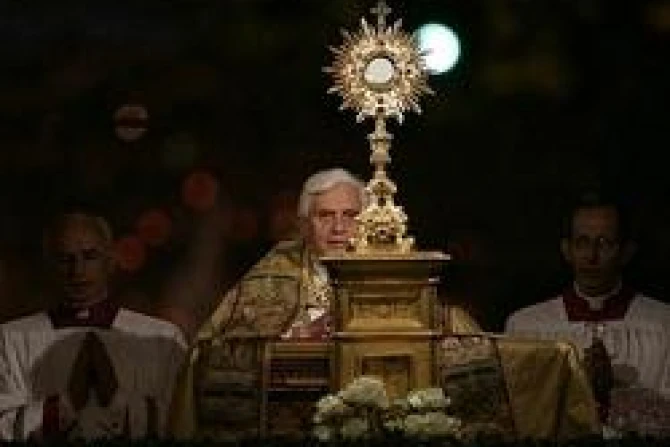
The Corpus Christi events began at seven o’clock in the evening on Thursday with the Pope celebrating Mass on the square in front of Rome's Basilica of St. John Lateran. He then led a Eucharistic procession to the Basilica of St. Mary Major and concluded the evening with a time for the adoration of Jesus in the Eucharist. 

Benedict XVI dedicated his homily at St. John Lateran to explaining how the significance of Corpus Christi can be seen in the three events of the evening. Firstly "our coming together around the altar of the Lord to be together in His presence," secondly "the procession, walking with the Lord," and finally "kneeling before the Lord in adoration."

Beginning with the gathering around the altar of the Lord, the Holy Father quoted St. Paul's Letter to the Galatians, where it is written that "there is no longer Jew or Greek, there is no longer slave or free, there is no longer male and female; for all of you are one in Christ Jesus.' ... In these words," said the Pope, "we feel the truth and the power of the Christian revolution, the most profound revolution in human history, which we may experience in the Eucharist where people of different ages, sexes, social conditions and political ideas come together in the presence of the Lord.”

“The Eucharist can never be a private matter,” explained Pope Benedict.  “The Eucharist is public worship, which has nothing esoteric or exclusive about it. ... We remain united, over and above our differences, ... we open to one another in order to become a single thing in Him."

"Walking with the Lord" was the second aspect of the celebrations that the Pope discussed. The chance to accompany Jesus in the Eucharist allows us to reflect on how He in fact, “raises us up again ... and puts us on the journey with the power of this Bread of life. ... The procession of Corpus Christi teaches us that the Eucharist wants to free us from all distress and discomfort ... so that we can resume the journey with the strength God gives us in Jesus Christ," the Holy Father said.

Moreover, "Without the God-with-us, the God Who is near, how can we sustain the pilgrimage of life, either individually or as a society or a family of peoples?" asked the Pope.

"The Eucharist is the Sacrament of the God who does not leave us to journey alone, but puts Himself at our side and shows us the way. Indeed, it is not enough to keep going, it is important to see where we are going! Progress is not enough if there are no criteria of reference."

Finally, the third element of Corpus Christi, that of "kneeling in adoration before the Lord", is "the most valuable and radical remedy against the idolatries of yesterday and today, ... it is a profession of freedom: those who bow to Jesus cannot and must not prostrate themselves before any earthly power, however strong," said the Pope.

As Christians "we prostrate ourselves before God, Who first bowed down towards man ... to save him and give him life, who knelt before us to wash our dirty feet. Adoring the Body of Christ means believing that there, in that piece of bread, Christ is truly present and gives real meaning to life, to the vast universe as to the smallest of creatures, to the whole of human history as to the briefest of lives."

At the conclusion of Mass in front of St. John Lateran, Pope Benedict XVI led a Eucharistic procession along Rome's Via Merulana to the Basilica of St. Mary Major. The route was lined with thousands of people who prayed and sang, accompanying the Blessed Sacrament. The Holy Father knelt in adoration in an open vehicle carrying the Eucharist in a monstrance.

* The number of messages that can be online is limited. CNA reserves the right to edit messages for content and tone. Comments and opinions expressed by users do not necessarily reflect the opinions or beliefs of CNA. CNA will not publish comments with abusive language, insults or links to other pages

RESOURCES »

Featured Videos

Group launches tour to end abortion in Canada
Actor admires Mexican martyr's strong defense of the faith
First video game about Jesus launches on Facebook
Vandals strike historic Santa Cruz church
EU accused of funding abortion with development money
Brent Dusing's advice to Internet Evangelists
Creator of Bible-based Facebook game lauds internet evangelism
Sacrifice of Titanic's Catholic priests recalled on 100th anniversary
Benedict XVI visits the Shrine of the Virgin of Cobre and meets President Raul Castro
Vestments for Pope's Mass in Cuba arrive with love from Peru
Pope Benedict XVI in Antonio Maceo Square in Santiago de Cuba
Benedict XVI meets with President Calderon and Mexican children
Americans speak up for religious freedom at nationwide rallies
Neighborhood rallies against plan to build strip club near convent
Pope's first Mexican address offers encouragement to faithful
Arrival of  Pope Benedict XVI  to Mexico
Pope offers his blessing to handicapped children in Mexico
Texas bishops hear call to unity at St. Peter's tomb
Interview with Br. Guy Consolmagno
Indiana Catholics respond to 'devastating' storm damage
May
24

Liturgical Calendar

May 24, 2012

Thursday of the Seventh Week of Easter

All readings:
Today »
This year »

Catholic Daily

Gospel of the Day

Jn 17,20-26

Gospel
Date
05/24/12
05/23/12
05/22/12

Daily Readings


First Reading:: Acts 22:30; 23:6-11
Gospel:: Jn 17:20-26

Homily of the Day

Jn 17,20-26

Homily
Date
05/24/12
05/23/12
05/22/12
     HTML
Text only
Headlines
  

Follow us: