

Loading
Leadership of Pope St. Damasus I remembered Dec. 11
By Benjamin Mann
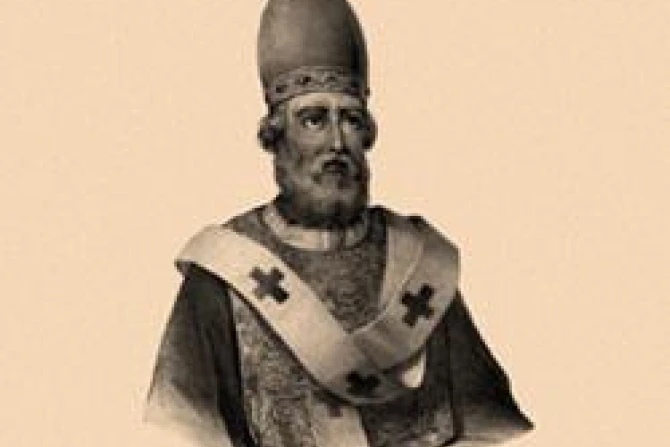
Pope Saint Damasus I

.- On Dec. 11, both Roman Catholics and Eastern Catholics commemorate Pope St. Damasus I, who led the Church through a critical part of the fourth-century Arian controversy over Jesus' divinity.

While not necessarily a figure of popular devotion today, Pope Damasus I made decisions that shaped the future of Western Catholicism and the universal Church. During his pontificate, Latin became the official liturgical language of the Roman Church, which had used Greek extensively in the past.

The same Pope authorized St. Jerome to revise the Latin translation of the Bible into what became the widely-used “Vulgate” edition. Pope Damasus also authorized the decrees of the Second Ecumenical Council, which expanded the Nicene Creed's profession of faith in the Holy Spirit and added portions on the Church, baptism, and the resurrection of the dead.

Pope Damasus' letters testify to the origin of the papacy as a office instituted by Christ. The need to articulate this doctrine grew during the fourth century, after the Emperor Constantine and his successors increased the profile of Constantinople as a center of political and religious affairs.

“The holy Roman Church has been placed at the forefront,” Damasus I wrote in 382, “not by the conciliar decisions of other churches, but has received the primacy by the evangelic voice of our Lord and Savior, who says: ‘You are Peter, and upon this rock I will build my Church' … The first see, therefore, is that of Peter the apostle, that of the Roman Church,” he affirmed.

The author of these words was born around 304, shortly before the Church gained legal status throughout the Roman Empire. History records little about Damasus' life and service to the Church, until his ordination as a deacon during the pontificate of Pope Liberius (352-366).

Liberius suffered persecution at the hands of the Arians, who believed that Christ was a created being and not God. Elected Pope after Liberius died in 366, Damasus took the reigns of a Church still suffering from widespread confusion four decades after its first ecumenical council.

After Damasus' election, a deacon named Ursinus attempted to set himself up as a rival pope – resulting in riots in which more than 130 people died, and a schism that persisted for some time during his papacy. The Pope prayed for the reconciliation of these separated clergy, and lived to see some of them return.

During Damasus' era, the Church's increased power and prestige tempted many clergy to lead corrupt lives. Damasus took pains to enforce the decree of the Western Emperor Valentinian, who urged the Pope to prevent scandalous behavior among the clergy and those in religious life.

While Valentinian, who reigned from 364 to 375, generally fulfilled his duties as a Catholic statesman of his day, the Eastern Emperor Valens promoted Arianism and persecuted Eastern Catholics who upheld orthodoxy. Damasus held two local councils reaffirming the Roman Church's opposition to Arianism, and condemning bishops who taught it.

Damasus also played a role in condemning a very different heresy, Apollinarianism. Its author, the bishop Apollinaris of Laodicea, taught that Jesus had taken on a human body and soul, but not a rational mind, in his incarnation. The Pope oversaw or authorized four condemnations of this error, the strongest of which came from the Second Ecumenical Council at Constantinople in 381.

One telling witness to Pope Damasus I's virtues comes from the letters of St. Jerome, the monk and scholar sometimes known for his brutal frankness and sarcasm. This saint, who did not hesitate to speak his mind, addressed Damasus with admiration and reverence in letters still read and cited today.

A saint in his own right, Pope Damasus I is also one of history's great devotees of the saints. Chroniclers of his life record not only his commitment to the intercession of the martyrs, but also his care for the tombs of the saints buried in Rome, which he renovated into shrines. Damasus composed Latin poetry in honor of these saints, some of which has survived.

Pope St. Damasus I died on Dec. 11, 384. Since the eighth century, his relics have been venerated both in Rome's Church of St. Lawrence in Damaso (first built by St. Damasus himself, though rebuilt in later centuries), and in St. Peter's Basilica.

* The number of messages that can be online is limited. CNA reserves the right to edit messages for content and tone. Comments and opinions expressed by users do not necessarily reflect the opinions or beliefs of CNA. CNA will not publish comments with abusive language, insults or links to other pages

RESOURCES »

Featured Videos

Group launches tour to end abortion in Canada
Actor admires Mexican martyr's strong defense of the faith
First video game about Jesus launches on Facebook
Vandals strike historic Santa Cruz church
EU accused of funding abortion with development money
Brent Dusing's advice to Internet Evangelists
Creator of Bible-based Facebook game lauds internet evangelism
Sacrifice of Titanic's Catholic priests recalled on 100th anniversary
Benedict XVI visits the Shrine of the Virgin of Cobre and meets President Raul Castro
Vestments for Pope's Mass in Cuba arrive with love from Peru
Pope Benedict XVI in Antonio Maceo Square in Santiago de Cuba
Benedict XVI meets with President Calderon and Mexican children
Americans speak up for religious freedom at nationwide rallies
Neighborhood rallies against plan to build strip club near convent
Pope's first Mexican address offers encouragement to faithful
Arrival of  Pope Benedict XVI  to Mexico
Pope offers his blessing to handicapped children in Mexico
Texas bishops hear call to unity at St. Peter's tomb
Interview with Br. Guy Consolmagno
Indiana Catholics respond to 'devastating' storm damage
May
25

Liturgical Calendar

May 25, 2012


All readings:
Today »
This year »

Catholic Daily

Gospel of the Day

Jn 21,15-19

Gospel
Date
05/25/12
05/24/12
05/23/12

Daily Readings


First Reading:: Acts 25:13b-21
Gospel:: Jn 21:15-19

Homily of the Day

Jn 21,15-19

Homily
Date
05/25/12
05/24/12
05/23/12
     HTML
Text only
Headlines
  

Follow us: