

Loading
Natural law must be used to combat 'dictatorship of relativism,' Pope teaches
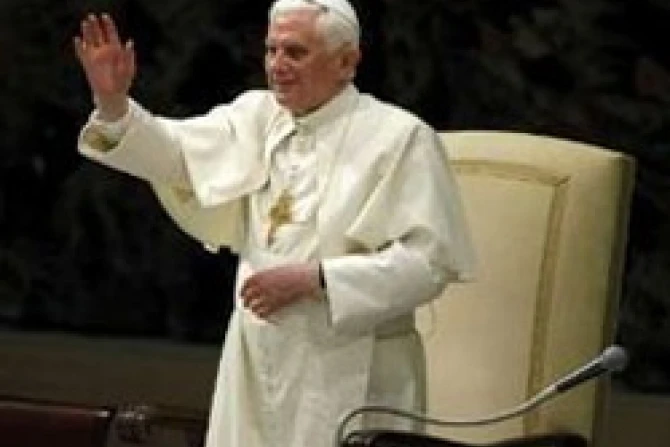
Pope Benedict XVI

.- The Holy Father addressed pilgrims on Wednesday morning with a message that applied of the medieval theologian John of Salisbury's reflections on the natural law to the moral and ethical issues of today. Drawing on the English theologian's teachings, the Pope said that logic and reason still have a place in today's society, especially on the issues of abortion, euthanasia and marriage.

John began his life in Salisbury, England, but he would eventually flee the tyranny of King Henry II to France, along with St. Thomas Becket, where he would become a part of the Chartres school of theology, the Pope explained to those who were gathered in the Paul VI Hall.

In his catechesis, Pope Benedict highlighted a pair of works that were written by John that "help us to comprehend how the faith, in harmony with just aspirations and reason, pushes thought towards the revealed truth, in which is found the real good of man."

The Pontiff first drew attention to John's work called “Metaloghicon,” meaning In Defense of Logic, which proposed that human knowledge is "imperfect, as it is subject to finiteness, to the limit of man." He wrote that "only in God is there perfect science."

He elaborated, however, that believers and theologians that "deepen the treasure of the faith, open themselves to practical knowledge that guides their daily actions, that is, to moral laws and the exercise of virtue."

“Policraticus” (The Man of Government), the second work to which Pope Benedict referred, signals the existence of "an objective and immutable truth, whose origin is in God, a truth accessible to human reason and which concerns practical and social activities.” “This is a natural law," said the Pope, "from which human legislation and political and religious authorities must gain their inspiration to promote the common good."

John of Salisbury gave the name “equity” to this concept of natural law, through which every person is given his rights.

"This is the central thesis of Policraticus," said the Pope.

"The question of the relationship between natural law and positive law, as mediated by equity, is still of great importance," remarked the Pontiff. "Above all in some countries, we witness a worrying detachment between reason, that has the task of discovering ethical values tied to the dignity of the human person, and liberty, that has the responsibility of accepting and promoting these values."

If John of Salisbury were here today, conjectured the Pope, he "would remind us that only those laws that to defend the sacredness of human life and reject the legitimacy of abortion, euthanasia and unrestrained genetic experimentation are equitable, those that respect the dignity of matrimony between man and woman, and that are inspired to a correct secularism of the state - secularism that must always allow for the safeguarding of religious freedom - and that seek subsidiarity and solidarity at the national and international level."

"Otherwise," concluded the Pontiff, "we would end up with... "the dictatorship of relativism." That dictatorship "doesn't recognize anything as definite and leaves as its ultimate measure only the self and its desires."

RESOURCES »

Feb
12

Liturgical Calendar

February 12, 2012

Sixth Sunday in Ordinary Time

All readings:
Today »
This year »

Catholic Daily

Gospel of the Day

Mk 1,40-45

Gospel
Date
02/12/12
02/11/12
02/10/12

Daily Readings


First Reading:: Lev 13:1-2, 44-46
Second Reading:: 1 Cor 10:31-11:1
Gospel:: Mk 1:40-45

Saint of the Day

St. Julian the Hospitaller »

Saint
Date
02/10/12

Homily of the Day

Mk 1,40-45

Homily
Date
02/12/12
02/11/12
02/10/12

Most Popular

     HTML
Text only
Headlines
  

Follow us: