Loading
St. Anthony of Egypt's monastic legacy remembered Jan. 17
St. Anthony of Egypt

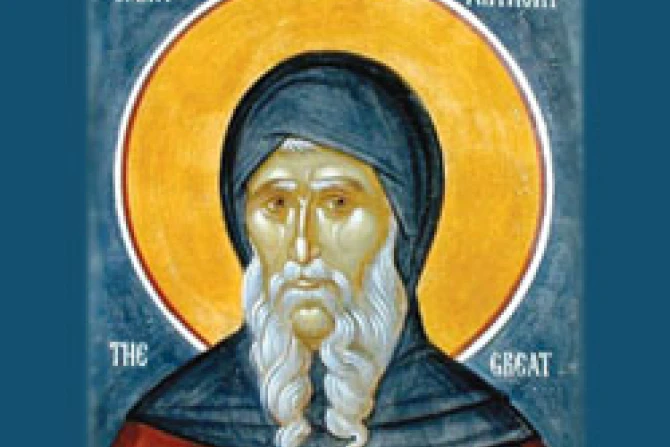
.- On his Jan. 17 feast day, both Eastern and Western Catholics will celebrate the life and legacy of St. Anthony of Egypt, the founder of Christian monasticism whose radical approach to discipleship permanently impacted the Church.

In Egypt's Coptic Catholic and Orthodox Churches, which have a special devotion to the native saint, his feast day is celebrated on Jan. 30.

Anthony was born around 251, to wealthy parents who owned land in the present-day Faiyum region near Cairo. During this time, the Catholic Church was rapidly spreading its influence throughout the vast expanses of the Roman empire, while the empire remained officially pagan and did not legally recognize the new religion.

In the course of his remarkable and extraordinarily long life, Anthony would live to see the Emperor Constantine's establishment of Christianity as the official religion of the Roman empire. Anthony himself, however, would establish something more lasting – by becoming the spiritual father of the monastic communities that have existed throughout the subsequent history of the Church.

Around the year 270, two great burdens came upon Anthony simultaneously: the deaths of both his parents, and his inheritance of their possessions and property. These simultaneous occurrences prompted Anthony to reevaluate his entire life in light of the principles of the Gospel– which proposed both the redemptive possibilities of his personal loss, and the spiritual danger of his financial gains.

Attending church one day, he heard –as if for the first time– Jesus' exhortation to another rich young man in the Biblical narrative: “If you wish to be perfect, go, sell your possessions, and give the money to the poor, and you will have treasure in heaven; then come, follow me.” Anthony told his disciples in later years, that it was as though Christ has spoken those words to him directly.

He duly followed the advice of selling everything he owned and donating the proceeds, setting aside a portion to provide for his sister. Although organized monasticism did not yet exist, it was not unknown for Christians to abstain from marriage, divest themselves of possessions to some extent, and live a life focused on prayer and fasting. Anthony's sister would eventually join a group of consecrated virgins.

Anthony himself, however, sought a more comprehensive vision of Christian asceticism. He found it among the hermits of the Egyptian desert, individuals who chose to withdraw physically and culturally from the surrounding society in order to devote themselves more fully to God. But these individuals' radical way of life had not yet become an organized movement.

After studying with one of these hermits, Anthony made his own sustained attempt to live alone in a secluded desert location, depending on the charity of a few patrons who would provide him with enough food to survive. This first period as a hermit lasted between 13 and 15 years.

Like many saints both before and after him, Anthony became engaged in a type of spiritual combat, against unseen forces seeking to remove him from the way of perfection he had chosen. These conflicts took their toll on Anthony in many respects. When he was around 33 years old, a group of his patrons found him in serious condition, and took him back to a local church to recover.


This setback did not dissuade Anthony from his goal of seeking God intensely, and he soon redoubled his efforts by moving to a mountain on the east bank of the Nile river. There, he lived in an abandoned fort, once again subsisting on the charity of those who implored his prayers on their behalf. He attracted not only these benefactors, but a group of inquirers seeking to follow after his example.

In the first years of the fourth century, when he was about 54, Anthony emerged from his solitude to provide guidance to the growing community of hermits that had become established in his vicinity. Although Anthony had not sought to form such a community, his decision to become its spiritual father –or “Abbot”– marked the beginning of monasticism as it is known today.

Anthony himself would live out this monastic calling for another four decades, providing spiritual and practical advice to disciples who would ensure the movement's continued existence. According to Anthony's biographer, St. Athanasius, the Emperor Constantine himself eventually wrote to the Abbot, seeking advice on the administration of an empire that was now officially Christian.

“Do not be astonished if an emperor writes to us, for he is a man,” Anthony told the other monks. “But rather: wonder that God wrote the Law for men, and has spoken to us through his own Son.”

Anthony wrote back to Constantine, advising him “not to think much of the present, but rather to remember the judgment that is coming, and to know that Christ alone was the true and Eternal King.”

St. Anthony may have been up to 105 years old when he died, sometime between 350 and 356. In keeping with his instructions, two of his disciples buried his body secretly in an unmarked grave.

* The number of messages that can be online is limited. CNA reserves the right to edit messages for content and tone. Comments and opinions expressed by users do not necessarily reflect the opinions or beliefs of CNA. CNA will not publish comments with abusive language, insults or links to other pages

RESOURCES »

Featured Videos

Catholics can decide the 2012 election, expert says
Group launches tour to end abortion in Canada
Actor admires Mexican martyr's strong defense of the faith
First video game about Jesus launches on Facebook
Vandals strike historic Santa Cruz church
EU accused of funding abortion with development money
Brent Dusing's advice to Internet Evangelists
Creator of Bible-based Facebook game lauds internet evangelism
Sacrifice of Titanic's Catholic priests recalled on 100th anniversary
Benedict XVI visits the Shrine of the Virgin of Cobre and meets President Raul Castro
Vestments for Pope's Mass in Cuba arrive with love from Peru
Pope Benedict XVI in Antonio Maceo Square in Santiago de Cuba
Benedict XVI meets with President Calderon and Mexican children
Americans speak up for religious freedom at nationwide rallies
Neighborhood rallies against plan to build strip club near convent
Pope's first Mexican address offers encouragement to faithful
Arrival of  Pope Benedict XVI  to Mexico
Pope offers his blessing to handicapped children in Mexico
Texas bishops hear call to unity at St. Peter's tomb
Interview with Br. Guy Consolmagno
May
25

Liturgical Calendar

May 25, 2012


All readings:
Today »
This year »

Catholic Daily

Gospel of the Day

Jn 21,15-19

Gospel
Date
05/25/12
05/24/12
05/23/12

Daily Readings


First Reading:: Acts 25:13b-21
Gospel:: Jn 21:15-19

Homily of the Day

Jn 21,15-19

Homily
Date
05/25/12
05/24/12
05/23/12
     HTML
Text only
Headlines
  

Follow us: