

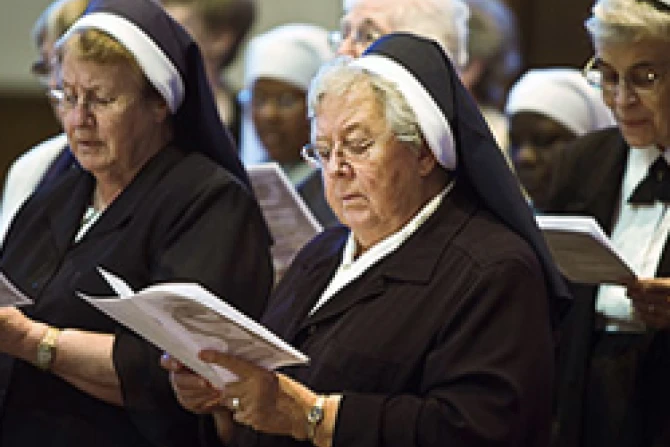
Survey finds younger, more faithful trend in new religious vocations
Imprimir Incrementar tamaño de fuente Disminuir tamaño de fuente

.- A new survey of those in U.S. religious communities finds that most vowed religious are aging. However, most postulants in training are under 30 and tend to favor larger communities that are faithful to the Church’s teachings.

The Georgetown University-based Center for the Applied Research in the Apostolate (CARA) conducted the survey on behalf of the National Religious Vocations Conference (NRVC), a Chicago-based professional association of religious vocation directors.

The survey polled both religious institutions and individuals who were in training for their vows or had made final vows, determining that at least 2,630 responding men and women were in initial formation and nearly 4,000 were in initial formation or had professed final vows in the previous 15 years.

Of those in training, about 43 percent of the respondents were under 30. About 21 percent of these were Hispanic, while 14 percent were Asian or Pacific Islander and six percent African or African American.

Previously, those who had finally professed made up an estimated 94 percent white, a press release from the NRVC says.

Among all new members 70 percent entered with a bachelor’s degree, while 90 percent held fulltime jobs. Seven percent have been married and five percent have children. A reported 73 percent attended Catholic schools for at least part of their education, while 68 percent considered religious life before age 21.

The NRVC reports that religious are an aging population overall, with most communities reporting diminishing numbers. According to the institutional survey results, about 75 percent of finally professed men and 91 percent of finally professed women are aged 60 and over, while a majority of those under the age of 60 are in their 50s.

However, some religious orders are attracting new members and a few are experiencing “significant growth.”  “Men’s communities and women’s communities following more traditional practices have better success attracting younger members today,” the NRVC says.

Looking at the big picture, the report finds that a majority of religious communities have at least one person in formation but only about 20 percent had more than five people in initial formation. Further, some responding institutes had recently merged, increasing the proportion of those institutes with postulants.

The survey reports that most new religious members want to live, work and pray with other members of their community. New entrants prefer to live in large communities of eight or more, while institutes in which members live alone face challenges attracting new members.

Older entrants to a community are drawn to its mission, while younger entrants look for an institute’s fidelity to the Church. Younger members also seek to wear a religious habit.

Younger members report not having known men and women religious when they first felt drawn to that life. They reported relying on a friend or mentor for recommendations and also used online vocation resources, including websites for religious communities.

Imprimir Incrementar tamaño de fuente Disminuir tamaño de fuente
Subscriber comments:
Published by: Donna Kelsch
Sanborn, NY, US 01/17/2010 09:44 PM EST
I have not found rejection of tradition religious life expectations to be the case in communities that I have visited, while discerning my own vocation. What I have found is a difficultty in realizing that "older" women today are viable candidates ( on a case by case basis ) because most of us are still working anyway, and intend to continue. Most of us ARE looking for basically traditional communities, that, hopefully have more realisitic views towards immediate families ( who are, if alive, elderly ). There is no ONE way that is the only way to be a religious.
Published by: Emma
Philadelphia 08/15/2009 11:23 AM EST
Women drawn to religious life of any age undergo a rude awakening once they actually experience how it is lived out in many convents and monastaries. Older white religious look on many Catholic traditions with distaste (rosary recitation, stations of the cross, Divine Office, novenas, adoration of Blessed Sacrament, meals/prayers in common, etc.). They have no desire to "go back" to what they consider to be the old repressive days of Pre-Vatican II where "women knew their place". Therefore, aspirants and new entrants who desire of more orthodox, traditional spirituality are looked on with suspicion by the fully professed and find them selves "winnowed out" during formation. There is also a very strong "feminist culture" in many religious communities for which encourages "independence" and discourages fidelity to the basic teachings of the Church. There is a huge dynamic regarding real conflict of interest that is not being addressed.
Published by: Justin in Ohio
Ohio 08/12/2009 12:59 PM EST
Unfortunately for the aging, dissenting orders of religious men and women, they are dying out. And it certainly won't be a bad thing for the Church to have these orders that relish in dissent and disobeying the Pope and bishops shrink and eventually disappear due to their infidelity.
Published by: Sr. Catherine Hagaba
Uganda 08/12/2009 04:53 AM EST
The evident desire among the young people for congregations that are more faithful to the church can only be a product of God's grace which ought to be supported by prayer. In my ten years of living in the United States, I encountered many lay people who expressed this need. Other wise, what is the purpose of a consecrated community or of an individual Catholic whose BASIC FAITH STRUCTURE is different that of the Church?
ADD A COMMENT (Your e-mail will NOT be published):
NAME:
CITY/STATE/COUNTRY:
EMAIL:
COMMENT:
 
PLEASE ENTER THE SECURITY CODE DISPLAYED ABOVE:
Chars:
* Thanks for your comments. The number of messages that can be online is limited. Length should not exceed 1500 characters. CNA reserves the right to edit messages for content and tone. Comments and opinions expressed by users do not necessarily reflect the opinions or beliefs of CNA. CNA will not publish comments with abusive language, insults or links to other pages.
ADVERTISING
Place your ad here
Resources:
Columns:
News:
Documents:
Tools:
ACI Group:
ACI Prensa