
By Tyler Arnold
Washington, D.C. Newsroom, Dec 11, 2025 / 12:30 pm
A majority of Catholic voters in the United States have a favorable opinion of President Donald Trump and support the broad-scale deportation of immigrants who are in the country illegally, according to a poll published by EWTN News and RealClear Opinion Research on Dec. 11.
The poll surveyed 1,000 self-identified Catholics from Nov. 9 through Nov. 11, nearly 10 months after Trump assumed office. Trump won the Catholic vote in the 2024 election last year, and one of his campaign promises was mass deportations — a policy strongly opposed by the country’s Catholic bishops.
With Trump administration deportation efforts underway, the poll revealed some tension between the public stance of the country’s Catholic bishops and the views held by the faithful. Among Catholics, support for large-scale deportations is even higher than their overall support for Trump.
About 54% of Catholic voters said they support “the detention and deportation of unauthorized immigrants on a broad scale.” Only 30% said they oppose this policy, and 17% neither support nor oppose it.
Among white Catholics, 60% support broad-scale deportations and only 26% oppose it. Among Latino Catholics, 41% support it and 39% oppose it.
For Catholics who attend Mass at least weekly, 58% support broad-scale deportations and only 23% are against it. For those who attend Mass less frequently, 50% support the deportations and 36% oppose it.
Catholics who attend Mass regularly were more likely to have a favorable opinion of Trump and more likely to support deportations. White Catholics were also more likely than Latino Catholics to support Trump and the deportations.

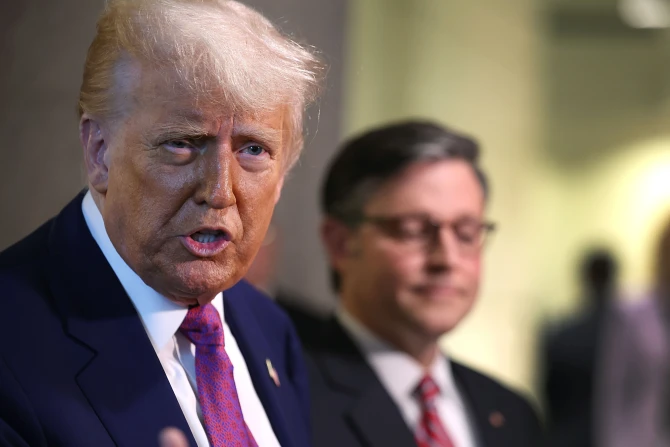
According to the poll, about 52% of Catholic voters say they have a favorable opinion of Trump, compared with 37% who say they have an unfavorable opinion and 11% who say they are neutral.
Among white Catholics, 58% have a favorable opinion of Trump and 34.5% have an unfavorable view of him. Latino Catholics were nearly evenly split, with 41% holding a favorable opinion and 40% holding an unfavorable opinion.
More than 60% of Catholics who attend Mass at least once per week said they have a favorable opinion of the president, compared with 30% who had an unfavorable opinion.
Among Catholics who attend Mass less frequently, about 45% have a favorable view of Trump and 42% have an unfavorable view.
Reacting to the results, White House Assistant Press Secretary Taylor Rogers told CNA that Trump “won in a landslide victory with historic support from patriotic Catholics across the country because he promised to fight for people of faith, and he has delivered in record time.”
“President Trump launched a task force to eliminate anti-Christian bias, pardoned Christian and pro-life activists, enforced the Hyde Amendment, defunded Planned Parenthood, stopped the chemical mutilation of our nation’s children, and stopped men from competing in women’s sports and invading their private spaces,” she said.
Other administration officials had positive favorability numbers. About 50% of Catholic voters have a favorable view of Vice President JD Vance, compared with 31% who have an unfavorable view. About 42% of Catholic voters have a favorable view of Secretary of State Marco Rubio, compared with 25% who have an unfavorable view.
Support for deportations at odds with bishops
(Story continues below)
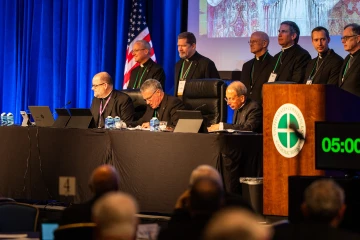
Just last month, the U.S. Conference of Catholic Bishops (USCCB) issued a unified message to oppose “the indiscriminate mass deportation of people.” It received approval from more than 95% of the voting bishops. The following week, Pope Leo XIV encouraged “all people in the United States to listen to [the bishops]” on the matter.
The USCCB did not immediately respond to a request for comment from CNA.
Chad Pecknold, a theology professor at The Catholic University of America who teaches theological politics and other subjects, told CNA the numbers “track with the general public support for deportation.”
“The bishops have operated on very well-worked-out presuppositions of liberalism, and Popperian ideas about an ‘Open Society,’ that are now badly outdated,” he said. “They would be wise to reexamine their priors on prudential matters as they are losing credibility through imprudent statements on prudential matters pertaining to national security and the common good.”
Julia Young, a historian and professor at The Catholic University of America, sees the issue differently, telling CNA that U.S. Catholic bishops have historically supported immigrants and that the Church has grown from European immigration in the mid-late 19th century and from Latin American immigration in the 20th century.
“The growth of the Catholic Church over the last several decades has been largely due to immigration,” she said. “So it does make sense that the Catholic bishops are concerned about immigrants and the immigrant population because that is their laity.”
Young said much of American Catholic history has been an “immigrant group coming in and being the target of nativism.” She noted that the historical “anti-Catholic nativism” faced by those immigrant groups was the notion that Catholics were “not going to be able to become proper loyal American citizens because their loyalty was going to be to the pope.”
The Catechism of the Catholic Church teaches that prosperous nations have an obligation, “to the extent they are able, to welcome the foreigner.” The immigrant has an obligation “to respect with gratitude the material and spiritual heritage of the country that receives them, to obey its laws and to assist in carrying civic burdens.”
“Political authorities, for the sake of the common good for which they are responsible, may make the exercise of the right to immigrate subject to various juridical conditions,” it adds.