

Vatican City, Dec 11, 2025 / 18:30 pm
Pope Leo XIV on Dec. 11 emphasized the academic, cultural, and ecclesial value of archaeology and called for the promotion of “cultural diplomacy” to overcome borders and prejudices.
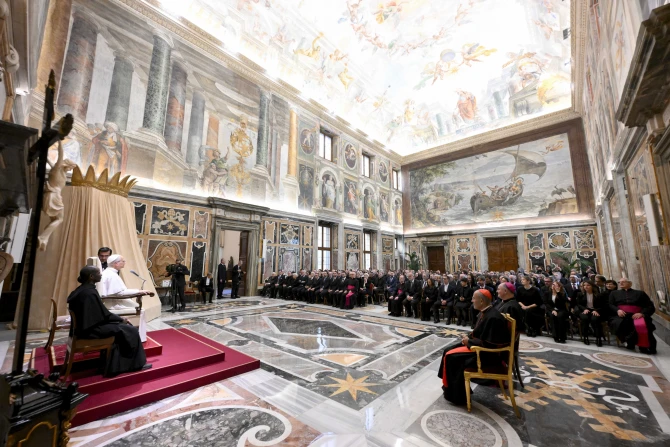
Receiving members of the Pontifical Institute of Christian Archaeology in an audience, the pope emphasized that its literary and monumental sources constitute an essential part of the “roots” of European society and nations.
“Take part through your studies in that cultural diplomacy that the world so desperately needs in our day,” the pope urged, addressing the faculty, students, and staff of the center.
To introduce his reflection, he referenced the motu proprio I Primitivi Cemeteri (“Primitive Cemeteries”), published exactly a century ago by Pius XI, in which he emphasized the Church’s responsibility for protecting its sacred heritage.
Pius XI then decided to add a new body to the work of the Pontifical Commission for Sacred Archaeology and the Pontifical Roman Academy of Archaeology: the Pontifical Institute of Christian Archaeology, created to “guide willing young people from all countries and nations toward the study and scientific research of the monuments of Christian antiquity.”
A century later, Leo XIV affirmed, this mission remains fully relevant.
The scientific dignity of Christian archaeology
The pope took the opportunity to present to those present his new apostolic letter, in which he emphasizes the importance of Christian archaeology. He pointed out that this field, focused on the monuments of the first centuries of Christianity, possesses its own “epistemological status,” with specific “chronological, historical, and thematic coordinates.”
However, he lamented that in some circles it continues to be included without distinction within medieval archaeology.
“In this regard, I suggest that they become upholders of the specificity of their discipline, in which the adjective ‘Christian’ is not intended to be an expression of a confessional perspective but rather a qualifier of the discipline itself with scientific and professional dignity,” he urged.
A bridge to ecumenism
Leo XIV emphasized the ecumenical nature of Christian archaeology, alluding to its capacity to recall a time when the Church remained united. Its study, he affirmed, is “a valuable instrument for ecumenism,” as it allows the various Christian traditions to recognize a common heritage.
He also recounted that during his recent apostolic journey to İznik — ancient Nicaea — in Turkey, where he commemorated the 1,700th anniversary of the first ecumenical council with representatives of other churches, he was able to personally witness this reality: “The presence of the remains of ancient Christian buildings was moving and motivating for all of us.”
The pope also welcomed the fact that the institute had dedicated a day of study to the topic, in collaboration with the Dicastery for Evangelization.
The power of ‘cultural diplomacy’
For the pope, rigorous study and historical research constitute a privileged way of building bridges: “Through culture, the human spirit transcends the boundaries of nations and overcomes the barriers of prejudice to place itself at the service of the common good. You too can contribute to building bridges, fostering encounters, and nurturing harmony.”
(Story continues below)
He also noted that the institute is symbolically situated between two major jubilee themes: peace, the central theme of the holy year of 1925, and hope, the focus of the current jubilee. “And, in fact, you are bearers of peace and hope wherever you operate with your excavations and research, so that, recognizing your white and red banner with the image of the Good Shepherd, doors may be opened wide to you not only as bearers of knowledge and science but also as heralds of peace.”
Christianity, the root of Europe
Finally, Leo XIV recalled the words of St. John Paul II on the Christian roots of Europe, remembering his affirmation that the continent “needs Christ and the Gospel, because here lie the roots of all its peoples.”
“Among the roots of European society and nations is undoubtedly Christianity, with its literary and monumental sources; and the work of archaeologists is a response to the call I have just evoked,” he stated.
This story was first published by ACI Prensa, CNA’s Spanish-language news partner. It has been translated and adapted by CNA.