


By Jim Graves
San Diego, California, Dec 19, 2025 / 15:22 pm
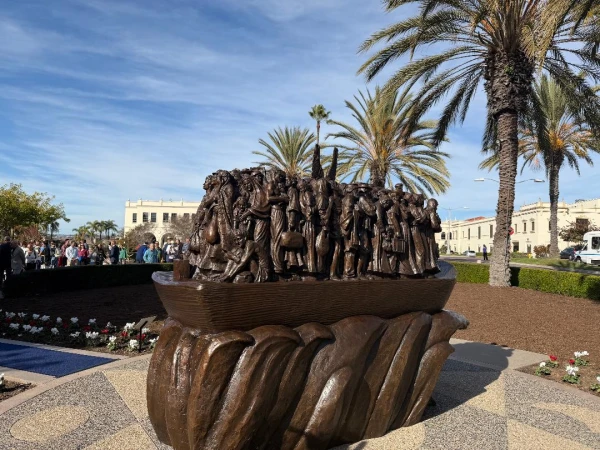
Bishop of San Diego Michael Pham dedicated “Angels Unawares,” a new sculpture on the campus of the University of San Diego (USD), on Thursday. The 8-foot-tall bronze sculpture by artist Timothy Schmalz is a scaled version of one in St. Peter’s Square in Rome commissioned by Pope Francis in 2019 and depicts 140 migrants of varying backgrounds on board a boat with a pair of angel wings in their midst.
According to USD President Jim Harris, the sculpture is intended to remind the viewer “of how biblical teachings encourage us to care for our most poor and vulnerable communities, including those who flee their countries in search of a better life.”
Located in front of the Joan B. Kroc School of Peace Studies on the western edge of campus, the new sculpture is situated in the perfect position, said Michael Lovette-Colyer, USD vice president of mission integration.
“It will be the first thing visitors see when they enter our campus,” he explained. “It overlooks the Pacific Ocean, with the boat pointing towards the heart of our campus. It calls to mind that our campus is a welcoming place.”
Lovette-Colyer also noted that the campus was located near a United States international border with Mexico, “so our geographic location calls for all people to respect human dignity.”
Victor Carmona, USD associate professor of theology and religious studies for the past eight years, also said he believes the installation reflects “a desire for USD to continue being a welcoming place.” He said he is “excited” about the sculpture’s installation, believing “it connects USD to the global Church in terms of priorities and mission.”
The work of artist Timothy Schmalz
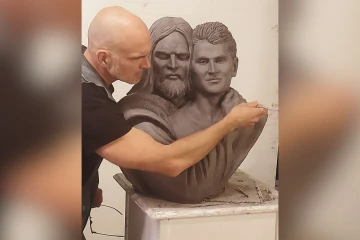
The sculpture is the creation of Canadian artist Timothy Schmalz, who attended the event and has created images in bronze for historical churches in Rome as well as worldwide.
Schmalz is also known for his “Homeless Jesus” sculpture depicting Jesus as a homeless man sleeping on a park bench and his “When I Was in Prison,” depicting Jesus behind bars.
The original “Homeless Jesus” sculpture was installed at Regis College in Toronto; the statue has been copied and installed at more than 90 other locations worldwide since. “When I Was in Prison” can be found at the Basilica of St. Paul Outside the Walls in Rome.
The “Angels Unawares” piece, Schmalz said, was inspired by the Scripture passage “Do not neglect hospitality, for through it some have unknowingly entertained angels [or “angels unawares” in other translations]” (Heb 13:2). Schmalz got the idea for the piece after a conversation with Jesuit Father (now Cardinal) Michael Czerny, former undersecretary of the Migrants and Refugees section of the Vatican’s Dicastery for Promoting Integral Human Development.
In 2017, Schmalz recalled, Czerny “suggested that I start thinking about creating a sculpture on migrants and refugees, not just because it is a crisis today but as always important throughout human history.”
He explained that the work “depicts a group of migrants and refugees from different cultural and racial backgrounds and from diverse historic periods of time. They stand together, shoulder to shoulder, huddled on a raft.”
The angel wings emerge from their midst, “suggesting the presence of the sacred among them.”
Replicas of the work have since gone on tour for viewing by the faithful throughout the U.S.; replicas have been installed at both The Catholic University of America in Washington, D.C., and St. Joseph’s Oratory in Canada. USD president Harris wanted a replica installed on his campus after viewing “Angels Unawares” in Rome, as “it aligned with USD’s Catholic mission and values,” he said. The sculpture was funded by an anonymous donor.
(Story continues below)
“I hope this sculpture can provide our Torero community with feelings of compassion that transcend all borders and politics,” Harris said.

Schmalz said the purpose of “Angels Unawares” as well as all his art “is to evangelize and preach the Gospel.” Nearly all of the 140 migrants featured on the boat are of actual people he researched; some are based on the faces of live models who came to his Toronto-area studio. Many of his ideas came from photographs of migrants who passed through New York Harbor’s Ellis Island. And two of the figures are based on the parents of Czerny, who were once migrants from Hungary fleeing communism.
The artist said he believes “Angels Unawares” is in the same category as the Statue of Liberty in New York Harbor, “but with faces and a spiritual centering.” He added that art was an effective tool that the Catholic Church can use to convey the “Christian message” and described himself as “an artist soldier for the Vatican.”
International Migrants Day
The blessing of the sculpture by Pham coincided with the United Nations’ International Migrants Day. Pham was invited not only because he is the bishop of San Diego and a member of the college’s board of trustees but also because he, too, was a migrant, having fled Vietnam in 1980.
Thursday’s blessing began with 12:15 p.m. Mass, with Pham as presider, followed by the unveiling of the sculpture. Harris offered remarks; participants included members of the USD faculty, staff, and student body.

Lovette-Colyer acknowledged that the sculpture installation coincided with a time of contentious debate over immigration in the United States and other countries, with Catholics passionately advocating on both sides of the issue.
Referencing recent statements and a video by the U.S. Catholic Conference of Bishops promoting a more generous immigration policy, he said: “We’re on the side of Pope Francis and Pope Leo, our local Bishop Pham and his predecessor [Cardinal Robert] McElroy on the issue. We acknowledge there are political dimensions, but we don’t want to be partisan. As Pope Francis emphasized, we want to be humane and respect the dignity of all human persons.”
He continued: “Immigration is a topic that evokes strong feelings. It is an important issue for our students to learn about and consider. The sculpture can be a conversation starter in the classroom, where our students can discuss it critically and carefully.”