
ACI Prensa Staff, Dec 25, 2025 / 11:07 am
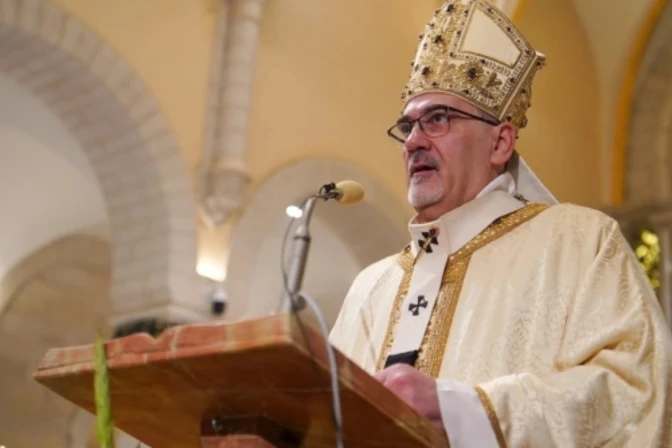
At the Christmas Eve Mass celebrated in Bethlehem, the Latin patriarch of Jerusalem, Cardinal Pierbattista Pizzaballa, affirmed that “one of the great messages of Christmas” is that God “does not wait for history to improve before entering into it” but rather embraces human reality.
During his homily, the cardinal explained that the birth of Jesus does not occur outside of time or apart from political events but within concrete history. “God does not create a parallel history. He does not enter the world when everything is finally ordered and peaceful” but rather “enters into real, concrete, sometimes harsh history.”
Commenting on the beginning of the Gospel of Luke, which places the birth of Christ in the context of a decree by Emperor Augustus, the patriarch indicated that this detail has profound theological significance. “The very history that claims to be self-sufficient becomes the place where God fulfills his promise,” he affirmed, adding that “no time is ever truly lost, and no situation is too dark for God to dwell in it.”
Pizzaballa emphasized that, although the emperor’s decree seems to dominate the scene, “unbeknownst to him, it becomes an instrument of a greater plan.” Faced with the logic of power that “counts, registers, and governs,” God responds with the logic of the gift, giving his Son in the fragility of “a child born without power.”
In this context, he recalled that Christmas is not an escape from the world’s problems. “Christmas is not a refuge that removes us from the tension of the present time,” he warned, but rather “a school of responsibility,” because Christ “does not wait for circumstances to be favorable: He inhabits them and transforms them.”
The patriarch also referred to the announcement of peace on the night of Jesus Christ’s birth in Bethlehem, clarifying that it is not a superficial peace. “It is not a mere balance of power nor the result of fragile agreements,” he explained, but rather “the fruit of God’s presence in history.” However, he added that this peace “is given, but also entrusted,” and only becomes real when it finds “hearts willing to receive it and hands ready to protect it.”
Speaking from the Holy Land, Pizzaballa acknowledged that the current reality remains marked by deep wounds. “We come from years of great suffering, in which war, violence, hunger, and destruction have marked the lives of many, especially children,” he stated. Nevertheless, he emphasized that it is precisely in this context that the Christmas message resonates most powerfully.
Finally, the patriarch urged people not to remain neutral in the face of the complexities of history. “The darkness of the world may be profound, but it is not definitive,” he said, reminding everyone that “the light of Bethlehem does not blind, but illuminates the path,” and is transmitted “from heart to heart, through humble gestures, words of reconciliation, and daily decisions for peace.”
This story was first published by ACI Prensa, CNA’s Spanish-language news partner. It has been translated and adapted by CNA.