
Jan 4, 2026 / 06:00 am
Archbishop Samuel Kleda of the Archdiocese of Douala in Cameroon has outlined a moral and social vision for the Central African nation, calling for a change of hearts that would translate into forgiveness, unity, justice, and an end to violence.
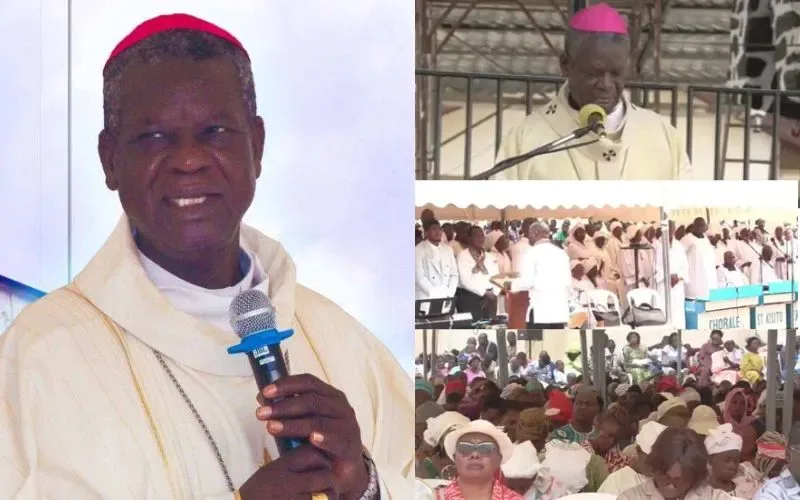
Presiding over the New Year Mass in the courtyard of the Sts. Peter and Paul Cathedral of his archdiocese on Jan. 1, the solemnity of Mary, Mother of God, Kleda urged Cameroonians to begin the year by dismantling not only weapons of war but also the inner attitudes that fuel division and conflict.
In his homily, the archbishop framed peace as the defining task of 2026, insisting that it cannot be imposed by force or decrees.
“Peace cannot take root in society unless it first reigns in individual lives,” he said, calling for what he described as a profound conversion of hearts.
He urged the faithful to scrutinize their words and actions, warning that everyday behaviors can either build peace or deepen wounds.
Kleda appealed to Cameroonians to banish “bitterness, irritation, anger, scorn, insults, and all forms of wickedness,” and to replace them with generosity, tenderness, and forgiveness as the foundations of social renewal.
Rejecting violence as a false solution to Cameroon’s crises, the archbishop had a message for all who bear arms or justify armed conflict: “Let us destroy all weapons of war and stop fighting one another,” he said, warning that violence breeds only fear, terror, and death — never peace.
Reflecting on the struggles of the people of God in Cameroon, the Church leader said that many Cameroonians today lack what he called “peace of heart,” weighed down by economic hardship and social insecurity.
He listed some of the realities eroding hope, including youth unemployment, limited access to health care, food insecurity, shortages of water and electricity, prolonged pretrial detention, internal displacement caused by conflict, and widespread poverty, among others.
“Cameroon is a very rich country, yet many of our people feel forced to emigrate,” Kleda observed, describing the situation as a troubling paradox that demands serious reflection and urgent action.
He noted that insecurity, corruption, and injustice continue to undermine social cohesion and stall national development.
Still, Kleda sought to encourage those who feel overwhelmed by fear or discouragement.
“Every obstacle we encounter is a grace that helps us to grow,” he said, inviting Cameroonians to see even painful experiences as opportunities for transformation and solidarity.
Addressing the country’s ongoing conflicts, particularly in the North West, South West, and Far North regions, the archbishop issued a moral challenge to those who sustain or profit from violence.
He warned that anyone who deliberately fuels conflict will be judged “first by the court of history and then by the divine court” for the bloodshed of innocent people.
In his homily, the Catholic leader also pointed to signs of hope, praising the spirit of solidarity shown in Douala, where displaced persons fleeing violence have been welcomed. He said the city has opened its doors to those affected by conflict, receiving them “as brothers and sisters,” a gesture he presented as a living example of the Gospel in action.
(Story continues below)
Unity, he stressed, must become a guiding principle for Cameroon in the new year. Drawing on a familiar proverb, he said: “One hand alone cannot tie a bundle,” underscoring the need for collective effort and mutual support.
He clarified that true unity does not mean uniformity, but harmony rooted in diversity, likening it to the spirit of Pentecost rather than the confusion of the Tower of Babel.
Kleda emphasized reconciliation, reminding the people of God that restoring broken relationships takes precedence even over acts of worship. Quoting Scripture, he said: “If your brother has something against you, go first and be reconciled,” insisting that responsibility for peace does not lie only with the one perceived to be at fault.
Forgiveness, he insisted, must be generous and persistent. It is not a one-time gesture but a continuous commitment that must be renewed again and again. Forgiveness, he added, “must be offered not just once, but 70 times seven.”
Warning against hardened attitudes, Kleda said that “resentment, refusal to forgive, and hardened attitudes make peace impossible, reviving tensions and perpetuating conflict.” Genuine peace, he explained, “requires honest dialogue, acknowledgment of shared responsibility, and a sincere commitment to forgiveness and reconciliation.”
Turning to leadership and governance, he called on political and social leaders to take concrete responsibility for peace by responding to the real suffering of the population. He urged them to “leave their offices and engage directly with the daily realities of ordinary Cameroonians,” cautioning that indifference to suffering breeds despair and erodes public trust.
Peace, the archbishop insisted, cannot endure without justice and development. Condemning corruption as a grave injustice, he said the nation’s resources belong to “all Cameroonians, not a privileged few.”
He urged both leaders and citizens to “reject greed and to serve the common good, following the example of Christ, who came not to be served, but to serve.”
At the start of 2026, the archbishop called on all Cameroonians to become servants of peace, willing to sacrifice personal interests for the good of the nation.
Entrusting the year to the intercession of Mary, Mother of God, he concluded his homily with a note of hope and prayer. “Let us commit ourselves to living this new year 2026 under the protection of the mother of Our Lord and our mother. If we walk with her in recourse to her intercession during this new year, her Son will fill us with his graces and his blessings,” he said.
This article was published by ACI Africa, CNA’s African news partner, and has been adapted for CNA.