

Vatican City, Jan 5, 2026 / 04:00 am
More than 33.4 million pilgrims traveled to Rome to participate in the Jubilee of Hope, surpassing initial projections, the Vatican said Monday.
Archbishop Rino Fisichella, pro-prefect of the Dicastery for Evangelization, said 33,475,369 pilgrims ultimately took part in the jubilee — nearly 2 million more than the Vatican’s initial estimate of 31.7 million.
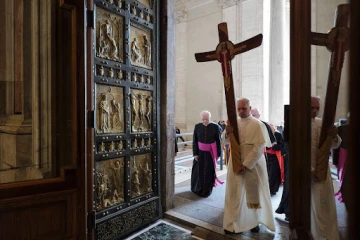
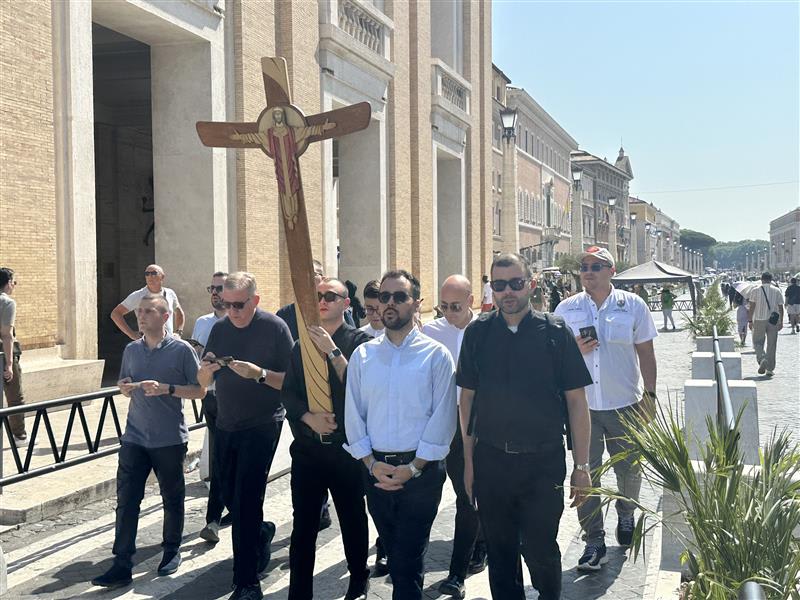
He also said the final group to pass through the Holy Door on Monday will be staff from the Dicastery for Evangelization, the principal organizers of the holy year, at 5:30 p.m. local time.
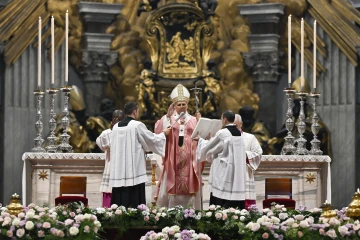
The solemn closing of the holy year will take place Tuesday at 9:30 a.m. local time, when Pope Leo XIV is scheduled to close the Holy Door of St. Peter’s Basilica in a ceremony expected to be attended by Italian President Sergio Mattarella, civil authorities, and large numbers of faithful.
The Holy Door is scheduled to be opened again in eight years, in 2033, for the Jubilee of the Redemption.
In his assessment of the jubilee, Fisichella described the year as extraordinary in many respects and noted its unusual historical arc: The jubilee began under Pope Francis and concludes under Pope Leo XIV — a transition he said underscored the complexity of the organizational effort.
He also pointed to major events that unfolded alongside the jubilee calendar, including the funeral of Pope Francis on April 26 and the election of his successor, Leo XIV, on May 8, saying those developments were integrated into the jubilee schedule amid an exceptional succession of events.
Pilgrims from 185 countries
According to official Vatican data presented Monday, pilgrims from 185 countries took part in jubilee events. By geographic area, Europe accounted for 62.63% of participants, followed by North America (16.54%), South America (9.44%), and Asia (7.69%). The remaining pilgrims came from Oceania (1.14%), Central America and the Caribbean (1.04%), Africa (0.95%), and the Middle East (0.46%).
By country, Italy represented 36.34% of pilgrims, followed by the United States (12.57%) and Spain (6.23%). Other leading countries included Brazil (4.67%), Poland (3.69%), Germany (3.16%), the United Kingdom (2.81%), China (2.79%), Mexico (2.37%), and France (2.31%). The Vatican also recorded significant participation from Argentina, Canada, Portugal, Colombia, Australia, the Philippines, Slovakia, Indonesia, and Austria.
Fisichella said that beginning in May — around the time of Leo XIV’s election — Rome saw an unexpected increase in pilgrims, which he said was managed with close attention in a city that remained under international media focus throughout the year.
How the count was made
Fisichella said the initial projections were based on a study by the faculty of sociology at Roma Tre University and were intended as an early planning guide.
He said the primary count was made at St. Peter’s Basilica’s Holy Door, where a camera automatically recorded the number of pilgrims passing through each day.
For the other three papal basilicas — St. John Lateran, St. Mary Major, and St. Paul Outside the Walls — the Vatican applied percentages based on the flow recorded at St. Peter’s, supplemented by volunteer counts using manual clickers. Attendance at major jubilee events and audiences was also tracked and cross-checked with registrations made through the official jubilee website.
Rome mayor cites lasting legacy and spending
(Story continues below)
Rome Mayor Roberto Gualtieri said the Jubilee of Hope has left a lasting legacy for the city, both in infrastructure and in institutional governance, pointing to what he described as a “jubilee method” of sustained cooperation among public administrations.
Gualtieri said the jubilee program included 332 interventions, with 204 already completed or partially completed. He added that street works in Rome were about 90% finished, with the remaining 10% scheduled for completion in 2026.
He also said government funding specifically allocated for jubilee-related works totaled 1.725 billion euros ($2.02 billion). According to Gualtieri, 75% of those resources were used for interventions completed or partially completed, while spending for essential, nondeferrable interventions reached 90%.
This story was first published by ACI Prensa, CNA’s Spanish-language news partner. It has been translated and adapted by CNA.