


Jan 13, 2026 / 18:45 pm
The U.S. Supreme Court heard arguments Tuesday on whether to uphold state laws banning transgender athletes from competing on women’s sports teams, and Catholic athletes outside the court said they hope justices keep the laws on the books.
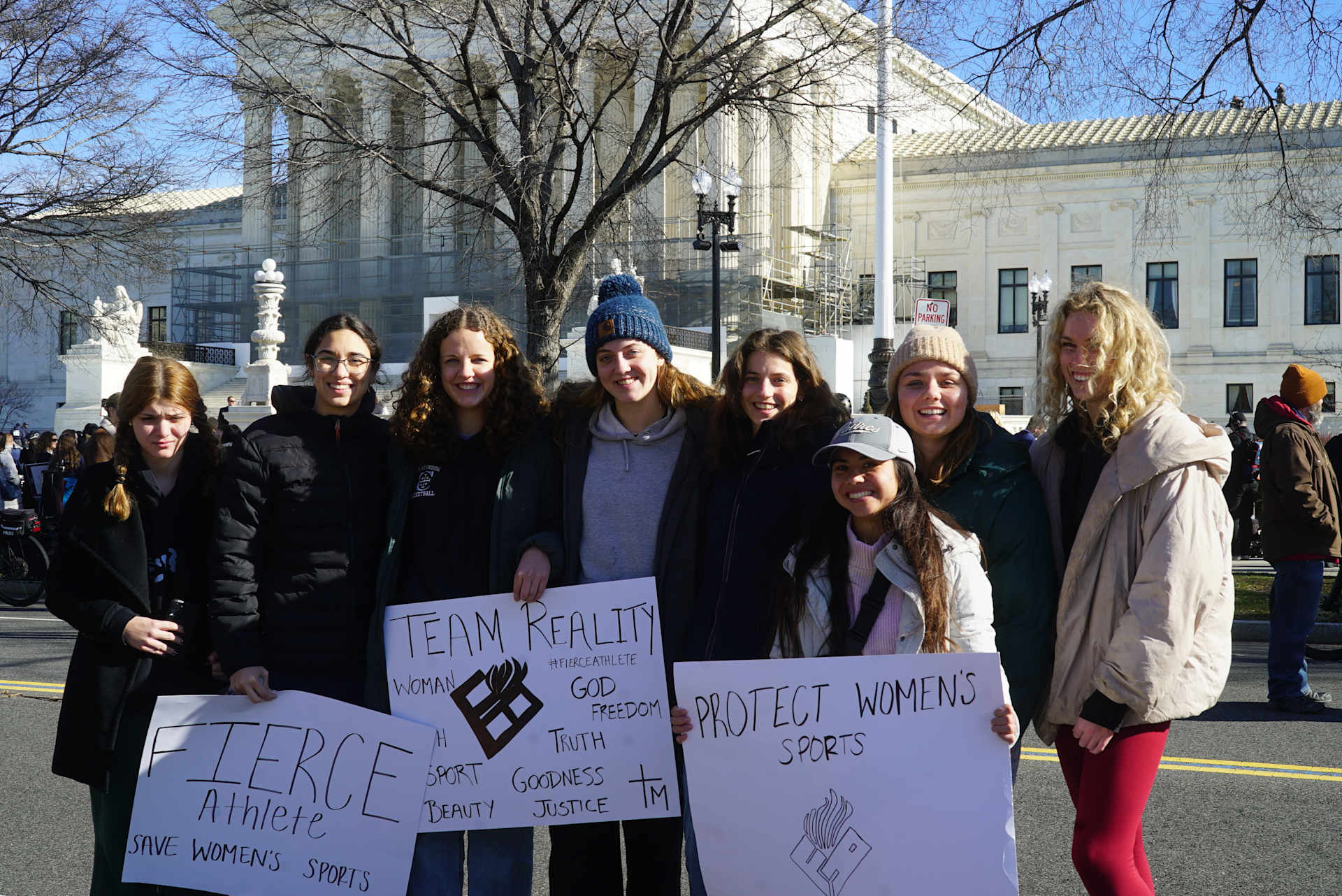
Mary Pennefather, captain of the women’s basketball team for Christendom College in Front Royal, Virginia, said: “If these court cases are allowed to happen, then say goodbye to all women’s sports, because then all the transgender athletes will just come and play in the women’s sports and get their national champion championships and NCAA titles from there.”
Standing among her teammates outside the Supreme Court, Pennefather said: “I can work as hard as I can to be good at my sport, and a man can come in and work half as hard, and he will always be bigger, faster, and stronger than me. It totally goes against God’s natural law. He made humans male and female. And now you have these people coming in here and saying, ‘That’s not right,’ that men could be women and vice versa … it’s totally disrupted and disordered, and it’s a breakdown of the family.”
The court heard more than three hours of arguments regarding two cases originating from Idaho and West Virginia in which lower courts upheld challenges by transgender athletes to statewide bans under the U.S. Constitution and federal anti-discrimination law. Supreme Court justices including Brett Kavanaugh, Samuel Alito, and Neil Gorsuch appeared to back the bans at several points during the oral arguments.
The challenges were brought by two transgender athletes: 15-year-old West Virginia high school student Becky Pepper-Jackson, and Boise State University student Lindsey Hecox of Idaho, who had attempted to withdraw the case but was ultimately denied.
Bishops weigh in
U.S. bishops submitted an amicus brief in support for the petitioners in Idaho v. Hecox and West Virginia v. B.P.J., stating that if Catholic schools were forced to allow transgender athletes in women’s sports, they would need to halt all athletic programs or stop accepting funding “because allowing such competition would undermine fundamental Catholic teachings regarding the immutable, God-given differences between the sexes.”
Idaho and West Virginia both have laws that ban transgender athletes from competing on sports teams at public schools and universities that do not correspond with their sex assigned at birth. There are 25 other states that have such laws.
“There are an awful lot of female athletes who are strongly opposed to participation by trans athletes in competitions with them,” Alito said at one point during the oral arguments. He then asked whether girls who express these opinions should be regarded as “bigots.” He added: “Are they deluded in thinking that they are subjected to unfair competition?” He also questioned whether transgender athletes hold an unfair advantage over biological women in sports at other points during the hearing.
Alito further insisted that a definition of sex is necessary in order to prove that transgender athletes are being discriminated against, stating: “How can a court determine whether there’s discrimination on the basis of sex without knowing what sex means for equal protection purposes?” Alito posed this question in response to ACLU lawyers’ position that a definition of sex is not legally necessary.
Kavanaugh emphasized the importance of Title IX and sex-based distinctions, stating: “One of the great successes in America over the last 50 years has been the growth of women and girls’ sports. And it’s inspiring.”
He said allowing transgender people to compete in women’s sports would “undermine or reverse that amazing success and create unfairness.”
“For the individual girl who does not make the team or doesn’t get on the stand for the medal or doesn’t make all-league,” he said, “there’s a harm there, and I think we can’t sweep that aside.”
Gorsuch said “bottom line, sports are assigned by sex because sex is what matters in sports,” adding that separation based on sex “is the fairest and the safest and the most administrable way to assign sports teams.”
“It’s been widely accepted for many decades because it’s necessary for fair competition because, where sports are concerned, men and women are obviously not the same,” he said during the hearing. “If Idaho can’t enforce a sex-based line here in sports, where nobody disputes that biological differences matter, then no line based on biological sex can survive constitutional scrutiny.”
“The court should uphold the Fairness in Women’s Sports Act and reverse,” he concluded.
(Story continues below)
Outside the court, Matt Sharp, senior counsel with Alliance Defending Freedom, highlighted the importance of the court “protecting fairness in women’s sports.”
“If young women are made spectators in their own sports,” Sharp said, “we know they’re going to lose medals, they’re going to lose scholarships, they’re going to have their privacy violated.”
Steve Ward, a board-certified internal medicine physician with Do No Harm, said: “I think this issue is representative of a much deeper concern that I have about the medical profession,” he said. “We’re here to support women’s sports, and that’s certainly important, but to my mind, we really have to think more carefully about what this means for the future of science and scientific research.”
Ward emphasized the importance of scientific research based on “objective and fixed” reality. “All of these great great scientists of the past understood that, that the world could be studied because they had a Judeo-Christian worldview understanding that we live in a world that you can approach and you can make objective observations, perform the scientific method and so forth and reach some type of a conclusion that you can repeat and move forward with, develop technologies and all sorts of things,” he said, adding: “If we discard all of that history in favor of psychological categories, then you really can no longer do science at all, and you have to throw that away.”