


Jan 14, 2026 / 07:00 am
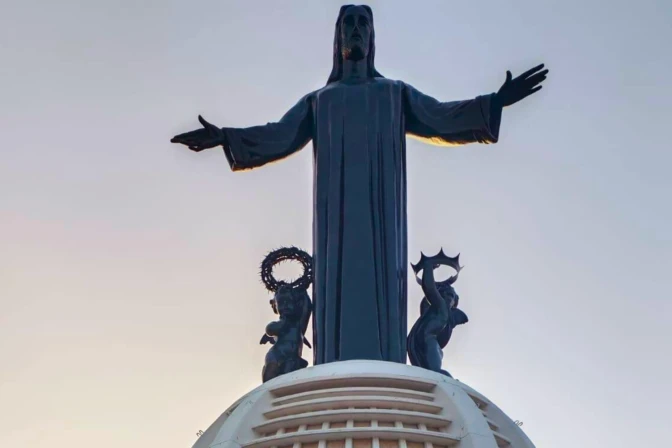
To commemorate the 100th anniversary of the start of the Cristero War, also known as the Cristiada, more than 45,000 young people from all over Mexico will participate on Jan. 31 in the National Youth March to the monument to Christ the King on Cubilete Hill in Guanajuato state.
The organizers announced at a Jan. 12 press conference that the activities will begin on the evening of Friday, Jan. 30, with Cubifest, a youth gathering that will take place in the small town of Aguas Buenas and will continue throughout the night. The event will feature performances by nationally known bands.
At dawn on Saturday, a Holy Hour will be held, followed by the official start of the ascent to the Christ the King monument atop the hill.
The day will culminate with the celebration of Holy Mass celebrated by the apostolic nuncio to Mexico, Archbishop Joseph Spiteri, and concelebrated by the archbishop of León, Jaime Calderón Calderón, along with other bishops and priests.
The 2026 edition of the youth pilgrimage coincides with the centenary of the beginning of the Cristero War, one of the most significant episodes in the religious and social history of Mexico.
The conflict originated after the so-called “Calles Law” went into force on July 31, 1926, which tightened restrictions against the Church and led to the Mexican bishops deciding to suspend public worship.
These provisions resulted in a spontaneous armed uprising of Catholics in different regions of the country. The conflict formally ended on June 21, 1929, although the persecution and killings of those who had participated in the Cristero War continued for several more years.
Current persecution
During the press conference, leaders of the Witness and Hope group, responsible for organizing the annual march, stated that one of the purposes of this year’s event is to denounce what they described as a “subtle but growing censorship” against Catholic expression.
They cited attacks on churches, the increase in the number of priests murdered in recent years, and “attempts at reforms that seek to limit religious life” as signs of this censorship.
“We raise our voices against a reality that deeply wounds the soul of Mexico. We are living in times when there is an attempt to silence faith, to silence pastors, and to relegate Christ to the private sphere, as if faith were an obstacle in public life,” they stated.
The organizers noted that this is a form of persecution in which, although the authorities “don’t wear a uniform or carry a rifle, they inflict wounds with the same contempt as in the past.”
“Mexico is not experiencing true secularism,” they said. “It is experiencing a climate that seeks to uproot the presence of Christianity from the social, cultural, and political life of our country.”
They emphasized that the march does not seek to rekindle an armed conflict but rather to demand respect and freedom to proclaim Christ peacefully, “with the cross, the rosary, and prayer as instruments of peace.”
A form of ‘resistance’
In a statement to ACI Prensa, CNA’s Spanish-language news partner, Rubén Loya, a member of Witness and Hope, said that rather than commemorating a war, the march seeks to remember “the beginning of the Cristero resistance.”
(Story continues below)
He explained that while war involves armed conflict, “resistance goes far beyond that,” as it includes the testimony of thousands of martyrs who lost their lives for their faith, as well as that of the families who remained in their homes “praying and reciting the rosary for the end of the war.”
He also remembered the priests who continued to celebrate Mass clandestinely during the persecution as an expression of fidelity and hope.
Loya said the commemoration of the 100th anniversary of the Cristero War aims to be a call for peace and unity, “not as a milestone [marking the beginning] of war but as a moment in which we as a Church come together again and find the transcendent meaning of what we do.”
This story was first published by ACI Prensa, CNA’s Spanish-language news partner. It has been translated and adapted by CNA.