
Jan 18, 2026 / 10:26 am
This past week, nearly a quarter of U.S. states sued the federal government for defining biological sex as binary, the U.S. Supreme Court heard arguments for and against legally allowing males to compete against females in sports, and a Vatican official called surrogacy a “new form of colonialism” that commodifies women and their children.
These are just the latest legal and cultural effects of a “mass cultural confusion” surrounding the meaning and purpose of the human body, and particularly women’s bodies, according to Leah Jacobson, program coordinator of the Catholic Women’s and Gender Studies Program at the University of St. Thomas in Houston.
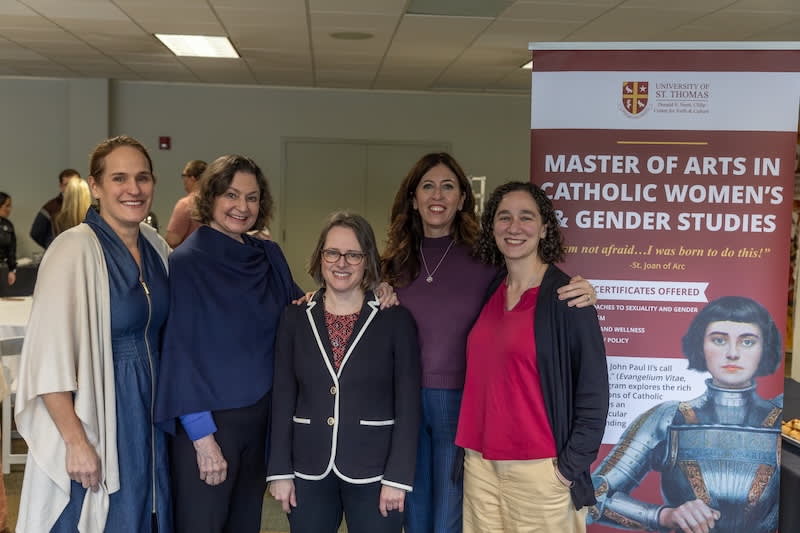
On Jan. 9–10, the program sponsored a symposium titled “The Beauty of Truth: Navigating Society Today as a Catholic Woman,” which brought together a group of Catholic women who have used their gifts of intellect and faith to serve as what Jacobson calls an “antidote” to the “chaos and confusion” of the cultural moment.
The speakers presented on a wide range of topics concerned with the beauty, truth, and necessity of the Church’s teachings on human sexuality in many realms.
‘Every act is an act of human subtraction’
In one of the first talks, writer Mary Eberstadt argued that the question “Who am I?” became harder to answer due to the widespread use of the birth control pill, which has led to huge increases in abortion, divorce, fatherlessness, single parenthood, and childlessness. These effects led to a reduction in the number of people in an individual's life, which, she argued, resulted in widespread confusion over gender identity and the meaning and purpose of the body.
While she acknowledged that not everyone has been affected equally, “members of our species share a collective environment.”
“Just as toxic waste affects everyone,” she said, the reduction in the number of human connections “amounts to a massive disturbance to the human ecosystem,” leading to a crisis of human identity.
“The number of people we can call our own” became smaller, she said. “Each of these acts is an act of human subtraction,” Eberstadt said. “I’m not trying to make a point about morality, but arithmetic.”
Eberstadt also attributed the decline in religiosity to this decline in the number of human connections modern people experience.
“The sexual revolution subtracted the number of role models,” she said. “Many children have no siblings, no cousins, no aunts or uncles, no father, yet that is how humans conduct social learning.”
“Without children, adults are less likely to go to church,” she said. “Without birth, we lose knowledge of the transcendent. Without an earthly father, it is hard to grasp the paradigm of an earthly father.”
‘A love deficit’
“Living without God is not liberating people,” she continued. “It’s tearing some individuals apart, making people miserable and lonely.”
When the sexual revolution made sex "recreational and not procreative, what it produced above all is a love deficit,” Eberstadt said.
At the same time, secularization produced “troubled, disconnected souls drifting through society without gravity, shattering the ability to answer ‘Who am I?’”
(Story continues below)
“The Church is the answer to the love deficit because Church teachings about who we are and what we’re here for are true,” she said.
She concluded with a final note on hope, saying “it is easy to feel embattled, but we must never lose sight of the faces of the sexual revolution’s victims,” she said, “who are sending up primal screams for a world more ordered than many of today’s people now know; more ordered to mercy, to community and redemption.”
The Church’s teachings were ’truly beautiful’ but 'very, very hard to live'
Erika Bachiochi, a legal scholar and fellow at the Ethics and Public Policy Center who teaches a class for the graduate program, shared her experience as a mother of seven who tried to live according to the Church’s “difficult” teachings.
As her children began to arrive at “a breakneck pace” and each pregnancy was “a bit of a crucible,” Bachiochi said being a mother was “very hard” for her, partly due to wounds from her youth (among other troubles, her own mother had been married and divorced three times), and partly because of a lack of community.
Echoing Eberstadt’s “arithmetic” problem, Bachiochi described having very few examples of Catholic family life and a very small support system.
Bachiochi said she believes God heals us from our wounds through our “particular vocations,” however.
Of motherhood, she said: “I think God really healed me through being faithful to teachings that I found quite hard, but truly beautiful. I was intellectually convinced by them and found them spiritually beautiful, but found them to be very, very hard to live.”
“Motherhood has served to heal me profoundly," she said, encouraging young mothers to have faith that though it might be difficult now, there is an “amazing future” awaiting them.
“It’s really an incredible gift that Church has given me ... the gift of obedience,” she said.
She also said by God’s grace, she was given an “excellent husband” and has found that “just as the Church promises, that leaning into motherhood, into the little things, the daily needs, the constant requests for my attention, has truly been a school of virtue.”
The Catholic Women’s and Gender Studies Program is a new part of the Nesti Center for Faith and Culture at the University of St. Thomas, a recognized Catholic cultural center of the Vatican’s Dicastery for Culture and Education.